
Science
Researchers Claim First Direct Evidence of Dark Matter via Gamma Rays

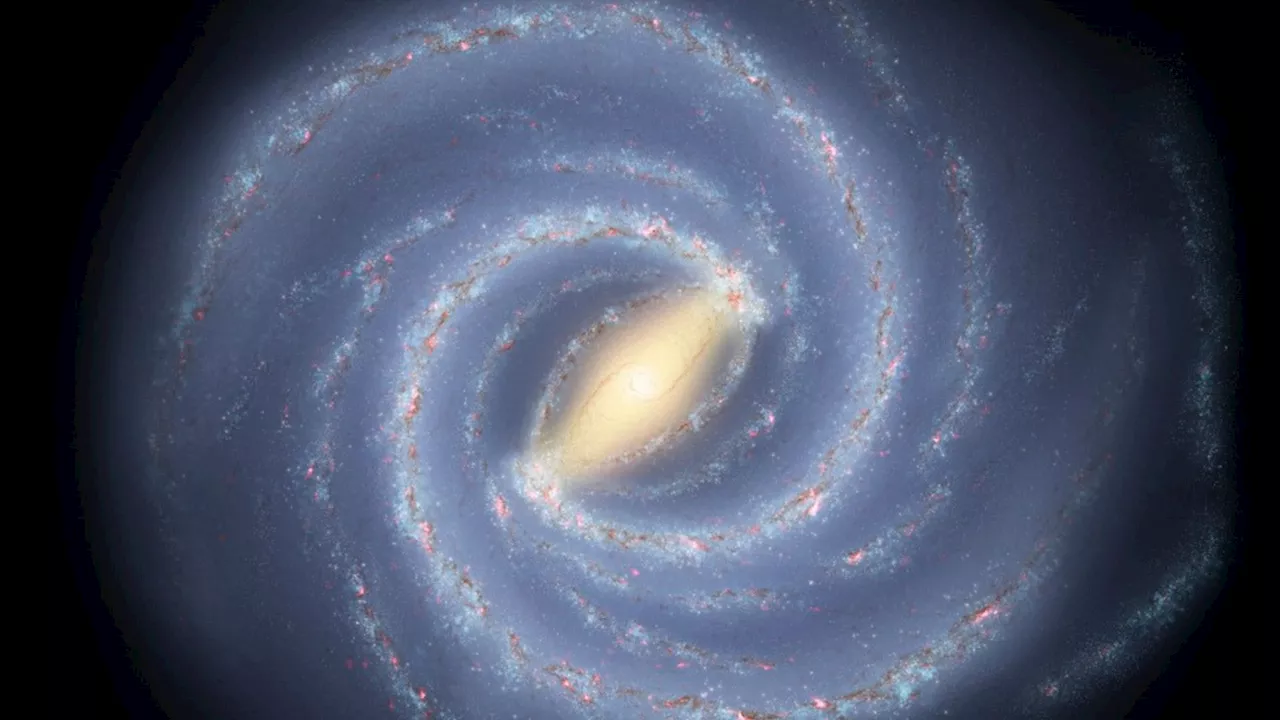
A team from the University of Tokyo has potentially made a groundbreaking discovery, claiming to have gathered the first direct evidence of dark matter through gamma-ray observations. This finding suggests that humanity may have effectively “seen” this elusive substance for the first time. Dark matter, which is believed to constitute approximately 85% of the universe’s mass, has remained largely invisible, detectable only through its gravitational effects on visible matter.
The observations were made using data collected by NASA’s Fermi Gamma-ray Space Telescope, a satellite dedicated to detecting high-energy light emitted across the universe. The team noted that the gamma rays detected align closely with theoretical predictions for the annihilation of dark matter particles, specifically Weakly Interacting Massive Particles (WIMPs). Professor Tomonori Totani, from the Department of Astronomy at the University of Tokyo, stated, “If this is correct, it would mark the first time humanity has ‘seen’ dark matter.”
Historic Context and Findings
The concept of dark matter was first introduced in the early 1930s by Swiss astronomer Fritz Zwicky, who observed that galaxies in the Coma cluster were moving at speeds that could not be accounted for by visible mass alone. He proposed that unseen “dunkle Materie” was providing the necessary gravitational binding. Since then, the existence of dark matter has gained acceptance, but direct evidence has remained elusive due to its lack of interaction with light.
In their latest research, the Tokyo team focused on the center of the Milky Way, a region where dark matter is anticipated to be densely concentrated. Their analysis revealed a surprising increase in high-energy gamma rays, specifically emissions with a photon energy of 20 gigaelectronvolts from the galactic core. Totani emphasized the significance of these findings, stating, “We detected gamma rays with an extremely large amount of energy, extending in a halo-like structure toward the center of the Milky Way galaxy.”
The detected gamma-ray spectrum aligns well with theoretical expectations for WIMP annihilation, indicating that the particles may possess a mass approximately 500 times that of a proton. This correlation provides what researchers describe as a “precise fingerprint” of dark matter.
Implications and Next Steps
The implications of this research are substantial, signifying a potential breakthrough in both astronomy and particle physics. However, the scientific community is approaching these findings with cautious optimism. The results now require validation through independent analyses by other research teams to confirm the signals observed.
Totani emphasized the need for further evidence, suggesting that additional confirmations could come from detecting the same gamma-ray signal in other dark matter-rich environments, such as dwarf galaxies orbiting the Milky Way. Until then, the prospect of understanding dark matter remains a tantalizing frontier in modern science.
The findings were published in the Journal of Cosmology and Astroparticle Physics on November 25, 2023. As researchers continue to explore the nature of dark matter, the universe’s greatest secret may finally be on the verge of revelation.

Bitcoin Plummets Below $88K Amid Tether Concerns and Warnings

Designers Unveil 5 Urgent Tricks to Transform Outdoor Eyesores

Shark Teeth Research Reveals Urgent Need to Protect Species

Church Members Unite in Resilience After Thanksgiving Fire

Community Unites to Attempt World Record for Largest Cookie Exchange

Mayor Lurie Appoints Alan Wong to District 4 Seat Amid Controversy

Mayor Appoints Alan Wong as New Supervisor for District 4

UK Report Reveals AI’s Role in Evaluating University Research Quality

Gabriela Jaquez Shines as No. 3 UCLA Dominates No. 14 Tennessee

University of Hawaiʻi Joins $25.6M AI Initiative to Monitor Disasters

Toledo City League Announces Hall of Fame Inductees for 2024

DOJ Seizes $15 Billion in Bitcoin from Major Crypto Fraud Network

Sharp Launches Five New Aquos QLED 4K Ultra HD Smart TVs

Celtics Coach Joe Mazzulla Dominates Local Media in Scrimmage

Community Unites for 7th Annual Walk to Raise Mental Health Awareness

Mutual Advisors LLC Increases Stake in SPDR Portfolio ETF

Western Executives Confront Harsh Realities of China’s Manufacturing Edge

INK Entertainment Launches Exclusive Sofia Pop-Up at Virgin Hotels
-
Science4 weeks ago
University of Hawaiʻi Joins $25.6M AI Initiative to Monitor Disasters
-
 Lifestyle2 months ago
Toledo City League Announces Hall of Fame Inductees for 2024
-
 Business2 months ago
DOJ Seizes $15 Billion in Bitcoin from Major Crypto Fraud Network
-
 Top Stories2 months ago
Sharp Launches Five New Aquos QLED 4K Ultra HD Smart TVs
-
 Sports2 months ago
Celtics Coach Joe Mazzulla Dominates Local Media in Scrimmage
-
 Politics2 months ago
Mutual Advisors LLC Increases Stake in SPDR Portfolio ETF
-
 Health2 months ago
Community Unites for 7th Annual Walk to Raise Mental Health Awareness
-
 Science2 months ago
Western Executives Confront Harsh Realities of China’s Manufacturing Edge
-
 World2 months ago
INK Entertainment Launches Exclusive Sofia Pop-Up at Virgin Hotels
-

 Politics2 months ago
Major Networks Reject Pentagon’s New Reporting Guidelines
-

 Science1 month ago
Astronomers Discover Twin Cosmic Rings Dwarfing Galaxies
-

 Top Stories1 month ago
Randi Mahomes Launches Game Day Clothing Line with Chiefs