
Science
Archaeologists Uncover Secrets of Easter Island’s Enigmatic Moai Statues

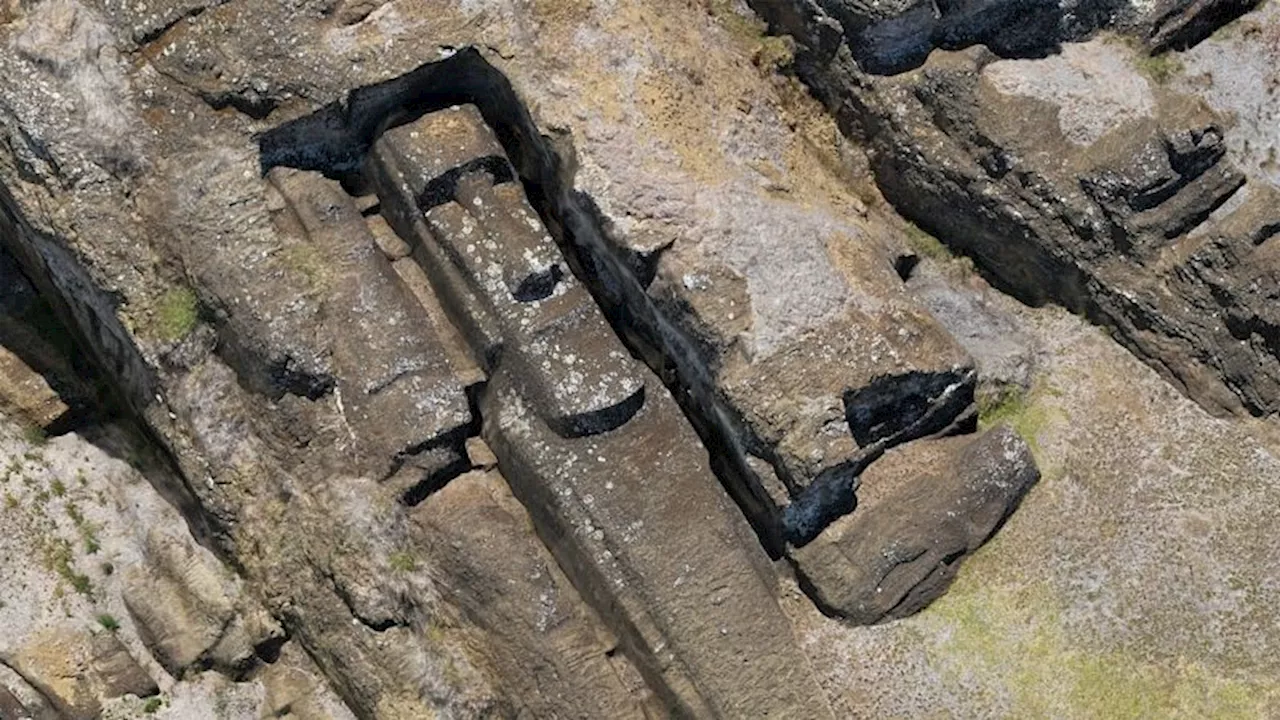
Archaeologists have made significant strides in understanding the construction of the iconic stone statues on Easter Island, also known as Rapa Nui. A recent study published in the journal PLOS One reveals insights from a high-resolution 3D model of a centuries-old quarry where hundreds of unfinished moai, or stone heads, lie embedded in rock.
The research indicates that the construction of these monumental structures was organized by individual clans rather than a centralized workforce, challenging previous beliefs about the societal structure of the island’s inhabitants. The findings stem from the analysis of the Rano Raraku moai quarry, a volcanic site that showcases the extensive efforts of the Polynesian society that created these remarkable statues.
Carl Lipo, a professor at Binghamton University, explained, “The sheer scale seemed to demand centralized coordination. The presence of monuments became circular evidence for hierarchy. Monuments meant chiefs because chiefs built monuments.” The study utilized advanced photogrammetry techniques, capturing over 11,000 images with a drone to create the first detailed 3D model of the quarry.
In their analysis, researchers identified 30 distinct quarrying sites, suggesting multiple independent work areas rather than a single, centralized operation. This decentralized production approach indicates that each family group may have operated within their zones, allowing for variability in extraction methods and finishing techniques. According to Lipo, this implies that the entire production process remained localized, contrasting with the expectations of an industrial quarry model.
The scale of the moai statues is staggering. From the 13th to 17th centuries, approximately 1,000 statues were erected, with the average height reaching 4 meters and weight around 12.5 tons. Some sculptures even exceeded 20 tons. The quarry model revealed 426 moai at various stages of completion, 341 trenches cut for carving, and 133 voids where statues had been removed successfully.
One of the most notable unfinished statues is known as Te Tokanga, which, if completed, would stand about 21 meters tall and weigh approximately 270 tons. Lipo remarked, “Some statues exceeded practical transport limits,” suggesting that competitive pressures may have driven communities to attempt ever-larger moai.
The evidence of unfinished statues indicates ongoing quarry operations rather than abandonment. Lipo notes that a 2019 study suggested statue production continued until the arrival of Europeans, marking the quarry’s deactivation due to introduced disruptions rather than catastrophic failure.
Despite the innovative methods employed in this study, some experts are cautious about the conclusions drawn. Helene Martinsson-Wallin, a professor of archaeology at Uppsala University, indicated that the clan-based system had been posited over a century ago. She emphasized that while the study offers a fresh perspective, it does not dramatically alter the understanding of Rapa Nui society.
Christopher Stevenson, an archaeologist at Virginia Commonwealth University, acknowledged the research’s innovative approach but called for more robust data to support claims of decentralized production. He pointed out that architectural styles near the quarry might suggest social distinctions not addressed in the study.
The history of Rapa Nui is complex, having been settled by a small group of Polynesian seafarers around 900 years ago. The island’s legacy has often been depicted as a cautionary tale about resource exploitation, particularly highlighted in Jared Diamond’s book “Collapse: How Societies Choose to Fail or Succeed.” However, recent research challenges this narrative, suggesting instead that Rapa Nui thrived in its isolated environment, with flexible social structures that adapted to changing conditions.
Lipo argues that the decentralized nature of moai production implies that no central authority drove the island to ecological collapse. “If monument production were decentralized, with autonomous communities making independent decisions, there would be no central authority to drive the island over an ecological cliff,” he stated.
The latest findings contribute to an evolving narrative about Easter Island, painting a picture of resilience and adaptability rather than inevitable decline. As research continues, the story of Rapa Nui and its monumental moai remains a captivating exploration of human ingenuity and social organization in one of the world’s most remote locations.

Designers Unveil 5 Urgent Tricks to Transform Outdoor Eyesores

Shark Teeth Research Reveals Urgent Need to Protect Species

Church Members Unite in Resilience After Thanksgiving Fire

Community Unites to Attempt World Record for Largest Cookie Exchange

Mayor Lurie Appoints Alan Wong to District 4 Seat Amid Controversy

Mayor Appoints Alan Wong as New Supervisor for District 4

UK Report Reveals AI’s Role in Evaluating University Research Quality

Gabriela Jaquez Shines as No. 3 UCLA Dominates No. 14 Tennessee

Trump Promises to Release MRI Results Despite Uncertainty on Scan

University of Hawaiʻi Joins $25.6M AI Initiative to Monitor Disasters

Toledo City League Announces Hall of Fame Inductees for 2024

DOJ Seizes $15 Billion in Bitcoin from Major Crypto Fraud Network

Sharp Launches Five New Aquos QLED 4K Ultra HD Smart TVs

Celtics Coach Joe Mazzulla Dominates Local Media in Scrimmage

Mutual Advisors LLC Increases Stake in SPDR Portfolio ETF

Community Unites for 7th Annual Walk to Raise Mental Health Awareness

Western Executives Confront Harsh Realities of China’s Manufacturing Edge

Major Networks Reject Pentagon’s New Reporting Guidelines
-
Science4 weeks ago
University of Hawaiʻi Joins $25.6M AI Initiative to Monitor Disasters
-
 Lifestyle2 months ago
Toledo City League Announces Hall of Fame Inductees for 2024
-
 Business2 months ago
DOJ Seizes $15 Billion in Bitcoin from Major Crypto Fraud Network
-
 Top Stories2 months ago
Sharp Launches Five New Aquos QLED 4K Ultra HD Smart TVs
-
 Sports2 months ago
Celtics Coach Joe Mazzulla Dominates Local Media in Scrimmage
-
 Politics2 months ago
Mutual Advisors LLC Increases Stake in SPDR Portfolio ETF
-
 Health2 months ago
Community Unites for 7th Annual Walk to Raise Mental Health Awareness
-
 Science2 months ago
Western Executives Confront Harsh Realities of China’s Manufacturing Edge
-
 Politics2 months ago
Major Networks Reject Pentagon’s New Reporting Guidelines
-

 World2 months ago
INK Entertainment Launches Exclusive Sofia Pop-Up at Virgin Hotels
-

 Science1 month ago
Astronomers Discover Twin Cosmic Rings Dwarfing Galaxies
-

 Top Stories1 month ago
Randi Mahomes Launches Game Day Clothing Line with Chiefs