
Science
NASA’s Perseverance Rover Detects Lightning Sounds on Mars

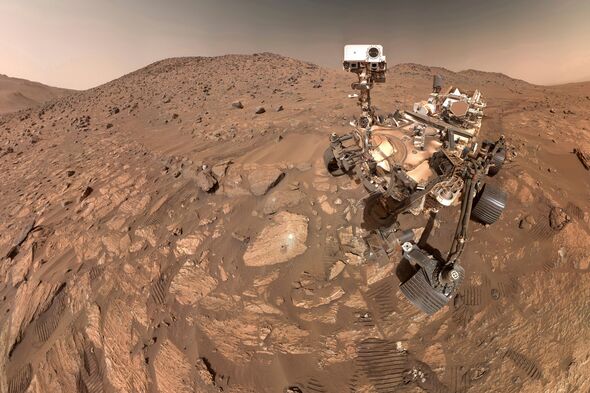
NASA’s Perseverance rover has made a significant discovery by recording what scientists believe to be the sounds of lightning on Mars. This breakthrough marks the first time that lightning has been documented on the Red Planet, despite long-standing theories regarding its existence. The sounds were captured during the rover’s monitoring of Martian winds, emphasizing the potential for further exploration of electrical phenomena in Mars’ atmosphere.
The findings were reported by a French-led research team, which indicated that the rover detected these crackling noises, referred to as “mini lightning,” 55 times over a span of two Martian years. Most of these occurrences coincided with dust storms and dust devils, particularly on the windiest days, or sols, on Mars. The electrical discharges were recorded within approximately 6 feet (2 meters) of the rover’s microphone, which is strategically located atop the rover’s tall mast.
The Perseverance rover is equipped with advanced tools, including cameras and lasers, to analyze Martian rocks. The crackling sounds recorded are believed to be caused by electrical discharges, reminiscent of static electricity on Earth. Lead author of the study, Baptiste Chide, from the Institute for Research in Astrophysics and Planetology in Toulouse, expressed excitement about the implications of this discovery. “It opens a completely new field of investigation for Mars science. It’s like finding a missing piece of the puzzle,” he stated.
While the evidence supporting the existence of lightning on Mars is compelling, some scientists urge caution. Daniel Mitchard, a researcher at Cardiff University who did not participate in the study, noted that the findings are based solely on data from the rover’s microphone, which was initially designed to capture sounds from laser interactions with rocks. He remarked, “It really is a chance discovery to hear something else going on nearby, and everything points to this being Martian lightning.” Nonetheless, he acknowledged that discussions among scientists about the nature of these recordings are likely to continue.
The research team analyzed a total of 28 hours of audio recordings that highlighted the electrical discharges associated with dust devils and storms. The discharges from dust devils lasted only a few seconds, while those from dust storms could be heard for durations of up to 30 minutes. Chide described these events as “like a thunderstorm on Earth, but barely visible to the naked eye and with plenty of faint zaps.” He added that the Martian atmosphere appears to be more conducive to electrical discharges than that of Earth.
Despite the intriguing findings, Mitchard reassured that the risk of lightning strikes on Mars is minimal. “The current evidence suggests it is extremely unlikely that the first person to walk on Mars could, as they plant a flag on the surface, be struck down by a bolt of lightning,” he explained. However, he cautioned that the frequent, small static-like discharges could pose challenges for sensitive equipment used in future missions.
This discovery reinforces the importance of ongoing research into Martian weather phenomena and the potential for understanding the planet’s climate and atmospheric conditions better. The Perseverance rover continues to be a vital asset in uncovering the mysteries of Mars, paving the way for future exploration and the possibility of human presence on the planet.

Designers Unveil 5 Urgent Tricks to Transform Outdoor Eyesores

Shark Teeth Research Reveals Urgent Need to Protect Species

Church Members Unite in Resilience After Thanksgiving Fire

Community Unites to Attempt World Record for Largest Cookie Exchange

Mayor Lurie Appoints Alan Wong to District 4 Seat Amid Controversy

Mayor Appoints Alan Wong as New Supervisor for District 4

UK Report Reveals AI’s Role in Evaluating University Research Quality

Gabriela Jaquez Shines as No. 3 UCLA Dominates No. 14 Tennessee

Trump Promises to Release MRI Results Despite Uncertainty on Scan

University of Hawaiʻi Joins $25.6M AI Initiative to Monitor Disasters

Toledo City League Announces Hall of Fame Inductees for 2024

DOJ Seizes $15 Billion in Bitcoin from Major Crypto Fraud Network

Sharp Launches Five New Aquos QLED 4K Ultra HD Smart TVs

Celtics Coach Joe Mazzulla Dominates Local Media in Scrimmage

Mutual Advisors LLC Increases Stake in SPDR Portfolio ETF

Community Unites for 7th Annual Walk to Raise Mental Health Awareness

Western Executives Confront Harsh Realities of China’s Manufacturing Edge

INK Entertainment Launches Exclusive Sofia Pop-Up at Virgin Hotels
-
Science4 weeks ago
University of Hawaiʻi Joins $25.6M AI Initiative to Monitor Disasters
-
 Lifestyle2 months ago
Toledo City League Announces Hall of Fame Inductees for 2024
-
 Business2 months ago
DOJ Seizes $15 Billion in Bitcoin from Major Crypto Fraud Network
-
 Top Stories2 months ago
Sharp Launches Five New Aquos QLED 4K Ultra HD Smart TVs
-
 Sports2 months ago
Celtics Coach Joe Mazzulla Dominates Local Media in Scrimmage
-
 Politics2 months ago
Mutual Advisors LLC Increases Stake in SPDR Portfolio ETF
-
 Health2 months ago
Community Unites for 7th Annual Walk to Raise Mental Health Awareness
-
 Science2 months ago
Western Executives Confront Harsh Realities of China’s Manufacturing Edge
-
 World2 months ago
INK Entertainment Launches Exclusive Sofia Pop-Up at Virgin Hotels
-

 Politics2 months ago
Major Networks Reject Pentagon’s New Reporting Guidelines
-
 Science1 month ago
Astronomers Discover Twin Cosmic Rings Dwarfing Galaxies
-

 Top Stories1 month ago
Randi Mahomes Launches Game Day Clothing Line with Chiefs