
World
Pope Leo XIV Urges Unity at Historic Nicaea Site in Turkey

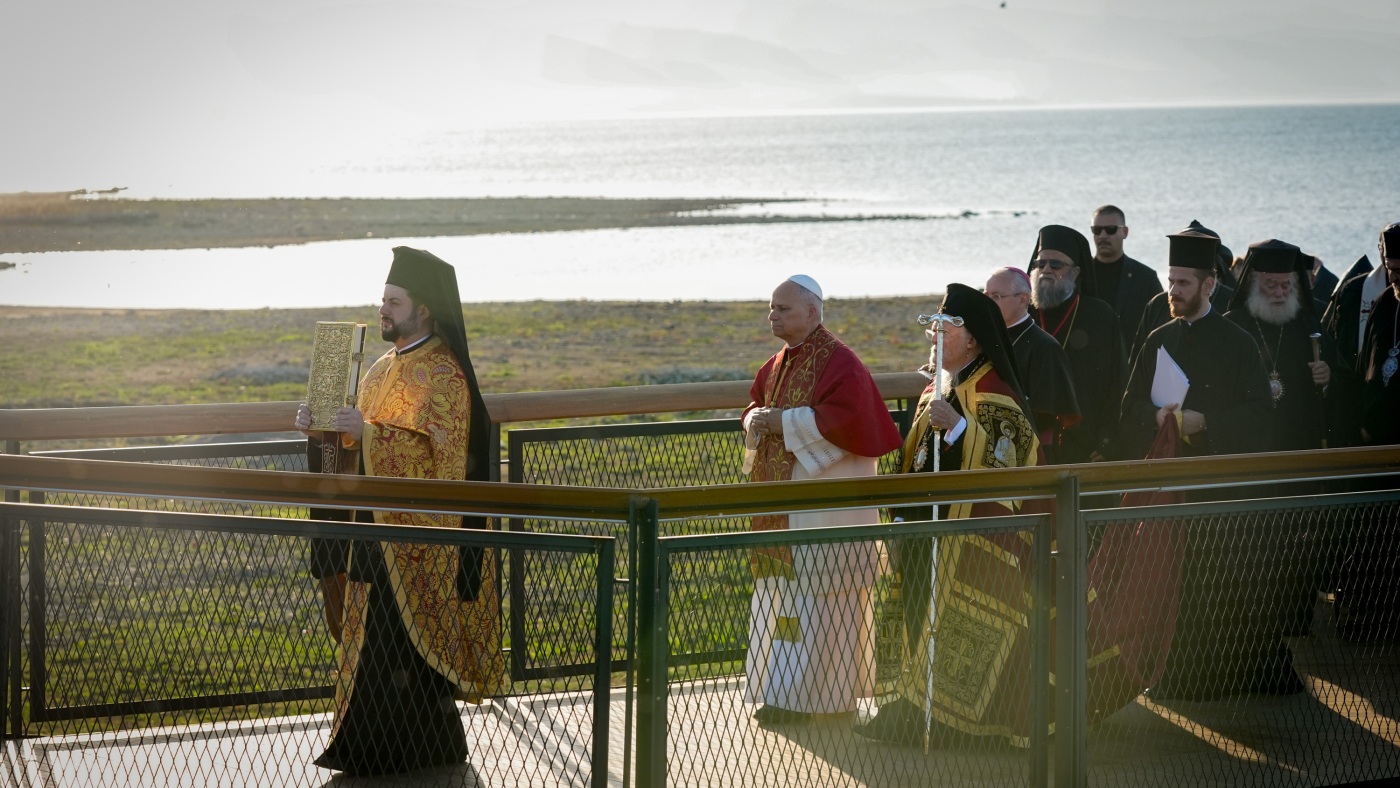
Pope Leo XIV emphasized the importance of unity among Christian denominations during his visit to the historic site of the First Council of Nicaea in Iznik, Turkey. This event marks the second day of his inaugural foreign trip, where he prayed alongside Ecumenical Patriarch Bartholomew, the spiritual leader of the Eastern Orthodox Church. The council, convened in 325 by Emperor Constantine, addressed critical theological divisions within early Christianity.
The First Council of Nicaea laid the groundwork for the Christian creed still recited in churches today. As the two leaders gathered amid the archaeological ruins of the lakeside church, Pope Leo called for a rejection of violence and fundamentalism, advocating instead for “fraternal encounter, dialogue and cooperation.” In his address, he stated, “We must strongly reject the use of religion for justifying war, violence, or any form of fundamentalism or fanaticism.”
During his trip, Pope Leo has consistently pressed for unity not only among Christians but also among different religions and communities. In a speech alongside Turkish President Recep Tayyip Erdogan, he warned that the current divisions in society pose significant risks to the future of humanity. This message resonates strongly with the historical context of the council, which sought to unify a fractured church during a time of persecution.
The First Council of Nicaea was a response to a major doctrinal crisis, primarily sparked by the teachings of Arius, an Alexandrian priest. Arius contended that Jesus was a created being and not equal to God. The council ultimately affirmed that Jesus is “of one substance” with the Father, a declaration that remains fundamental to the creed recited by Catholics today. The creed begins with the affirmation: “I believe in one God, the Father almighty…”
The location of the council was only confirmed in recent years, with Turkish archaeologist Mustafa Sahin revealing its position underwater in Lake Iznik. “It was under about eight feet of water,” he explained to NPR. As water levels have receded, more of the basilica’s structure has been exposed, including its apse and numerous ancient graves, allowing locals and visitors to engage with their historical heritage.
The Catholic Church remained unified until the Great Schism of 1054, which split Catholic and Eastern Orthodox Christianity over theological differences and power struggles between Rome and Constantinople, now known as Istanbul. On Friday, Pope Leo XIV and Patriarch Bartholomew participated in a joint silent prayer over the exposed ruins, symbolizing their commitment to reconciliation.
Ahead of the anniversary of the council, Pope Leo released an apostolic letter highlighting the creed as a “common heritage of Christians,” penned during a time when Christians were still reeling from persecution. On Saturday, the Pope and the Patriarch plan to sign a joint declaration, further demonstrating their shared commitment to unity in the face of historical divisions.
This visit to Iznik serves as a poignant reminder of the ongoing journey towards reconciliation and collaboration among diverse faiths, as Pope Leo XIV calls for a future built on understanding and cooperation.

Designers Unveil 5 Urgent Tricks to Transform Outdoor Eyesores

Shark Teeth Research Reveals Urgent Need to Protect Species

Church Members Unite in Resilience After Thanksgiving Fire

Community Unites to Attempt World Record for Largest Cookie Exchange

Mayor Lurie Appoints Alan Wong to District 4 Seat Amid Controversy

Mayor Appoints Alan Wong as New Supervisor for District 4

UK Report Reveals AI’s Role in Evaluating University Research Quality

Gabriela Jaquez Shines as No. 3 UCLA Dominates No. 14 Tennessee

Trump Promises to Release MRI Results Despite Uncertainty on Scan

University of Hawaiʻi Joins $25.6M AI Initiative to Monitor Disasters

Toledo City League Announces Hall of Fame Inductees for 2024

DOJ Seizes $15 Billion in Bitcoin from Major Crypto Fraud Network

Sharp Launches Five New Aquos QLED 4K Ultra HD Smart TVs

Celtics Coach Joe Mazzulla Dominates Local Media in Scrimmage

Community Unites for 7th Annual Walk to Raise Mental Health Awareness

Mutual Advisors LLC Increases Stake in SPDR Portfolio ETF

Western Executives Confront Harsh Realities of China’s Manufacturing Edge

INK Entertainment Launches Exclusive Sofia Pop-Up at Virgin Hotels
-
Science4 weeks ago
University of Hawaiʻi Joins $25.6M AI Initiative to Monitor Disasters
-
 Lifestyle2 months ago
Toledo City League Announces Hall of Fame Inductees for 2024
-
 Business2 months ago
DOJ Seizes $15 Billion in Bitcoin from Major Crypto Fraud Network
-
 Top Stories2 months ago
Sharp Launches Five New Aquos QLED 4K Ultra HD Smart TVs
-
 Sports2 months ago
Celtics Coach Joe Mazzulla Dominates Local Media in Scrimmage
-
 Health2 months ago
Community Unites for 7th Annual Walk to Raise Mental Health Awareness
-
 Politics2 months ago
Mutual Advisors LLC Increases Stake in SPDR Portfolio ETF
-
 Science2 months ago
Western Executives Confront Harsh Realities of China’s Manufacturing Edge
-
 World2 months ago
INK Entertainment Launches Exclusive Sofia Pop-Up at Virgin Hotels
-

 Politics2 months ago
Major Networks Reject Pentagon’s New Reporting Guidelines
-
 Science1 month ago
Astronomers Discover Twin Cosmic Rings Dwarfing Galaxies
-

 Top Stories1 month ago
Randi Mahomes Launches Game Day Clothing Line with Chiefs