
Science
ALMA and JWST Uncover Secrets of Star Formation in HH 211

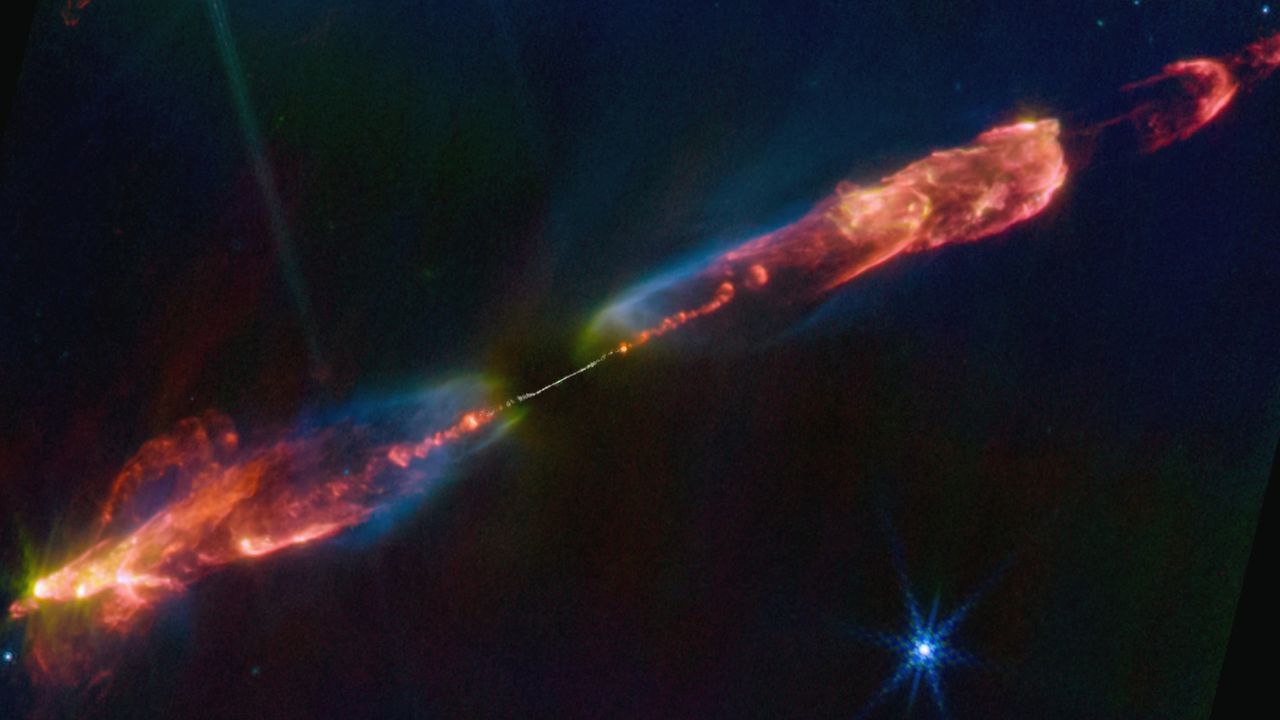
A significant breakthrough in our understanding of star formation has emerged through the collaboration of the Atacama Large Millimeter/submillimeter Array (ALMA) and the James Webb Space Telescope (JWST). Researchers have captured remarkable images of a protostar known as HH 211, located approximately 1,000 light-years away in the constellation Perseus. These observations provide critical insights into the mechanisms that govern the birth of stars, particularly the role of energetic jets in the process.
Decoding Star Formation
Star formation, although a fundamental process in the universe, remains partially understood. It begins in dense clouds of cold gas and dust that collapse under their own gravity when they reach a specific mass threshold. This collapse leads to the creation of a protostar surrounded by an accretion disk—a rotating disk of material that feeds the star as it forms.
As protostars develop, they exert powerful gravitational forces that pull material from their surroundings. However, if the accretion disk spins too rapidly, it can hinder material from falling toward the star. To counter this, astronomers theorize that protostars emit energetic jets, known as protostellar jets, which help facilitate the movement of material into the star.
The challenge has been to observe these jets, as they originate from regions extremely close to the star, making them difficult to image even with advanced telescopes. Previous studies indicated that magnetic fields within protostellar systems might play a key role in launching these jets, but direct evidence remained elusive.
New Discoveries from ALMA and JWST
In a study published on August 13, 2023, in the journal Scientific Reports, researchers utilized ALMA to investigate HH 211, a Herbig-Haro object that is only about 35,000 years old and features a tiny central protostar with a mass of just 0.06 times that of the sun. The observations revealed a bright bipolar jet consisting of two beams of energized, ionized material shooting out in opposite directions. Remarkably, this system is one of the few where a magnetic field has been detected, providing a unique opportunity to explore the mechanics of jet ejection.
ALMA’s observations demonstrated that the jet travels at approximately 66 miles per second (or 107 kilometers per second). Notably, while the jet moves quickly, it exhibits a slower rotation, indicating that it has removed excess rotational energy from the accretion disk. By applying principles of angular momentum conservation, researchers estimated that the jet originates from a mere 0.02 astronomical units—equivalent to about 1.85 million miles (or 3 million kilometers) from the protostar.
This discovery aligns with models suggesting that magnetic fields can act like a slingshot, propelling gas outward and aiding star formation. The collaboration between ALMA and JWST culminated in a stunning image of the bipolar jet captured in near-infrared wavelengths. Although JWST’s view was obstructed by dense surrounding dust, ALMA’s data provided crucial insights into the jet’s launch point.
The combination of data from both observatories has created a comprehensive picture of the star formation process, illustrating how protostellar jets play an essential role in allowing material to flow toward newborn stars by alleviating angular momentum from the accretion disk.
This research not only enhances our understanding of star formation but also illustrates the power of advanced astronomical tools working in concert to unveil the mysteries of the universe.

Urgent: Vehicle Fire Closes Two Lanes on I-215 in Salt Lake City

Knicks Dominate Raptors 116-94 at Home, Extend Winning Streak

Hallmark’s ‘Christmas at the Catnip Café’ Premieres Tonight!

Millville Woman Arrested for Threatening U-Haul Worker with Baton

Japan’s PM Takaichi Confirms Continued Fiscal Management Strategy

Bitcoin Plummets Below $88K Amid Tether Concerns and Warnings

Designers Unveil 5 Urgent Tricks to Transform Outdoor Eyesores

Shark Teeth Research Reveals Urgent Need to Protect Species

Church Members Unite in Resilience After Thanksgiving Fire

University of Hawaiʻi Joins $25.6M AI Initiative to Monitor Disasters

Toledo City League Announces Hall of Fame Inductees for 2024

DOJ Seizes $15 Billion in Bitcoin from Major Crypto Fraud Network

Sharp Launches Five New Aquos QLED 4K Ultra HD Smart TVs

Celtics Coach Joe Mazzulla Dominates Local Media in Scrimmage

Mutual Advisors LLC Increases Stake in SPDR Portfolio ETF

Community Unites for 7th Annual Walk to Raise Mental Health Awareness

Western Executives Confront Harsh Realities of China’s Manufacturing Edge

INK Entertainment Launches Exclusive Sofia Pop-Up at Virgin Hotels
-
Science4 weeks ago
University of Hawaiʻi Joins $25.6M AI Initiative to Monitor Disasters
-
 Lifestyle2 months ago
Toledo City League Announces Hall of Fame Inductees for 2024
-
 Business2 months ago
DOJ Seizes $15 Billion in Bitcoin from Major Crypto Fraud Network
-
 Top Stories2 months ago
Sharp Launches Five New Aquos QLED 4K Ultra HD Smart TVs
-
 Sports2 months ago
Celtics Coach Joe Mazzulla Dominates Local Media in Scrimmage
-
 Politics2 months ago
Mutual Advisors LLC Increases Stake in SPDR Portfolio ETF
-
 Health2 months ago
Community Unites for 7th Annual Walk to Raise Mental Health Awareness
-
 Science2 months ago
Western Executives Confront Harsh Realities of China’s Manufacturing Edge
-
 World2 months ago
INK Entertainment Launches Exclusive Sofia Pop-Up at Virgin Hotels
-

 Politics2 months ago
Major Networks Reject Pentagon’s New Reporting Guidelines
-

 Science1 month ago
Astronomers Discover Twin Cosmic Rings Dwarfing Galaxies
-

 Top Stories1 month ago
Randi Mahomes Launches Game Day Clothing Line with Chiefs