
Science
New Study Reveals Mechanosensor Behind Venus Flytrap’s Quick Response

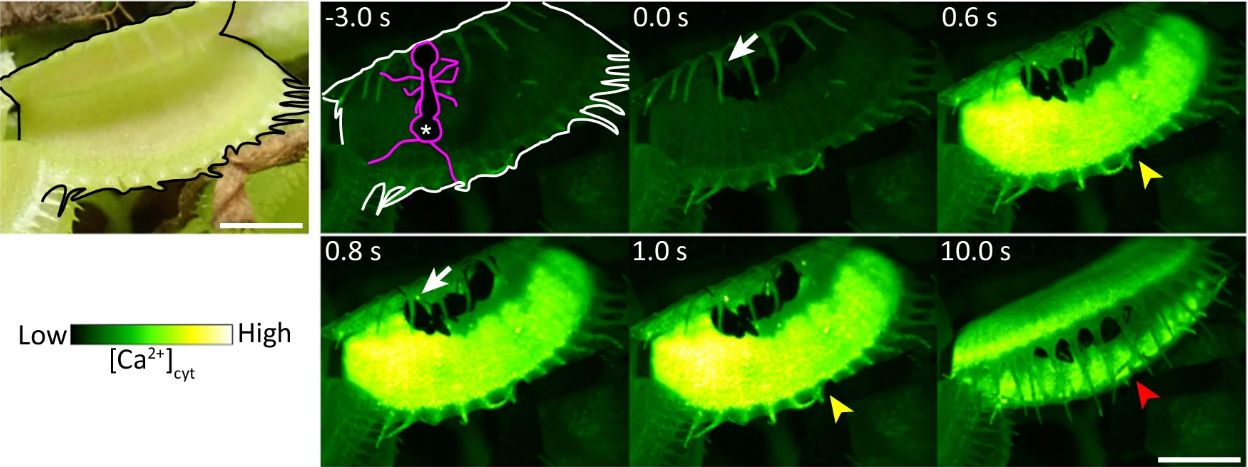
Carnivorous plants, particularly the Venus flytrap (Dionaea muscipula), have long intrigued scientists and nature enthusiasts alike due to their unique adaptations for capturing prey. A recent study published in Nature Communications by researcher Hiraku Suda and colleagues has shed light on the rapid response mechanism of these plants, revealing the role of a specific mechanosensor.
Understanding the Mechanism of Prey Capture
These fascinating plants utilize specialized hairs on their leaves that react to stimuli, allowing them to snap shut when they detect movement. The study confirms that a mechanosensor known as DmMSL10 is crucial for this quick reaction. By creating a variant of the plant that lacks this chloride ion channel, researchers were able to observe the differences in response times between the wild type and the knockout variant.
While the sensory hairs in both the wild type and the knockout variant trigger the release of calcium ions, the rate of action potential generation was significantly diminished in the knockout plants. The wild type continued to produce action potentials even after stimulation had stopped, highlighting the importance of DmMSL10 in processing slight stimuli and effectively detecting prey.
Experimental Evidence Supports Findings
To further substantiate their findings, the team conducted experiments allowing ants to wander on the leaves of both plant types. The wild type successfully caught the first wandering ant, demonstrating its efficient calcium signaling system. In contrast, the knockout variant did not respond to four consecutive ants, failing to generate sufficient calcium signals to close its leaves.
This research not only provides insight into the mechanisms that allow D. muscipula to thrive as a carnivorous plant but also suggests evolutionary parallels with sensory mechanisms found in animals. Understanding how these plants developed such rapid responses could open up new avenues in the study of plant biology and sensory perception.
The findings from Hiraku Suda and his team present a significant advancement in our understanding of plant sensory mechanisms, potentially paving the way for future research on similar adaptations in other species. As scientists continue to explore the intricacies of plant responses, the relationship between plants and their environments becomes increasingly fascinating.

Urgent: Vehicle Fire Closes Two Lanes on I-215 in Salt Lake City

Knicks Dominate Raptors 116-94 at Home, Extend Winning Streak

Hallmark’s ‘Christmas at the Catnip Café’ Premieres Tonight!

Millville Woman Arrested for Threatening U-Haul Worker with Baton

Japan’s PM Takaichi Confirms Continued Fiscal Management Strategy

Bitcoin Plummets Below $88K Amid Tether Concerns and Warnings

Designers Unveil 5 Urgent Tricks to Transform Outdoor Eyesores

Shark Teeth Research Reveals Urgent Need to Protect Species

Church Members Unite in Resilience After Thanksgiving Fire

University of Hawaiʻi Joins $25.6M AI Initiative to Monitor Disasters

Toledo City League Announces Hall of Fame Inductees for 2024

DOJ Seizes $15 Billion in Bitcoin from Major Crypto Fraud Network

Sharp Launches Five New Aquos QLED 4K Ultra HD Smart TVs

Celtics Coach Joe Mazzulla Dominates Local Media in Scrimmage

Community Unites for 7th Annual Walk to Raise Mental Health Awareness

Mutual Advisors LLC Increases Stake in SPDR Portfolio ETF

Western Executives Confront Harsh Realities of China’s Manufacturing Edge

INK Entertainment Launches Exclusive Sofia Pop-Up at Virgin Hotels
-
Science4 weeks ago
University of Hawaiʻi Joins $25.6M AI Initiative to Monitor Disasters
-
 Lifestyle2 months ago
Toledo City League Announces Hall of Fame Inductees for 2024
-
 Business2 months ago
DOJ Seizes $15 Billion in Bitcoin from Major Crypto Fraud Network
-
 Top Stories2 months ago
Sharp Launches Five New Aquos QLED 4K Ultra HD Smart TVs
-
 Sports2 months ago
Celtics Coach Joe Mazzulla Dominates Local Media in Scrimmage
-
 Health2 months ago
Community Unites for 7th Annual Walk to Raise Mental Health Awareness
-
 Politics2 months ago
Mutual Advisors LLC Increases Stake in SPDR Portfolio ETF
-
 Science2 months ago
Western Executives Confront Harsh Realities of China’s Manufacturing Edge
-
 World2 months ago
INK Entertainment Launches Exclusive Sofia Pop-Up at Virgin Hotels
-

 Politics2 months ago
Major Networks Reject Pentagon’s New Reporting Guidelines
-

 Science1 month ago
Astronomers Discover Twin Cosmic Rings Dwarfing Galaxies
-

 Top Stories1 month ago
Randi Mahomes Launches Game Day Clothing Line with Chiefs