
Science
Deep Learning Transforms 3D Imaging of Fruit Tissue Structures

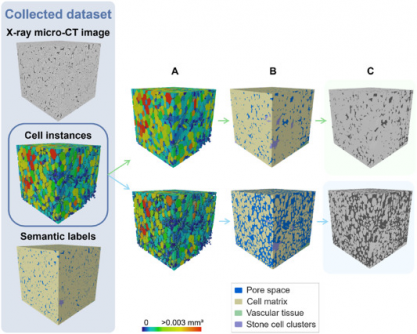
Researchers at KU Leuven have developed a groundbreaking deep learning model that significantly improves the accuracy of analyzing the three-dimensional (3D) microstructure of fruit tissues, specifically apples and pears. Published in the journal Plant Phenomics on July 5, 2025, this study demonstrates how advanced technology can enhance our understanding of plant anatomy and its implications for agriculture and food science.
Traditional microscopy techniques for studying plant tissues often involve extensive preparation and yield limited views of the samples. Although X-ray micro-computed tomography (micro-CT) has emerged as a non-destructive imaging method, it poses challenges in accurately quantifying tissue morphology due to overlapping features and low contrast in images. Previous segmentation methods frequently struggled to differentiate between various types of cells, including parenchyma, vascular tissues, and stone cell clusters.
To address these issues, Pieter Verboven and his team at KU Leuven utilized a comprehensive deep learning framework that automates the labeling and quantification of plant tissue architecture. Their model employs a 3D panoptic segmentation approach, combining the capabilities of the 3D extension of Cellpose and a 3D Residual U-Net architecture. This innovative model effectively performs both instance and semantic segmentation, allowing it to predict gradient fields in three dimensions and classify different tissue types.
The deep learning model was trained on datasets from apples and pears, incorporating synthetic data augmentation techniques such as morphological dilation and erosion, grey-value assignment, and Gaussian noise addition. When benchmarked against a 2D instance segmentation model and a marker-based watershed algorithm, the 3D model achieved impressive results. The model reached an Aggregated Jaccard Index (AJI) of 0.889 for apples and 0.773 for pears, outperforming the 2D model’s scores of 0.861 and 0.732, respectively.
The accuracy of the model was further validated through visual assessments, demonstrating precise detection of vascular bundles in apple varieties such as ‘Kizuri’ and ‘Braeburn’ and realistic segmentation of stone cell clusters in pears like ‘Celina’ and ‘Fred.’ The model achieved a Dice Similarity Coefficient (DSC) of up to 0.90 in some cases.
Despite these advancements, the research team noted that further data augmentation did not enhance performance, suggesting that dataset imbalance and domain shifts might have affected the outcomes. Morphometric analysis confirmed the model’s effectiveness, with vasculature widths ranging from 70 to 780 μm and variable dimensions and sphericity of stone cell clusters (ranging from 0.68 to 0.74).
This deep learning model represents a significant step forward in the field of plant science, offering a non-destructive tool for researchers to explore how microscopic structures affect water, gas, and nutrient transport. By improving the efficiency of “human-in-the-loop” analysis, the model not only reduces manual labor but also enhances tissue characterization accuracy.
In the context of fruit research, the model provides insights into how cellular arrangements influence texture, storability, and susceptibility to physiological disorders such as browning or watercore. More broadly, this technology establishes a scalable framework to study tissue development, ripening, and stress responses across various crops.
The compatibility of this deep learning model with standard X-ray micro-CT instruments positions it as an accessible solution for integrating artificial intelligence into research focused on plant anatomy and food science. As the field continues to evolve, the implications of this work may lead to significant advancements in agricultural practices and food preservation techniques.
Funding for this research was provided by the Research Foundation – Flanders (FWO), under grant number S003421N, as part of the SBO project FoodPhase.

Hallmark’s ‘Christmas at the Catnip Café’ Premieres Tonight!

Millville Woman Arrested for Threatening U-Haul Worker with Baton

Japan’s PM Takaichi Confirms Continued Fiscal Management Strategy

Bitcoin Plummets Below $88K Amid Tether Concerns and Warnings

Designers Unveil 5 Urgent Tricks to Transform Outdoor Eyesores

Shark Teeth Research Reveals Urgent Need to Protect Species

Church Members Unite in Resilience After Thanksgiving Fire

Community Unites to Attempt World Record for Largest Cookie Exchange

Mayor Lurie Appoints Alan Wong to District 4 Seat Amid Controversy

University of Hawaiʻi Joins $25.6M AI Initiative to Monitor Disasters

Toledo City League Announces Hall of Fame Inductees for 2024

DOJ Seizes $15 Billion in Bitcoin from Major Crypto Fraud Network

Sharp Launches Five New Aquos QLED 4K Ultra HD Smart TVs

Celtics Coach Joe Mazzulla Dominates Local Media in Scrimmage

Community Unites for 7th Annual Walk to Raise Mental Health Awareness

Mutual Advisors LLC Increases Stake in SPDR Portfolio ETF

Western Executives Confront Harsh Realities of China’s Manufacturing Edge

INK Entertainment Launches Exclusive Sofia Pop-Up at Virgin Hotels
-
Science4 weeks ago
University of Hawaiʻi Joins $25.6M AI Initiative to Monitor Disasters
-
 Lifestyle2 months ago
Toledo City League Announces Hall of Fame Inductees for 2024
-
 Business2 months ago
DOJ Seizes $15 Billion in Bitcoin from Major Crypto Fraud Network
-
 Top Stories2 months ago
Sharp Launches Five New Aquos QLED 4K Ultra HD Smart TVs
-
 Sports2 months ago
Celtics Coach Joe Mazzulla Dominates Local Media in Scrimmage
-
 Health2 months ago
Community Unites for 7th Annual Walk to Raise Mental Health Awareness
-
 Politics2 months ago
Mutual Advisors LLC Increases Stake in SPDR Portfolio ETF
-
 Science2 months ago
Western Executives Confront Harsh Realities of China’s Manufacturing Edge
-
 World2 months ago
INK Entertainment Launches Exclusive Sofia Pop-Up at Virgin Hotels
-

 Politics2 months ago
Major Networks Reject Pentagon’s New Reporting Guidelines
-

 Science1 month ago
Astronomers Discover Twin Cosmic Rings Dwarfing Galaxies
-

 Top Stories1 month ago
Randi Mahomes Launches Game Day Clothing Line with Chiefs