
Science
Dinosaur Mummies Found in Wyoming Reveal Unique Features

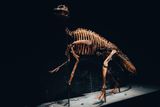
A recent study has unveiled remarkable findings about the dinosaur species Edmontosaurus annectens, known for its horse-like hooves and duck bill. Researchers discovered mummified specimens in Wyoming that are providing new insights into this unique dinosaur. The findings, published in the journal Science, highlight the mummification process that preserved these creatures in extraordinary detail.
The Edmontosaurus species, including E. annectens and its close relative E. regalis, were among the last dinosaurs on Earth before the Cretaceous-Paleogene extinction event approximately 66 million years ago. These hadrosaurids, commonly referred to as “duck-billed dinosaurs,” possessed distinctive long bills ideal for foraging for plants. Fossils of these dinosaurs have been found across several states in the western United States, including Wyoming and Colorado, and in Canadian provinces like Saskatchewan and Alberta.
Mummification Process Revealed
The two notable specimens of E. annectens from the Cretaceous era were discovered in the Lance Formation in Wyoming. The first, a juvenile estimated to be around 2 years old, and the second, an early adult between 5 and 8 years, exhibited remarkable details preserved in clay. Unlike typical fossilized bones, which harden over time, these specimens are remarkable for their preservation in sediment, revealing their outline, skin texture, and other features.
Researchers identified this unique preservation area as the “mummy zone.” Unlike human mummies, these dinosaur remains lacked organic tissues. Instead, they were enveloped in a clay layer approximately 1/100th of an inch thick. The mummification process involved a flash flood that buried the dinosaurs, followed by a biofilm that coated their remains in clay. As the organic material decayed, a 3D template of the dinosaurs’ shapes remained.
“This is a mask, a template, a clay layer so thin you could blow it away,” said Paul Sereno, a paleontologist at the University of Chicago and senior author of the study. “It was attracted to the outside of the carcass in a fluke event of preservation.”
Discovering Unique Features
Using advanced imaging techniques such as micro-CT scans and X-ray spectroscopy, researchers were able to analyze the anatomical features of E. annectens. The dinosaur showcased a fleshy crest along its neck and trunk, transitioning into a line of spikes extending down its tail. Notably, the scales were relatively small, ranging from 1 to 4 millimeters in size, with wrinkles on the ribcage indicating thin skin.
One of the most surprising revelations from the study was the reconstruction of the dinosaurs’ hooves. The findings suggest that each of the three hind toes was encased in a wedge-shaped hoof with a flat bottom, resembling the hooves of modern horses. This discovery marks significant milestones in paleontology, including the identification of the earliest hooves documented in a land vertebrate and the first confirmed hooved reptile.
“There are so many amazing ‘firsts’ preserved in these duck-billed mummies — the earliest hooves documented in a land vertebrate, the first confirmed hooved reptile, and the first hooved four-legged animal with different forelimb and hindlimb posture,” noted Sereno.
The discoveries surrounding Edmontosaurus annectens not only expand the understanding of dinosaur biology but also shed light on the conditions that can lead to exceptional fossil preservation. As researchers continue to explore the implications of these findings, they provide a fascinating glimpse into the past of these ancient creatures.

Arlene Hartman, Beloved Community Member, Passes at 87

Urgent: Vehicle Fire Closes Two Lanes on I-215 in Salt Lake City

Knicks Dominate Raptors 116-94 at Home, Extend Winning Streak

Hallmark’s ‘Christmas at the Catnip Café’ Premieres Tonight!

Millville Woman Arrested for Threatening U-Haul Worker with Baton

Japan’s PM Takaichi Confirms Continued Fiscal Management Strategy

Bitcoin Plummets Below $88K Amid Tether Concerns and Warnings

Designers Unveil 5 Urgent Tricks to Transform Outdoor Eyesores

Shark Teeth Research Reveals Urgent Need to Protect Species

University of Hawaiʻi Joins $25.6M AI Initiative to Monitor Disasters

Toledo City League Announces Hall of Fame Inductees for 2024

DOJ Seizes $15 Billion in Bitcoin from Major Crypto Fraud Network

Sharp Launches Five New Aquos QLED 4K Ultra HD Smart TVs

Celtics Coach Joe Mazzulla Dominates Local Media in Scrimmage

Mutual Advisors LLC Increases Stake in SPDR Portfolio ETF

Community Unites for 7th Annual Walk to Raise Mental Health Awareness

Western Executives Confront Harsh Realities of China’s Manufacturing Edge

INK Entertainment Launches Exclusive Sofia Pop-Up at Virgin Hotels
-
Science4 weeks ago
University of Hawaiʻi Joins $25.6M AI Initiative to Monitor Disasters
-
 Lifestyle2 months ago
Toledo City League Announces Hall of Fame Inductees for 2024
-
 Business2 months ago
DOJ Seizes $15 Billion in Bitcoin from Major Crypto Fraud Network
-
 Top Stories2 months ago
Sharp Launches Five New Aquos QLED 4K Ultra HD Smart TVs
-
 Sports2 months ago
Celtics Coach Joe Mazzulla Dominates Local Media in Scrimmage
-
 Politics2 months ago
Mutual Advisors LLC Increases Stake in SPDR Portfolio ETF
-
 Health2 months ago
Community Unites for 7th Annual Walk to Raise Mental Health Awareness
-
 Science2 months ago
Western Executives Confront Harsh Realities of China’s Manufacturing Edge
-
 World2 months ago
INK Entertainment Launches Exclusive Sofia Pop-Up at Virgin Hotels
-

 Politics2 months ago
Major Networks Reject Pentagon’s New Reporting Guidelines
-

 Science1 month ago
Astronomers Discover Twin Cosmic Rings Dwarfing Galaxies
-

 Top Stories1 month ago
Randi Mahomes Launches Game Day Clothing Line with Chiefs