
Science
Astronomers Discover Nickel Vapor in Interstellar Comet 3I/ATLAS

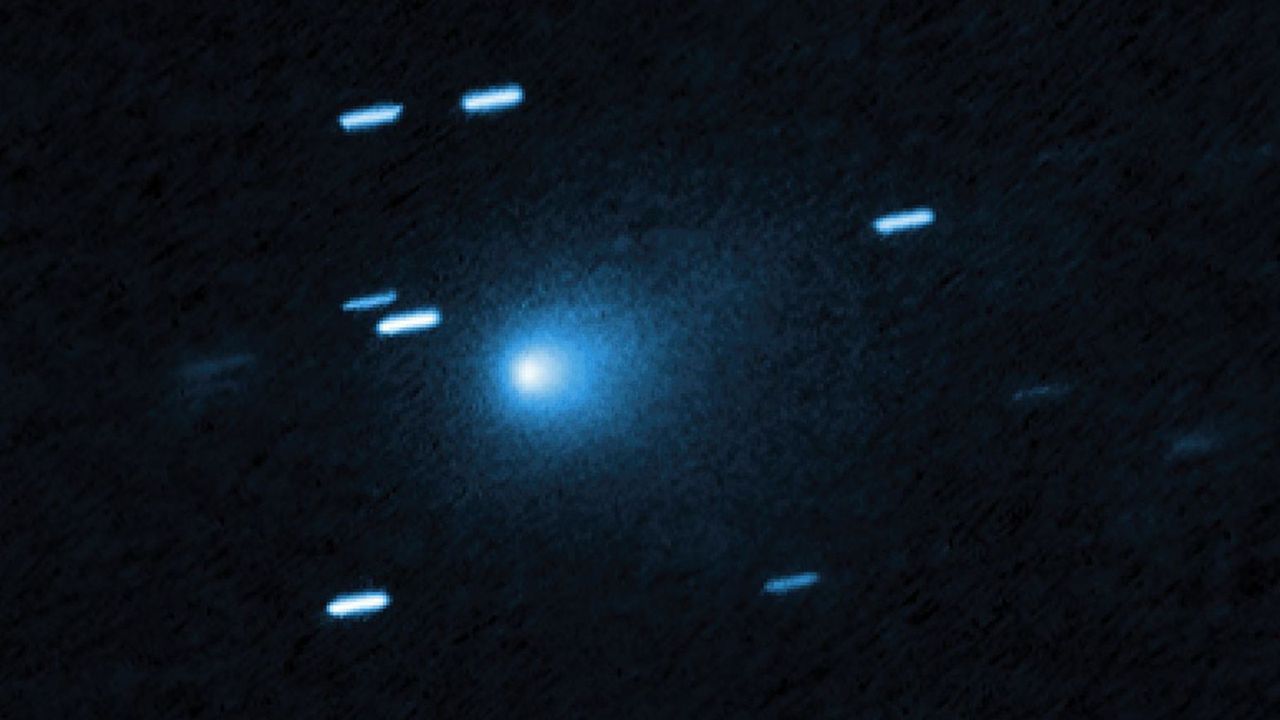
An international team of astronomers has made a groundbreaking discovery, detecting glowing nickel vapor in the gas surrounding the interstellar comet **3I/ATLAS** at an unexpected distance from the sun. This finding sheds light on the chemistry of materials originating from beyond our solar system and challenges existing theories about such celestial bodies.
On **July 1, 2025**, the comet was identified during a routine sky survey by the **Asteroid Terrestrial-impact Last Alert System (ATLAS)**. It is only the third confirmed interstellar object ever discovered, following the enigmatic **’Oumuamua** and comet **Borisov**. Unlike these predecessors, **3I/ATLAS** was caught early in its journey, allowing astronomers to observe its transition as it approaches our sun.
Rohan Rahatgaonkar, a Ph.D. student at the **Instituto de Astrofísica-Pontificia Universidad Católica de Chile**, and Darryl Z. Seligman, an Assistant Professor of Physics and Astronomy at **Michigan State University**, are part of the team examining this fascinating comet. The researchers utilized the **Very Large Telescope (VLT)** in Chile to monitor the chemical processes occurring in real-time as the comet travels through our solar system.
Unraveling the Comet’s Secrets
As **3I/ATLAS** moves closer to the sun, the team has documented a remarkable sequence of chemical activations. Initial significant observations occurred on **July 20**, when spectral lines indicating the presence of atomic nickel vapor were recorded at a distance of **3.88 astronomical units (AU)** from the sun. This distance is nearly four times that of Earth, where temperatures remain too frigid for metals to vaporize normally.
The findings suggest that nickel, a metal typically requiring high temperatures to vaporize, is being released through mechanisms that operate at much lower temperatures. As the comet neared the sun, the amount of nickel vapor detected increased significantly, indicating a chemical awakening that had not been anticipated.
By mid-August, when **3I/ATLAS** was approximately **3.07 AU** from the sun, the researchers also detected cyanogen (CN) gas, a common emission found in solar system comets. This combination of findings is noteworthy, as previous studies indicate that the nickel was detected without concurrent levels of iron, suggesting a distinctive release process possibly tied to specific molecules.
Implications for Astrophysics
The implications of this discovery extend beyond the comet itself. Interstellar objects like **3I/ATLAS** serve as cosmic time capsules, offering insights into the conditions of their parent star systems, which may be billions of years old. Understanding their chemical makeup can reveal whether the building blocks of planetary systems are consistent across the galaxy or vary significantly.
The observations from this comet are complemented by data from the **James Webb Space Telescope** (JWST), which indicated a higher ratio of carbon dioxide to water in the comet’s coma compared to typical solar system comets. This suggests a complex mixture of frozen materials that, as they warm, contribute to the activity observed.
The combination of findings points to a potential chemical mechanism in which nickel atoms are bound within special molecules that dissociate when exposed to sunlight. This phenomenon could lead to the release of both metals and gases in ways previously unconsidered.
As **3I/ATLAS** continues its journey toward perihelion, or its closest approach to the sun on **October 29, 2025**, the team remains vigilant in gathering data. They anticipate further increases in activity and possibly the emergence of new chemical species as temperatures rise.
The ongoing research, involving scientists from **Chile**, **Belgium**, the **U.K.**, **Canada**, **New Zealand**, the **United States**, and **Italy**, aims to unlock additional secrets from this cosmic messenger before it departs our solar system, carrying its ancient materials back into the interstellar void. This investigation underscores the importance of evidence-based research in expanding our understanding of the universe and its myriad complexities.

Hallmark’s ‘Christmas at the Catnip Café’ Premieres Tonight!

Millville Woman Arrested for Threatening U-Haul Worker with Baton

Japan’s PM Takaichi Confirms Continued Fiscal Management Strategy

Bitcoin Plummets Below $88K Amid Tether Concerns and Warnings

Designers Unveil 5 Urgent Tricks to Transform Outdoor Eyesores

Shark Teeth Research Reveals Urgent Need to Protect Species

Church Members Unite in Resilience After Thanksgiving Fire

Community Unites to Attempt World Record for Largest Cookie Exchange

Mayor Lurie Appoints Alan Wong to District 4 Seat Amid Controversy

University of Hawaiʻi Joins $25.6M AI Initiative to Monitor Disasters

Toledo City League Announces Hall of Fame Inductees for 2024

DOJ Seizes $15 Billion in Bitcoin from Major Crypto Fraud Network

Sharp Launches Five New Aquos QLED 4K Ultra HD Smart TVs

Celtics Coach Joe Mazzulla Dominates Local Media in Scrimmage

Mutual Advisors LLC Increases Stake in SPDR Portfolio ETF

Community Unites for 7th Annual Walk to Raise Mental Health Awareness

Western Executives Confront Harsh Realities of China’s Manufacturing Edge

INK Entertainment Launches Exclusive Sofia Pop-Up at Virgin Hotels
-
Science4 weeks ago
University of Hawaiʻi Joins $25.6M AI Initiative to Monitor Disasters
-
 Lifestyle2 months ago
Toledo City League Announces Hall of Fame Inductees for 2024
-
 Business2 months ago
DOJ Seizes $15 Billion in Bitcoin from Major Crypto Fraud Network
-
 Top Stories2 months ago
Sharp Launches Five New Aquos QLED 4K Ultra HD Smart TVs
-
 Sports2 months ago
Celtics Coach Joe Mazzulla Dominates Local Media in Scrimmage
-
 Politics2 months ago
Mutual Advisors LLC Increases Stake in SPDR Portfolio ETF
-
 Health2 months ago
Community Unites for 7th Annual Walk to Raise Mental Health Awareness
-
 Science2 months ago
Western Executives Confront Harsh Realities of China’s Manufacturing Edge
-
 World2 months ago
INK Entertainment Launches Exclusive Sofia Pop-Up at Virgin Hotels
-

 Politics2 months ago
Major Networks Reject Pentagon’s New Reporting Guidelines
-

 Science1 month ago
Astronomers Discover Twin Cosmic Rings Dwarfing Galaxies
-

 Top Stories1 month ago
Randi Mahomes Launches Game Day Clothing Line with Chiefs