
Science
Interstellar Comet 3I/ATLAS Approaches Sun, Offering Cosmic Insights

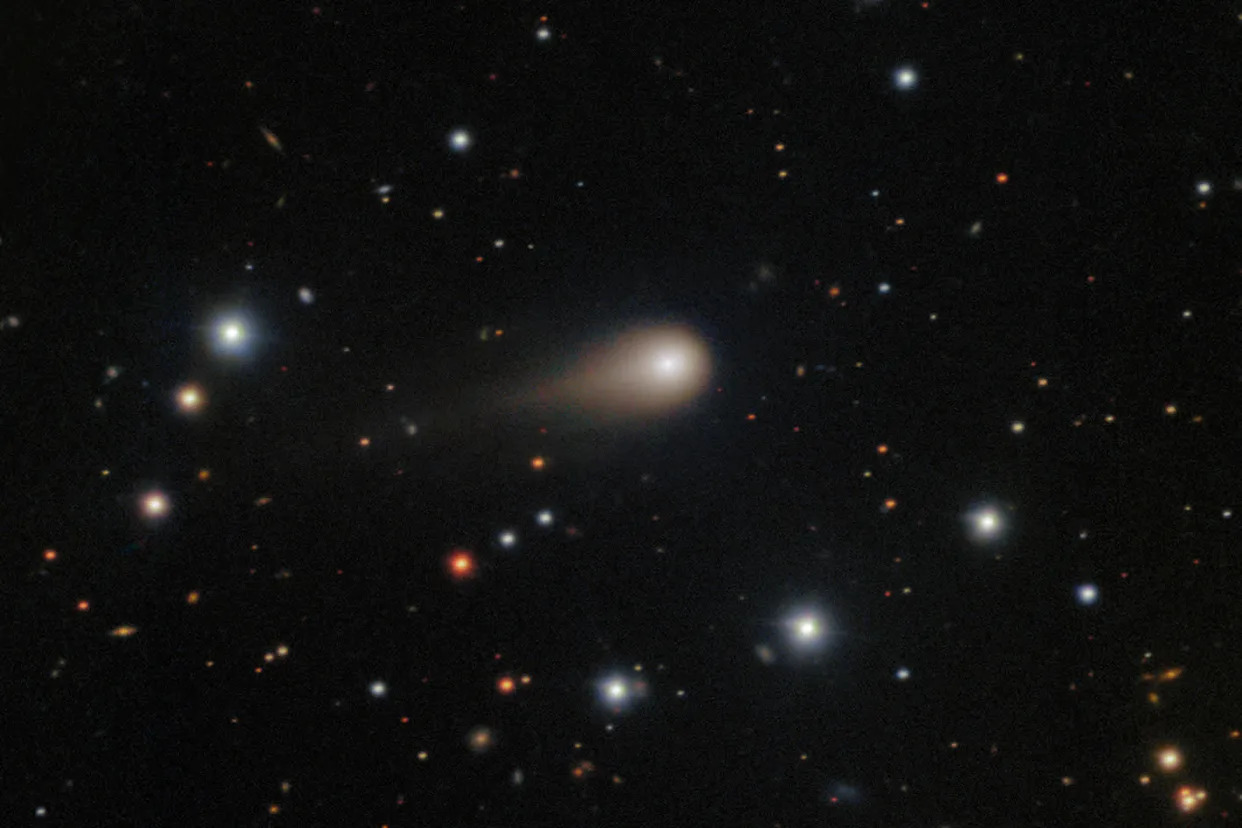
An interstellar comet, designated **3I/ATLAS**, will reach its closest point to the sun on **October 30, 2025**. This remarkable celestial body, which will not approach Earth any closer than **170 million miles**, has captured the interest of astronomers globally due to its unique origins and characteristics.
Discovered on **July 1, 2025**, by the **Asteroid Terrestrial-impact Last Alert System (ATLAS)** survey telescope in **Rio Hurtado, Chile**, Comet 3I/ATLAS is only the third known interstellar object to enter our solar system, according to **NASA**. Earlier observations from telescope archives revealed that the comet had been visible as far back as **June 14**.
Characteristics and Composition
The comet’s nucleus measures between **1,444 feet** and **3.5 miles** in diameter, as determined by observations from the **Hubble Telescope**. Its composition classifies it as a comet because it is primarily made of ice, encased in a bright cloud of gas and dust known as the coma. As 3I/ATLAS approaches the sun, its ice and dust will begin to vaporize, creating the characteristic fuzzy appearance and tail that comets are known for.
Astronomers believe that 3I/ATLAS may have originated billions of years ago, potentially making it older than our solar system itself. This offers a rare opportunity to study materials that have not been influenced by the solar environment.
Understanding Its Trajectory
The trajectory of Comet 3I/ATLAS is classified as hyperbolic, meaning it does not follow a closed orbit around the sun. It is traveling at an impressive speed of approximately **137,000 miles per hour**, which prevents it from being significantly affected by the sun’s gravitational pull.
Despite being in our solar system, astronomers confirm that the comet poses no threat to Earth. NASA has assured the public that it will maintain a safe distance, remaining well beyond the reach of our planet.
As the comet approaches the sun, it will not be visible to the naked eye after early December when it will reemerge on the other side of the sun. Observations will require telescopes to track its movement further along its path.
Scientific Significance
The study of interstellar objects like 3I/ATLAS is crucial for understanding the building blocks of our universe. These cosmic visitors serve as time capsules, potentially containing chemical and physical information about their origins in other star systems.
Interestingly, astronomers have detected atomic nickel vapor from 3I/ATLAS at a great distance from the sun, where temperatures are extremely low—about four times the distance from Earth to the sun. This raises intriguing questions about how nickel can vaporize under such conditions.
Researchers speculate that the nickel atoms may be interacting with carbon monoxide or other organic compounds, which could facilitate the release of nickel at lower temperatures than typically required for direct vaporization.
As Comet 3I/ATLAS approaches its closest point to the sun, astronomers are keenly observing its behavior, hoping to uncover more about its ancient origins and the mysteries of interstellar travel.

Hallmark’s ‘Christmas at the Catnip Café’ Premieres Tonight!

Millville Woman Arrested for Threatening U-Haul Worker with Baton

Japan’s PM Takaichi Confirms Continued Fiscal Management Strategy

Bitcoin Plummets Below $88K Amid Tether Concerns and Warnings

Designers Unveil 5 Urgent Tricks to Transform Outdoor Eyesores

Shark Teeth Research Reveals Urgent Need to Protect Species

Church Members Unite in Resilience After Thanksgiving Fire

Community Unites to Attempt World Record for Largest Cookie Exchange

Mayor Lurie Appoints Alan Wong to District 4 Seat Amid Controversy

University of Hawaiʻi Joins $25.6M AI Initiative to Monitor Disasters

Toledo City League Announces Hall of Fame Inductees for 2024

DOJ Seizes $15 Billion in Bitcoin from Major Crypto Fraud Network

Sharp Launches Five New Aquos QLED 4K Ultra HD Smart TVs

Celtics Coach Joe Mazzulla Dominates Local Media in Scrimmage

Mutual Advisors LLC Increases Stake in SPDR Portfolio ETF

Community Unites for 7th Annual Walk to Raise Mental Health Awareness

Western Executives Confront Harsh Realities of China’s Manufacturing Edge

INK Entertainment Launches Exclusive Sofia Pop-Up at Virgin Hotels
-
Science4 weeks ago
University of Hawaiʻi Joins $25.6M AI Initiative to Monitor Disasters
-
 Lifestyle2 months ago
Toledo City League Announces Hall of Fame Inductees for 2024
-
 Business2 months ago
DOJ Seizes $15 Billion in Bitcoin from Major Crypto Fraud Network
-
 Top Stories2 months ago
Sharp Launches Five New Aquos QLED 4K Ultra HD Smart TVs
-
 Sports2 months ago
Celtics Coach Joe Mazzulla Dominates Local Media in Scrimmage
-
 Politics2 months ago
Mutual Advisors LLC Increases Stake in SPDR Portfolio ETF
-
 Health2 months ago
Community Unites for 7th Annual Walk to Raise Mental Health Awareness
-
 Science2 months ago
Western Executives Confront Harsh Realities of China’s Manufacturing Edge
-
 World2 months ago
INK Entertainment Launches Exclusive Sofia Pop-Up at Virgin Hotels
-

 Politics2 months ago
Major Networks Reject Pentagon’s New Reporting Guidelines
-

 Science1 month ago
Astronomers Discover Twin Cosmic Rings Dwarfing Galaxies
-

 Top Stories1 month ago
Randi Mahomes Launches Game Day Clothing Line with Chiefs