
Science
Interstellar Object 3I/ATLAS Shows Signs of Artificial Engine

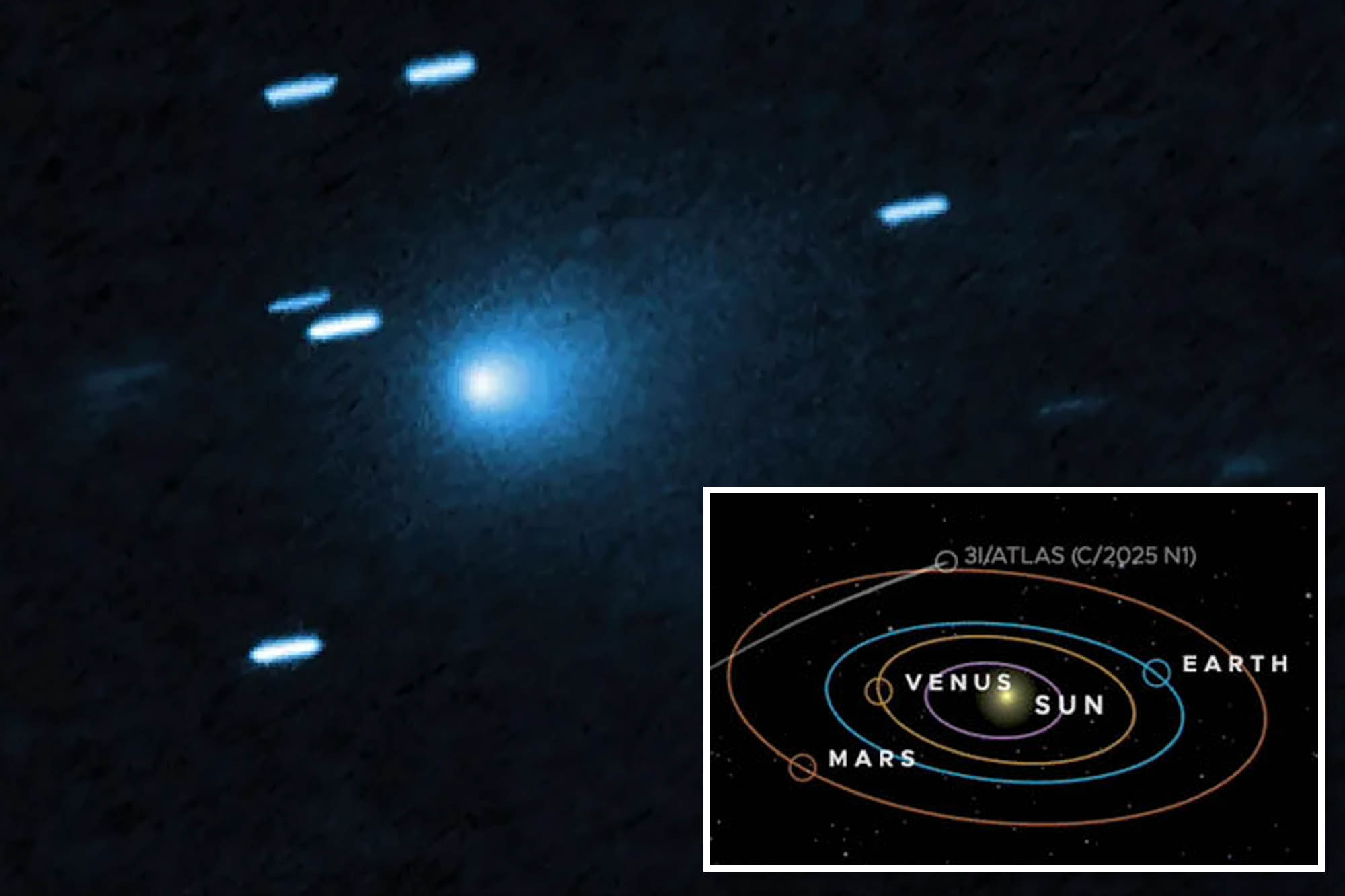
The interstellar object known as 3I/ATLAS has displayed unusual characteristics as it travels through our solar system, including non-gravitational acceleration and a blue hue that is notably brighter than that of the Sun. These observations, made by NASA this week, have sparked speculation from Avi Loeb, a professor of science at Harvard University, who suggests these features could indicate the presence of an artificial propulsion system.
NASA’s recent findings reveal that 3I/ATLAS is experiencing dramatic outgassing, a phenomenon typically associated with comets. This process could result in the object losing up to half its mass and producing a substantial tail of debris in the coming months. In a recent post on Medium, Loeb posited that the object’s acceleration and blue appearance might point to an artificial origin. He stated, “This might also explain the report on 3I/ATLAS getting ‘bluer than the Sun.’”
As 3I/ATLAS approached the Sun, Earth-based telescopes were unable to collect direct measurements, as the planet was positioned on the opposite side of the star. However, spacecraft orbiting the Sun were able to record a “rapid brightening” of the object, which appeared distinctly bluer than the Sun. The US Naval Research Lab has documented these findings, underscoring the unexpected nature of the hue change, which has shifted from red to green before reaching its current blue state.
Upcoming Close Encounter and Implications
The closest approach of 3I/ATLAS to Earth is scheduled for December 19, 2023, when it will pass at a distance of approximately 167 million miles. This event presents a significant opportunity for scientists to determine whether the object is indeed a comet or an artificial craft. Loeb emphasized that if no substantial gas cloud is observed around 3I/ATLAS during this close pass, it could imply the presence of a “propulsion system.”
Loeb has criticized NASA for not releasing images taken by the Mars Reconnaissance Orbiter, which captured the object during its close approach to Mars in early October. Reports suggest these images may not be made public until the government reopens, causing frustration among researchers eager to analyze the data.
In response to growing speculation about the nature of 3I/ATLAS, NASA’s Acting Administrator, Sean Duffy, reassured the public that the object poses no threat. On social media platform X, he stated, “NASA’s observations show that this is the third interstellar comet to pass through our solar system. No aliens. No threat to life here on Earth.”
As researchers continue to study 3I/ATLAS, the scientific community is left to ponder the implications of its unusual characteristics and what they may reveal about the universe beyond our solar system.

Knicks Dominate Raptors 116-94 at Home, Extend Winning Streak

Hallmark’s ‘Christmas at the Catnip Café’ Premieres Tonight!

Millville Woman Arrested for Threatening U-Haul Worker with Baton

Japan’s PM Takaichi Confirms Continued Fiscal Management Strategy

Bitcoin Plummets Below $88K Amid Tether Concerns and Warnings

Designers Unveil 5 Urgent Tricks to Transform Outdoor Eyesores

Shark Teeth Research Reveals Urgent Need to Protect Species

Church Members Unite in Resilience After Thanksgiving Fire

Community Unites to Attempt World Record for Largest Cookie Exchange

University of Hawaiʻi Joins $25.6M AI Initiative to Monitor Disasters

Toledo City League Announces Hall of Fame Inductees for 2024

DOJ Seizes $15 Billion in Bitcoin from Major Crypto Fraud Network

Sharp Launches Five New Aquos QLED 4K Ultra HD Smart TVs

Celtics Coach Joe Mazzulla Dominates Local Media in Scrimmage

Mutual Advisors LLC Increases Stake in SPDR Portfolio ETF

Community Unites for 7th Annual Walk to Raise Mental Health Awareness

Western Executives Confront Harsh Realities of China’s Manufacturing Edge

INK Entertainment Launches Exclusive Sofia Pop-Up at Virgin Hotels
-
Science4 weeks ago
University of Hawaiʻi Joins $25.6M AI Initiative to Monitor Disasters
-
 Lifestyle2 months ago
Toledo City League Announces Hall of Fame Inductees for 2024
-
 Business2 months ago
DOJ Seizes $15 Billion in Bitcoin from Major Crypto Fraud Network
-
 Top Stories2 months ago
Sharp Launches Five New Aquos QLED 4K Ultra HD Smart TVs
-
 Sports2 months ago
Celtics Coach Joe Mazzulla Dominates Local Media in Scrimmage
-
 Politics2 months ago
Mutual Advisors LLC Increases Stake in SPDR Portfolio ETF
-
 Health2 months ago
Community Unites for 7th Annual Walk to Raise Mental Health Awareness
-
 Science2 months ago
Western Executives Confront Harsh Realities of China’s Manufacturing Edge
-
 World2 months ago
INK Entertainment Launches Exclusive Sofia Pop-Up at Virgin Hotels
-

 Politics2 months ago
Major Networks Reject Pentagon’s New Reporting Guidelines
-

 Science1 month ago
Astronomers Discover Twin Cosmic Rings Dwarfing Galaxies
-

 Top Stories1 month ago
Randi Mahomes Launches Game Day Clothing Line with Chiefs