
Science
Researchers Develop Unique Pillar-Cage Framework for Gas Separation

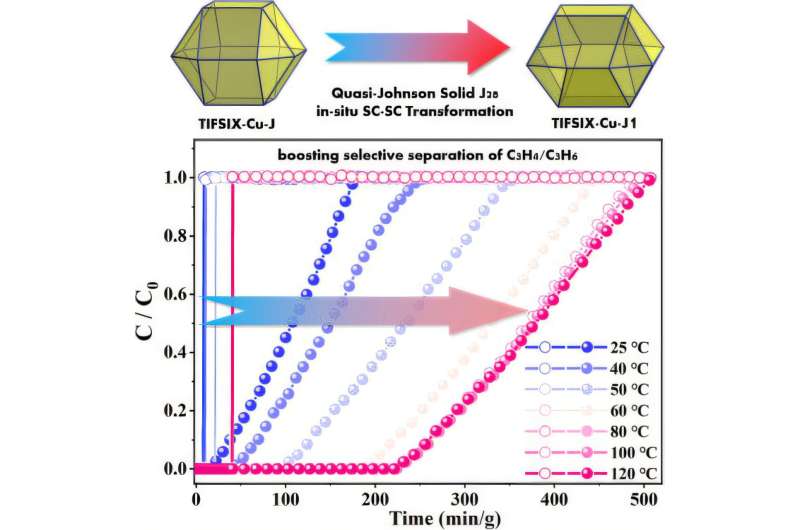
A team of researchers led by Prof. Wu Mingyan from the Fujian Institute of Research on the Structure of Matter, part of the Chinese Academy of Sciences, has introduced a novel approach to synthesizing a unique pillar-cage fluorinated hybrid porous framework named TIFSIX-Cu-J. This framework features a rare crystalline structure known as the quasi-Johnson solid J28, which may have significant implications for gas separation technologies.
The study, published on November 5, 2025, in the journal Chem, details how the researchers created TIFSIX-Cu-J using a bottom-up, self-assembly methodology. This method incorporates geometrical elements of quadrangles and isosceles triangles, leading to a highly organized porous structure. Notably, TIFSIX-Cu-J can undergo a heat-triggered structural transformation, where the initial J28 cage reconfigures into a new distorted square orthobicupola structure.
Significant Findings on Adsorption Capacity
Through a combination of single-crystal-to-single-crystal (SC-SC) transformation studies and bulk crystalline powder X-ray diffraction analysis, the research team elucidated the structural changes of TIFSIX-Cu-J. The findings revealed that TIFSIX-Cu-J1, a variant of the framework, achieved an impressive adsorption capacity of 140.5 cm³·g⁻¹ for propylene (C3H6). Furthermore, the difference in adsorption amounts between propylene and propene increased from 19.6 cm³·g⁻¹ to 34.8 cm³·g⁻¹.
The selectivity of TIFSIX-Cu-J1 was found to be superior, yielding a higher C3H4/C3H6 ideal adsorbed solution theory (IAST) selectivity compared to its predecessor TIFSIX-Cu-J. In practical applications, in-situ breakthrough experiments demonstrated that a packed column of TIFSIX-Cu-J1 could directly produce a significantly higher C3H6 output—approximately twenty times greater than that of TIFSIX-Cu-J.
Implications for Energy-Efficient Gas Purification
The research indicates that the optimized pore surface within the quasi-Johnson solid J28 cavity of TIFSIX-Cu-J1 preferentially captures propylene over propene. This characteristic enhances the selective separation capabilities of the framework, potentially making it valuable for energy-efficient gas purification processes.
This study not only contributes new insights into the design and synthesis of advanced porous frameworks but also emphasizes the effectiveness of the bottom-up, self-assembly approach in constructing artificial cage-like three-dimensional architectures with selective separation properties.
As the field of gas separation continues to evolve, the developments around TIFSIX-Cu-J and its variants could pave the way for novel applications in various industrial separation scenarios, underscoring the importance of innovative materials in addressing energy efficiency challenges.
For further details, refer to the original publication by Cheng Chen and colleagues in Chem.

Rolette Record Transitions to New Ownership in Cando Deal

Reverend Thomas Perry Resigns Amid Controversy Over Conduct

University of Arizona Researchers Discover Key to Preventing Scar Tissue

Missouri Sports Betting Launches Amid Ongoing Scandals

Four Arrested in Australia for Alleged International Child Abuse Ring

Rolette Record Sold to Cando Men: Major Change in Local Media

Marsh & McLennan Faces Challenges as Stock Underperforms Financial Sector

Fire Erupts at Indigo Apartments in OKC, Residents Fearful

Arlene Hartman, Beloved Community Member, Passes at 87

University of Hawaiʻi Joins $25.6M AI Initiative to Monitor Disasters

Toledo City League Announces Hall of Fame Inductees for 2024

DOJ Seizes $15 Billion in Bitcoin from Major Crypto Fraud Network

Sharp Launches Five New Aquos QLED 4K Ultra HD Smart TVs

Celtics Coach Joe Mazzulla Dominates Local Media in Scrimmage

Mutual Advisors LLC Increases Stake in SPDR Portfolio ETF

Community Unites for 7th Annual Walk to Raise Mental Health Awareness

Western Executives Confront Harsh Realities of China’s Manufacturing Edge

INK Entertainment Launches Exclusive Sofia Pop-Up at Virgin Hotels
-
Science4 weeks ago
University of Hawaiʻi Joins $25.6M AI Initiative to Monitor Disasters
-
 Lifestyle2 months ago
Toledo City League Announces Hall of Fame Inductees for 2024
-
 Business2 months ago
DOJ Seizes $15 Billion in Bitcoin from Major Crypto Fraud Network
-
 Top Stories2 months ago
Sharp Launches Five New Aquos QLED 4K Ultra HD Smart TVs
-
 Sports2 months ago
Celtics Coach Joe Mazzulla Dominates Local Media in Scrimmage
-
 Politics2 months ago
Mutual Advisors LLC Increases Stake in SPDR Portfolio ETF
-
 Health2 months ago
Community Unites for 7th Annual Walk to Raise Mental Health Awareness
-
 Science2 months ago
Western Executives Confront Harsh Realities of China’s Manufacturing Edge
-
 World2 months ago
INK Entertainment Launches Exclusive Sofia Pop-Up at Virgin Hotels
-

 Politics2 months ago
Major Networks Reject Pentagon’s New Reporting Guidelines
-

 Science1 month ago
Astronomers Discover Twin Cosmic Rings Dwarfing Galaxies
-

 Top Stories1 month ago
Randi Mahomes Launches Game Day Clothing Line with Chiefs