
Science
Ancient DNA Reveals 8,500-Year-Old Lineage in Argentina

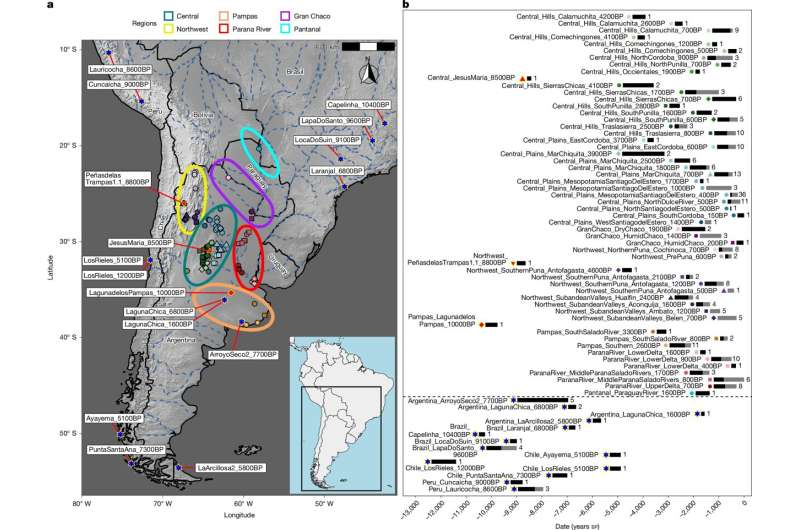
A recent study has uncovered a previously unknown genetic lineage in Argentina that has persisted for at least 8,500 years. Conducted by a team of researchers and published in the journal Nature, this groundbreaking work sheds light on the ancient population history of the central Southern Cone, a region that has seen limited genetic research up until now.
The central Southern Cone, primarily located in Argentina, is recognized as one of the last regions globally to be settled by humans. Although evidence suggests that migration into this area occurred over 12,000 years ago, the genetic lineages associated with these early inhabitants have remained largely unexplored. To address this gap, the research team analyzed ancient DNA from 344 bone and tooth samples, representing 310 individuals who lived between 10,000 and 150 years ago, yielding genome-wide data from 238 of these samples.
Revealing Historical Connections
The researchers enriched ancient DNA libraries for more than 1.2 million targeted single-nucleotide polymorphisms (SNPs) and compared their findings with previously published data from 588 pre-European contact Native Americans, as well as data from present-day Indigenous populations. Through rigorous statistical analyses, the team was able to identify population structures, inter-group mixing, and community sizes.
One of the most significant outcomes was the identification of a deep genetic lineage that has existed in central Argentina for over 8,500 years. This lineage appears to have maintained its presence despite environmental challenges, including severe droughts. The study indicates that modern Argentinians still share genetic ties with this ancient population, emphasizing a continuity that has lasted millennia.
According to the authors, “We found that the central Argentina lineage is geographically structured along two clines, one reflecting admixture with central-Andes-like ancestry and the other with Middle Holocene Pampas-like ancestry.” This lineage became the predominant ancestry in the Pampas region after 800 years ago and expanded southward, intertwining with other groups around 3,300 years ago.
Long-lasting Genetic Isolation
The research highlights that while there was some intermingling among populations, the central Argentina lineage largely maintained genetic homogeneity. There is evidence of multiple languages spoken in the region, yet the study suggests a kinship-based organizational structure that may have contributed to this genetic continuity. Increased instances of close-kin unions, particularly in northwest Argentina, reflect practices similar to those in the central Andes.
The authors note that these patterns may indicate the early adoption of the ayllu system—a social and political unit defined by kinship ties and reciprocity. This system likely fostered cooperation and resource-sharing within communities, further limiting gene flow between different groups for extended periods.
The findings of this study offer a crucial framework for understanding the Indigenous population history within Argentina and the broader Southern Cone. As researchers continue to explore genetic data from underrepresented regions and time periods, they hope to clarify the dynamics of migration and admixture among ancient populations.
This research was led by a team including Javier Maravall-López, with the article reviewed by experts in the field to ensure its credibility. The work not only enhances our understanding of ancient human history in Argentina but also serves as a reminder of the complex narratives that shape our understanding of human migration and cultural exchange.

Urgent: Vehicle Fire Closes Two Lanes on I-215 in Salt Lake City

Knicks Dominate Raptors 116-94 at Home, Extend Winning Streak

Hallmark’s ‘Christmas at the Catnip Café’ Premieres Tonight!

Millville Woman Arrested for Threatening U-Haul Worker with Baton

Japan’s PM Takaichi Confirms Continued Fiscal Management Strategy

Bitcoin Plummets Below $88K Amid Tether Concerns and Warnings

Designers Unveil 5 Urgent Tricks to Transform Outdoor Eyesores

Shark Teeth Research Reveals Urgent Need to Protect Species

Church Members Unite in Resilience After Thanksgiving Fire

University of Hawaiʻi Joins $25.6M AI Initiative to Monitor Disasters

Toledo City League Announces Hall of Fame Inductees for 2024

DOJ Seizes $15 Billion in Bitcoin from Major Crypto Fraud Network

Sharp Launches Five New Aquos QLED 4K Ultra HD Smart TVs

Celtics Coach Joe Mazzulla Dominates Local Media in Scrimmage

Mutual Advisors LLC Increases Stake in SPDR Portfolio ETF

Community Unites for 7th Annual Walk to Raise Mental Health Awareness

Western Executives Confront Harsh Realities of China’s Manufacturing Edge

INK Entertainment Launches Exclusive Sofia Pop-Up at Virgin Hotels
-
Science4 weeks ago
University of Hawaiʻi Joins $25.6M AI Initiative to Monitor Disasters
-
 Lifestyle2 months ago
Toledo City League Announces Hall of Fame Inductees for 2024
-
 Business2 months ago
DOJ Seizes $15 Billion in Bitcoin from Major Crypto Fraud Network
-
 Top Stories2 months ago
Sharp Launches Five New Aquos QLED 4K Ultra HD Smart TVs
-
 Sports2 months ago
Celtics Coach Joe Mazzulla Dominates Local Media in Scrimmage
-
 Politics2 months ago
Mutual Advisors LLC Increases Stake in SPDR Portfolio ETF
-
 Health2 months ago
Community Unites for 7th Annual Walk to Raise Mental Health Awareness
-
 Science2 months ago
Western Executives Confront Harsh Realities of China’s Manufacturing Edge
-
 World2 months ago
INK Entertainment Launches Exclusive Sofia Pop-Up at Virgin Hotels
-

 Politics2 months ago
Major Networks Reject Pentagon’s New Reporting Guidelines
-

 Science1 month ago
Astronomers Discover Twin Cosmic Rings Dwarfing Galaxies
-

 Top Stories1 month ago
Randi Mahomes Launches Game Day Clothing Line with Chiefs