
Science
Scientists Uncover Io’s Extreme Heat, Challenging Past Estimates

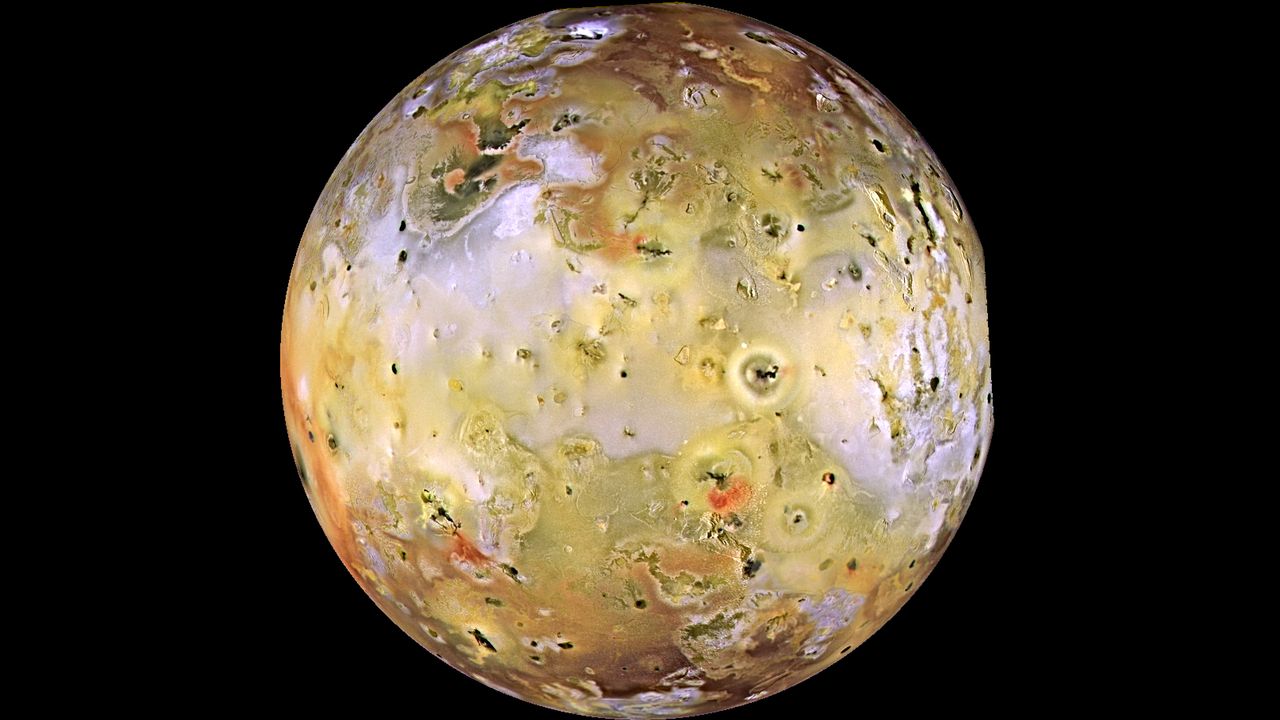
Recent research using data from NASA’s Juno spacecraft reveals that Jupiter’s moon Io, known for its intense volcanic activity, is significantly hotter than previously estimated. Scientists discovered that Io could be emitting heat from its surface at levels hundreds of times greater than earlier calculations suggested. This surprising finding stems from a reinterpretation of Juno’s data rather than a lack of available information.
The study indicates that about half of the heat radiating from Io originates from just 17 of the moon’s 266 recognized volcanic sources. This concentrated thermal emission challenges previous assumptions regarding the existence of a global lava lake beneath Io’s surface, a concept that had been widely theorized.
In a statement, Federico Tosi, the team leader from the National Institute for Astrophysics (INAF), explained, “In recent years, several studies have proposed that the distribution of heat emitted by Io, measured in the infrared spectrum, could help us understand whether a global magma ocean existed beneath its surface.” However, Tosi noted that by comparing their findings with other Juno data and applying more detailed thermal models, they recognized inconsistencies in previous thermal output values.
The research team found that earlier studies predominantly focused on a specific infrared light band known as the M-band. While data collected by the Jovian InfraRed Auroral Mapper (JIRAM) aboard Juno has been crucial for identifying Io’s hottest regions, Tosi pointed out that this band is sensitive only to the highest temperatures. Consequently, it overlooks cooler yet more extensive areas, leading to an underestimation of the total heat being emitted.
Tosi likened this to assessing the brightness of a bonfire by only observing the flames, ignoring the heat radiated by the surrounding embers. “When this ‘hidden’ component is also considered, the actual heat flux is up to hundreds of times higher than that calculated by analyzing the M-band alone,” he added. This recalibration of heat estimates significantly alters the understanding of Io’s energy dynamics.
In light of these new findings, the existence of a global magma ocean beneath Io’s surface cannot be entirely dismissed, although Tosi emphasized that this research does not definitively confirm its presence. “Our caution, therefore, is well-founded: we’re not saying that such an ocean doesn’t exist, but that it can’t be deduced from these observations,” he clarified.
Looking ahead, the research team acknowledges that it may be some time before scientists can conduct detailed observations of Io again. Tosi noted that in 2023 and 2024, Juno executed the most detailed close-up observations of Io ever achieved by a spacecraft. However, due to the spacecraft’s orbital evolution, future opportunities for similar close encounters will be limited.
Upcoming missions, including the European Space Agency’s Juice and NASA’s Europa Clipper, are primarily focused on studying Ganymede and Europa rather than Io and will not provide the same level of spatial resolution. Nonetheless, Tosi believes that the insights gained from this study will enhance the interpretation of remote observations of Io.
These developments may ultimately pave the way for future missions dedicated to Io, allowing scientists to directly observe the processes that drive its remarkable volcanic activity. The team’s findings were published on November 5, 2023, in the journal Frontiers in Astronomy and Space Sciences, providing a new framework for understanding one of the solar system’s most dynamic bodies.

Urgent: Vehicle Fire Closes Two Lanes on I-215 in Salt Lake City

Knicks Dominate Raptors 116-94 at Home, Extend Winning Streak

Hallmark’s ‘Christmas at the Catnip Café’ Premieres Tonight!

Millville Woman Arrested for Threatening U-Haul Worker with Baton

Japan’s PM Takaichi Confirms Continued Fiscal Management Strategy

Bitcoin Plummets Below $88K Amid Tether Concerns and Warnings

Designers Unveil 5 Urgent Tricks to Transform Outdoor Eyesores

Shark Teeth Research Reveals Urgent Need to Protect Species

Church Members Unite in Resilience After Thanksgiving Fire

University of Hawaiʻi Joins $25.6M AI Initiative to Monitor Disasters

Toledo City League Announces Hall of Fame Inductees for 2024

DOJ Seizes $15 Billion in Bitcoin from Major Crypto Fraud Network

Sharp Launches Five New Aquos QLED 4K Ultra HD Smart TVs

Celtics Coach Joe Mazzulla Dominates Local Media in Scrimmage

Community Unites for 7th Annual Walk to Raise Mental Health Awareness

Mutual Advisors LLC Increases Stake in SPDR Portfolio ETF

Western Executives Confront Harsh Realities of China’s Manufacturing Edge

INK Entertainment Launches Exclusive Sofia Pop-Up at Virgin Hotels
-
Science4 weeks ago
University of Hawaiʻi Joins $25.6M AI Initiative to Monitor Disasters
-
 Lifestyle2 months ago
Toledo City League Announces Hall of Fame Inductees for 2024
-
 Business2 months ago
DOJ Seizes $15 Billion in Bitcoin from Major Crypto Fraud Network
-
 Top Stories2 months ago
Sharp Launches Five New Aquos QLED 4K Ultra HD Smart TVs
-
 Sports2 months ago
Celtics Coach Joe Mazzulla Dominates Local Media in Scrimmage
-
 Health2 months ago
Community Unites for 7th Annual Walk to Raise Mental Health Awareness
-
 Politics2 months ago
Mutual Advisors LLC Increases Stake in SPDR Portfolio ETF
-
 Science2 months ago
Western Executives Confront Harsh Realities of China’s Manufacturing Edge
-
 World2 months ago
INK Entertainment Launches Exclusive Sofia Pop-Up at Virgin Hotels
-

 Politics2 months ago
Major Networks Reject Pentagon’s New Reporting Guidelines
-

 Science1 month ago
Astronomers Discover Twin Cosmic Rings Dwarfing Galaxies
-

 Top Stories1 month ago
Randi Mahomes Launches Game Day Clothing Line with Chiefs