
Science
Researchers Unveil AI Tool to Revolutionize Single-Cell Analysis

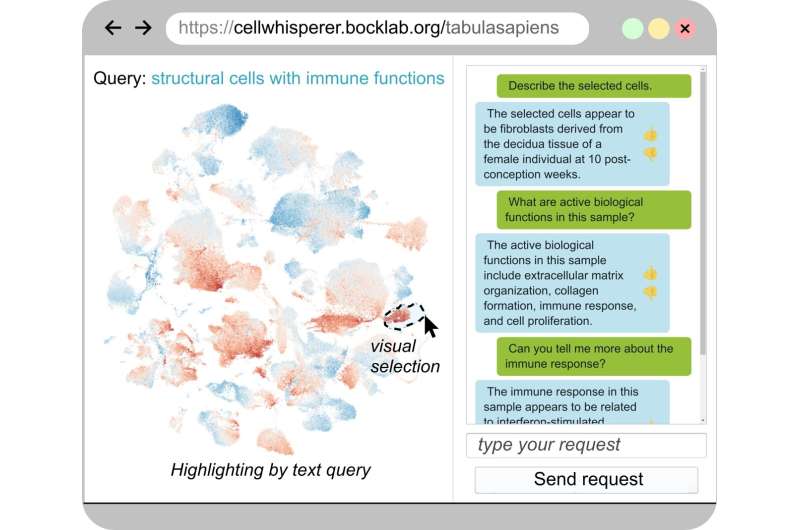
Biomedical researchers have gained a powerful new tool for single-cell data analysis with the introduction of CellWhisperer, an artificial intelligence method developed by a team led by Christoph Bock at the CeMM Research Center for Molecular Medicine in Vienna. This innovative software allows scientists to explore complex biological data using natural language, effectively bridging the gap between advanced computational techniques and biological insights.
Leveraging cutting-edge RNA sequencing technology, researchers can now analyze gene activity across millions of single cells. This creates intricate maps of tissues, organs, and diseases. However, the analysis of such vast datasets typically demands a rare skill set, combining deep biological knowledge with expertise in computer programming. Recognizing this challenge, Bock and his team designed CellWhisperer to serve as a virtual assistant, simplifying the data exploration process.
Transforming Data Interaction
CellWhisperer employs multimodal deep learning, integrating gene expression profiles with curated biological text sourced from public databases. This allows users to conduct text-based queries, such as, “Show me immune cells from the inflamed colon of patients with autoimmune diseases.” The software’s AI capabilities include a large language model trained on interactions between biologists and bioinformaticians, enhancing the user experience by facilitating dialogue that reflects real-world scientific collaboration.
The AI methodology enables researchers to ask CellWhisperer about specific genes and their biological implications in an accessible manner. Co-first author Moritz Schaefer, who previously worked as a Postdoctoral Researcher in Bock’s group and is now at Stanford University, noted the significance of this approach. “By training on experimental data from 20,000 studies over the past two decades, CellWhisperer has learned about the roles of genes and cells, making biomedical data exploration easier and more engaging,” he stated.
Applications and Discoveries
To showcase CellWhisperer’s capabilities, the research team applied it to single-cell RNA sequencing data related to human embryonic development. Through basic queries such as “heart” or “brain,” the AI identified developmental time points, specific cell populations, and marker genes associated with organ formation. Notably, many of these markers aligned with established developmental genes, while others hinted at previously unnoticed candidates.
Co-first author Peter Peneder from the St. Anna Children’s Cancer Research Institute emphasized the collaborative nature of scientific discovery. He remarked, “CellWhisperer is not just making biomedical research easier; it helps me understand what is happening in the cells I study. With this AI research assistant on our team, we can conduct exploratory research more effectively, gaining initial insights from new datasets and directing our focus where it is most needed.”
The research findings were published in Nature Biotechnology on November 11, 2025. Bock highlighted the tool’s potential to enhance scientific inquiry, stating, “CellWhisperer empowers us as human scientists by providing immediate support in understanding complex biological data.”
As AI continues to reshape various fields, CellWhisperer exemplifies how technology can facilitate groundbreaking discoveries in biomedical research. By enabling researchers to engage with complex data through natural language, this innovative tool marks a significant advancement in the exploration of the biological foundations of diseases.

Knicks Dominate Raptors 116-94 at Home, Extend Winning Streak

Hallmark’s ‘Christmas at the Catnip Café’ Premieres Tonight!

Millville Woman Arrested for Threatening U-Haul Worker with Baton

Japan’s PM Takaichi Confirms Continued Fiscal Management Strategy

Bitcoin Plummets Below $88K Amid Tether Concerns and Warnings

Designers Unveil 5 Urgent Tricks to Transform Outdoor Eyesores

Shark Teeth Research Reveals Urgent Need to Protect Species

Church Members Unite in Resilience After Thanksgiving Fire

Community Unites to Attempt World Record for Largest Cookie Exchange

University of Hawaiʻi Joins $25.6M AI Initiative to Monitor Disasters

Toledo City League Announces Hall of Fame Inductees for 2024

DOJ Seizes $15 Billion in Bitcoin from Major Crypto Fraud Network

Sharp Launches Five New Aquos QLED 4K Ultra HD Smart TVs

Celtics Coach Joe Mazzulla Dominates Local Media in Scrimmage

Mutual Advisors LLC Increases Stake in SPDR Portfolio ETF

Community Unites for 7th Annual Walk to Raise Mental Health Awareness

Western Executives Confront Harsh Realities of China’s Manufacturing Edge

INK Entertainment Launches Exclusive Sofia Pop-Up at Virgin Hotels
-
Science4 weeks ago
University of Hawaiʻi Joins $25.6M AI Initiative to Monitor Disasters
-
 Lifestyle2 months ago
Toledo City League Announces Hall of Fame Inductees for 2024
-
 Business2 months ago
DOJ Seizes $15 Billion in Bitcoin from Major Crypto Fraud Network
-
 Top Stories2 months ago
Sharp Launches Five New Aquos QLED 4K Ultra HD Smart TVs
-
 Sports2 months ago
Celtics Coach Joe Mazzulla Dominates Local Media in Scrimmage
-
 Politics2 months ago
Mutual Advisors LLC Increases Stake in SPDR Portfolio ETF
-
 Health2 months ago
Community Unites for 7th Annual Walk to Raise Mental Health Awareness
-
 Science2 months ago
Western Executives Confront Harsh Realities of China’s Manufacturing Edge
-
 World2 months ago
INK Entertainment Launches Exclusive Sofia Pop-Up at Virgin Hotels
-

 Politics2 months ago
Major Networks Reject Pentagon’s New Reporting Guidelines
-

 Science1 month ago
Astronomers Discover Twin Cosmic Rings Dwarfing Galaxies
-

 Top Stories1 month ago
Randi Mahomes Launches Game Day Clothing Line with Chiefs