
Science
Harvard Astronomer Suggests Interstellar Object May Be Using Thrusters

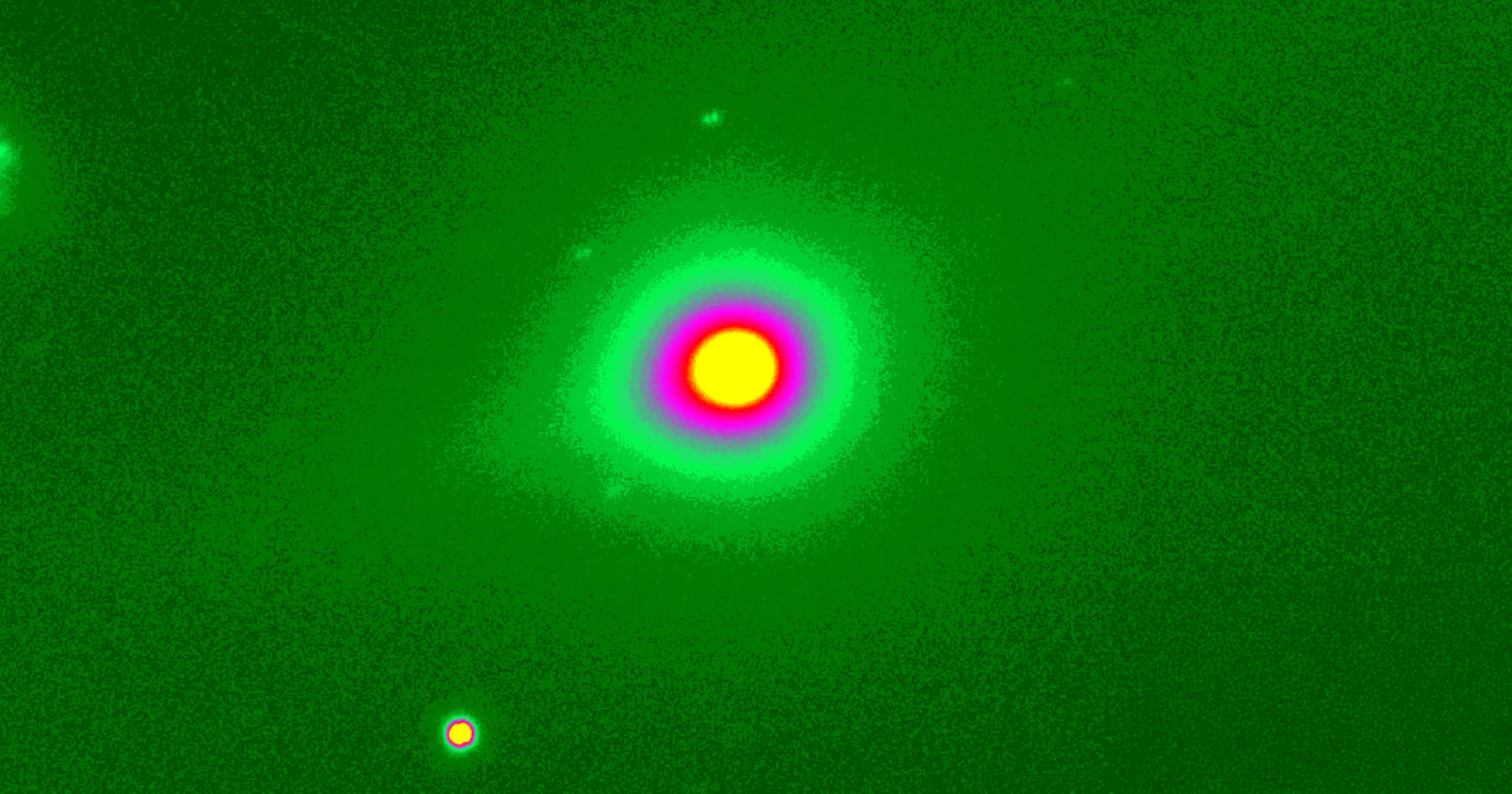
A rare interstellar object, designated 3I/ATLAS, has reappeared from behind the Sun, prompting renewed interest from astronomers. This object, believed to be a comet primarily composed of carbon dioxide ice, is on a highly eccentric trajectory. It is expected to make its closest approach to Earth just days before Christmas in December 2023, as it exits our solar system.
Recent observations indicate that 3I/ATLAS has survived its perihelion, or closest approach to the Sun, largely intact. This contradicts earlier predictions by Avi Loeb, a professor at Harvard University, who speculated that the object might break apart during this phase. New images captured by the Nordic Optical Telescope in the Canary Islands show a single body with no signs of fragmentation. In his follow-up blog post, Loeb acknowledged this finding, stating, “The images show a single body, with no evidence for breakup following the perihelion passage two weeks earlier.”
Loeb noted the presence of a prominent “anti-tail” in these images. This feature, which consists of jets pointing towards the Sun, is thought to be composed of larger dust particles that are less affected by solar radiation. While Loeb interprets this as a potential sign of “thrusters on a technological spacecraft,” he acknowledges that this is only one interpretation among several possibilities.
If 3I/ATLAS is indeed a craft from a technological civilization, Loeb suggests it may be accelerating its exit from the solar system. He explained, “Technological thrusters which point their exhaust towards the Sun would accelerate away from the Sun.” This notion raises intriguing questions about the object’s intentions, especially in light of ongoing global uncertainties.
Loeb’s theory has been met with skepticism from many in the scientific community. For instance, Jason Wright, an astronomer at Pennsylvania State University, has challenged Loeb’s interpretations. He pointed out that the “anti-tail” is not unique and has been observed in previous comets due to large dust grains not being swept up by solar wind.
Despite the pushback, Loeb remains optimistic about the potential implications of 3I/ATLAS. He has suggested that the object might be significantly larger than previously estimated, with a calculated surface area equivalent to a sphere with a diameter of 14.3 miles. This size would imply a substantial mass loss, raising further questions about its nature.
In a previous blog post, Loeb proposed that advanced technology could allow for greater exhaust speeds, thus reducing the mass required for propulsion significantly. He stated, “Alien-tech thrusters might employ yet higher exhaust speeds, reducing the required mass loss by several orders of magnitude.”
Loeb emphasizes the importance of maintaining an open mind regarding these extraordinary claims. “The foundation of science is the curiosity, the humility to learn,” he remarked. As the astronomical community continues to study 3I/ATLAS, Loeb urges patience: “Let’s just wait a few more weeks, we’ll figure it out, and let’s hope that there will be no gifts from this object for the holidays on Earth.”
As this enigmatic object continues its journey, it serves as a reminder of the vast mysteries that still exist in our universe and the potential for groundbreaking discoveries that lie ahead.

Knicks Dominate Raptors 116-94 at Home, Extend Winning Streak

Hallmark’s ‘Christmas at the Catnip Café’ Premieres Tonight!

Millville Woman Arrested for Threatening U-Haul Worker with Baton

Japan’s PM Takaichi Confirms Continued Fiscal Management Strategy

Bitcoin Plummets Below $88K Amid Tether Concerns and Warnings

Designers Unveil 5 Urgent Tricks to Transform Outdoor Eyesores

Shark Teeth Research Reveals Urgent Need to Protect Species

Church Members Unite in Resilience After Thanksgiving Fire

Community Unites to Attempt World Record for Largest Cookie Exchange

University of Hawaiʻi Joins $25.6M AI Initiative to Monitor Disasters

Toledo City League Announces Hall of Fame Inductees for 2024

DOJ Seizes $15 Billion in Bitcoin from Major Crypto Fraud Network

Sharp Launches Five New Aquos QLED 4K Ultra HD Smart TVs

Celtics Coach Joe Mazzulla Dominates Local Media in Scrimmage

Mutual Advisors LLC Increases Stake in SPDR Portfolio ETF

Community Unites for 7th Annual Walk to Raise Mental Health Awareness

Western Executives Confront Harsh Realities of China’s Manufacturing Edge

INK Entertainment Launches Exclusive Sofia Pop-Up at Virgin Hotels
-
Science4 weeks ago
University of Hawaiʻi Joins $25.6M AI Initiative to Monitor Disasters
-
 Lifestyle2 months ago
Toledo City League Announces Hall of Fame Inductees for 2024
-
 Business2 months ago
DOJ Seizes $15 Billion in Bitcoin from Major Crypto Fraud Network
-
 Top Stories2 months ago
Sharp Launches Five New Aquos QLED 4K Ultra HD Smart TVs
-
 Sports2 months ago
Celtics Coach Joe Mazzulla Dominates Local Media in Scrimmage
-
 Politics2 months ago
Mutual Advisors LLC Increases Stake in SPDR Portfolio ETF
-
 Health2 months ago
Community Unites for 7th Annual Walk to Raise Mental Health Awareness
-
 Science2 months ago
Western Executives Confront Harsh Realities of China’s Manufacturing Edge
-
 World2 months ago
INK Entertainment Launches Exclusive Sofia Pop-Up at Virgin Hotels
-

 Politics2 months ago
Major Networks Reject Pentagon’s New Reporting Guidelines
-

 Science1 month ago
Astronomers Discover Twin Cosmic Rings Dwarfing Galaxies
-

 Top Stories1 month ago
Randi Mahomes Launches Game Day Clothing Line with Chiefs