
Science
Study Reveals Finger-Counting Boosts Children’s Math Skills

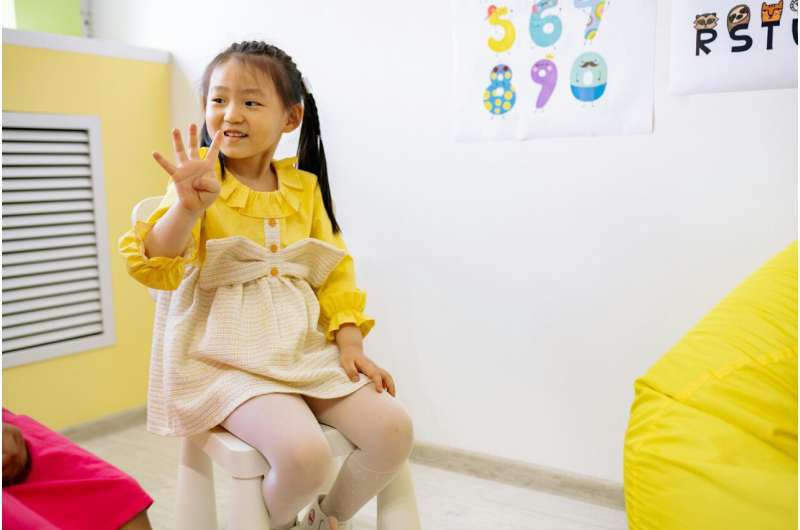
Research published in Developmental Psychology reveals that finger-counting significantly enhances young children’s mathematical abilities. Children aged 4 to 6.5 who utilize their fingers while counting demonstrate superior addition skills by age 7 compared to those who do not, indicating that this practice serves as a vital foundation for advanced math skills.
Lead author Catherine Thevenot, Ph.D., from the University of Lausanne in Switzerland, states, “Finger counting is not just a tool for immediate success in young children, but a way to support the development of advanced abstract arithmetic skills.” Despite this, many teachers discourage finger counting, often interpreting it as a sign of difficulty in grasping numerical concepts. A study in France found that 30% of first-grade teachers consider this method indicative of a child’s struggle with math.
To better understand the implications of finger counting on children’s arithmetic development, Thevenot and her colleague Marie Krenger, Ph.D., tracked the progress of 211 Swiss children from ages 4.5 to 7.5. Their research aimed to clarify whether children who no longer used their fingers had moved on from the practice or had never engaged in it at all.
The study involved assessing the children’s counting strategies over time by administering addition problems of increasing difficulty every six months. The initial tasks involved adding two digits between 1 and 5, then progressing to more complex sums involving digits between 6 and 9. The researchers ensured that children advanced to the next level of difficulty only if they correctly solved 80% of the previous problems. Throughout the assessments, the children were videotaped to observe their finger-counting habits.
By analyzing the data, the researchers found that finger counting peaked between ages 5.5 and 6.5. Interestingly, up until age 5, more children solved addition problems without using their fingers. However, by age 6.5, an impressive 92% of children had incorporated finger counting at least once during testing. By age 7.5, 43% of participants were classified as “ex-finger counters,” meaning they had previously used their fingers but did not rely on them anymore. In contrast, 50% were still using finger counting, while only 7% had never employed this method.
The findings suggest that the highest-performing children were those who had previously used their fingers but had since transitioned away from the practice. Beginning at age 6, these former finger counters outperformed both those who had never counted on their fingers and those who continued to use this method.
The study’s conclusions carry significant implications for educational practices. Thevenot emphasizes the importance of allowing children to use their fingers for solving arithmetic problems, stating, “There is no reason to discourage children in school from using their fingers… This research supports encouraging children to use their fingers in arithmetic without fear that they will become stuck in limited strategies.”
In conclusion, the research underscores the value of finger counting as an effective strategy for enhancing children’s mathematical skills, ultimately encouraging educators to embrace this practice rather than dismiss it as a sign of weakness.
For further details, see the article “The Role of Children’s Finger Counting History on Their Addition Skills” in Developmental Psychology (2025). DOI: 10.1037/dev0002099.

Hallmark’s ‘Christmas at the Catnip Café’ Premieres Tonight!

Millville Woman Arrested for Threatening U-Haul Worker with Baton

Japan’s PM Takaichi Confirms Continued Fiscal Management Strategy

Bitcoin Plummets Below $88K Amid Tether Concerns and Warnings

Designers Unveil 5 Urgent Tricks to Transform Outdoor Eyesores

Shark Teeth Research Reveals Urgent Need to Protect Species

Church Members Unite in Resilience After Thanksgiving Fire

Community Unites to Attempt World Record for Largest Cookie Exchange

Mayor Lurie Appoints Alan Wong to District 4 Seat Amid Controversy

University of Hawaiʻi Joins $25.6M AI Initiative to Monitor Disasters

Toledo City League Announces Hall of Fame Inductees for 2024

DOJ Seizes $15 Billion in Bitcoin from Major Crypto Fraud Network

Sharp Launches Five New Aquos QLED 4K Ultra HD Smart TVs

Celtics Coach Joe Mazzulla Dominates Local Media in Scrimmage

Mutual Advisors LLC Increases Stake in SPDR Portfolio ETF

Community Unites for 7th Annual Walk to Raise Mental Health Awareness

Western Executives Confront Harsh Realities of China’s Manufacturing Edge

INK Entertainment Launches Exclusive Sofia Pop-Up at Virgin Hotels
-
Science4 weeks ago
University of Hawaiʻi Joins $25.6M AI Initiative to Monitor Disasters
-
 Lifestyle2 months ago
Toledo City League Announces Hall of Fame Inductees for 2024
-
 Business2 months ago
DOJ Seizes $15 Billion in Bitcoin from Major Crypto Fraud Network
-
 Top Stories2 months ago
Sharp Launches Five New Aquos QLED 4K Ultra HD Smart TVs
-
 Sports2 months ago
Celtics Coach Joe Mazzulla Dominates Local Media in Scrimmage
-
 Politics2 months ago
Mutual Advisors LLC Increases Stake in SPDR Portfolio ETF
-
 Health2 months ago
Community Unites for 7th Annual Walk to Raise Mental Health Awareness
-
 Science2 months ago
Western Executives Confront Harsh Realities of China’s Manufacturing Edge
-
 World2 months ago
INK Entertainment Launches Exclusive Sofia Pop-Up at Virgin Hotels
-

 Politics2 months ago
Major Networks Reject Pentagon’s New Reporting Guidelines
-

 Science1 month ago
Astronomers Discover Twin Cosmic Rings Dwarfing Galaxies
-

 Top Stories1 month ago
Randi Mahomes Launches Game Day Clothing Line with Chiefs