
Science
Acoustic Radiometer Demonstrates Unique Energy Conversion Method

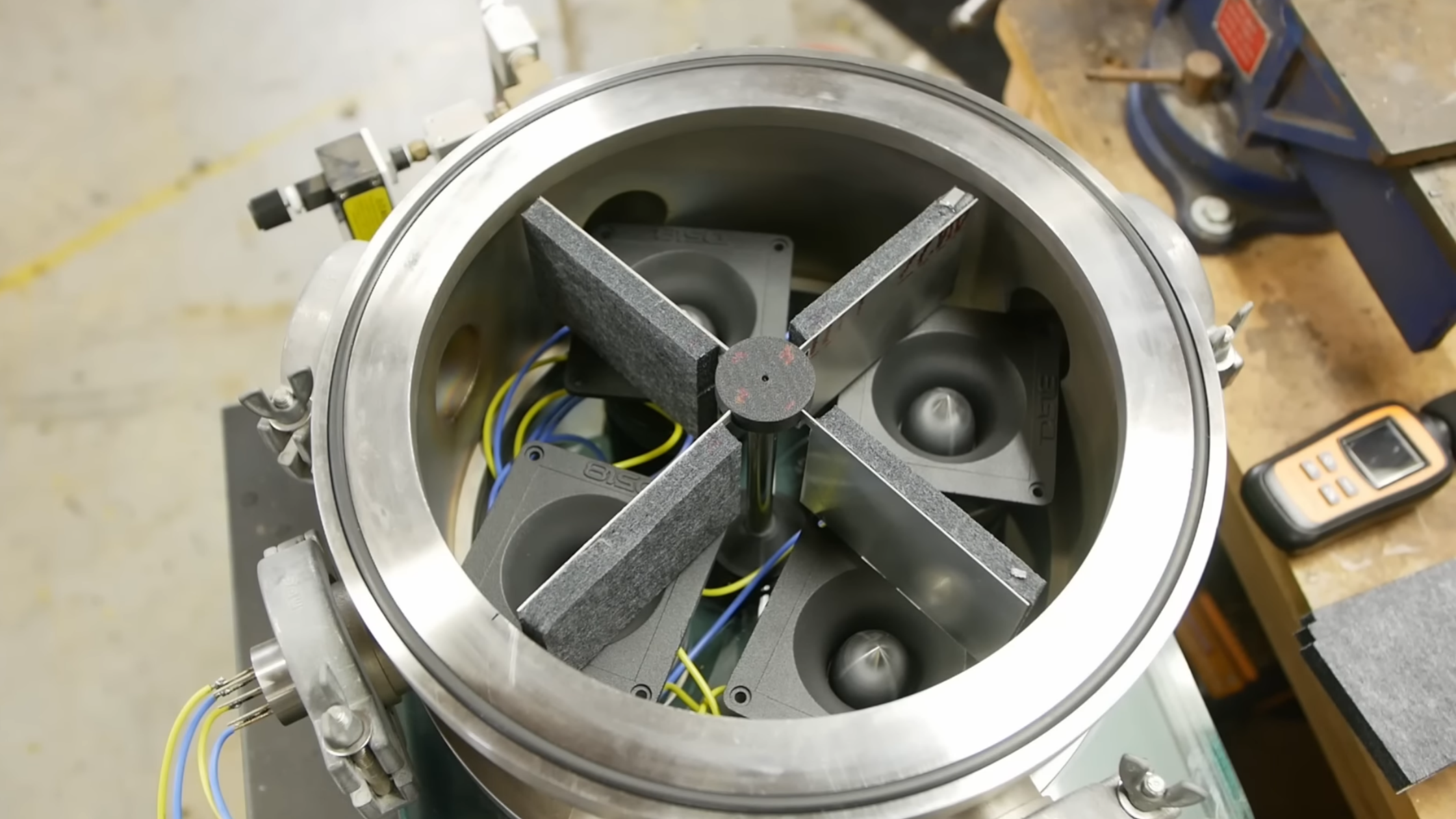
Engineers and physicists continue to explore innovative ways to harness sound energy, as demonstrated by a recent project involving the construction of an acoustic radiometer. This device, built by inventor Ben Krasnow, operates on the principle of acoustic radiation rather than the commonly misunderstood radiation pressure used in traditional Crookes radiometers.
The Crookes radiometer, often misattributed to radiation pressure, actually works by heating vanes inside a near-vacuum chamber. When light strikes these vanes, they gain energy, which then affects gas molecules that come into contact with them. In contrast, Krasnow’s radiometer utilizes sound waves to generate movement, presenting a fresh approach to energy conversion.
Innovative Design and Testing
Krasnow crafted two sets of vanes from laser-cut aluminium, attaching sound-absorbing foam to one side. He mounted these vanes around a jewel bearing sourced from an analog voltmeter, positioning the rotor above four speakers within an acoustically sealed chamber. By playing a sound level of 130 decibels of white noise through the speakers, he created a significant difference in pressure between the two sides of the vanes. The aluminium side, designed to reflect sound more effectively, experienced greater pressure, causing the vanes to spin.
Testing revealed that the vanes spun in opposite directions when the foam was mounted on alternate sides. This outcome demonstrated that the pressure difference caused by the sound waves was indeed responsible for the rotation, rather than an acoustic streaming effect, as initially speculated.
Challenges and Efficiency
Throughout the experimentation, Krasnow faced challenges, particularly with speaker durability. The high volume often led to speaker burnout. To mitigate this, he monitored the temperature of the speaker coil at varying power levels. By observing the increase in resistance as the coil heated, he established a method for calculating its temperature, allowing him to prevent overheating.
Additionally, Krasnow tested the performance of the radiometer with various gases, including hydrogen, helium, carbon dioxide, and sulfur hexafluoride. Surprisingly, none of these gases outperformed air, which is counterintuitive given their differing properties. The results suggest that speakers are optimized for transferring energy to air, making it the most effective medium for this application.
While the acoustic radiometer represents a novel approach to converting electrical power into motion, it is not yet a practical solution for efficient energy conversion. Nevertheless, the exploration of acoustic resonance has previously led to various engines powered by sound, indicating potential for future developments in this area.
For those interested in the intricacies of the original Crookes radiometers, Krasnow has previously provided insightful explanations that delve into their workings, adding context to the advances being made with acoustic technologies. As research in this field progresses, it highlights the creative potential of sound as an energy source.

Hallmark’s ‘Christmas at the Catnip Café’ Premieres Tonight!

Millville Woman Arrested for Threatening U-Haul Worker with Baton

Japan’s PM Takaichi Confirms Continued Fiscal Management Strategy

Bitcoin Plummets Below $88K Amid Tether Concerns and Warnings

Designers Unveil 5 Urgent Tricks to Transform Outdoor Eyesores

Shark Teeth Research Reveals Urgent Need to Protect Species

Church Members Unite in Resilience After Thanksgiving Fire

Community Unites to Attempt World Record for Largest Cookie Exchange

Mayor Lurie Appoints Alan Wong to District 4 Seat Amid Controversy

University of Hawaiʻi Joins $25.6M AI Initiative to Monitor Disasters

Toledo City League Announces Hall of Fame Inductees for 2024

DOJ Seizes $15 Billion in Bitcoin from Major Crypto Fraud Network

Sharp Launches Five New Aquos QLED 4K Ultra HD Smart TVs

Celtics Coach Joe Mazzulla Dominates Local Media in Scrimmage

Mutual Advisors LLC Increases Stake in SPDR Portfolio ETF

Community Unites for 7th Annual Walk to Raise Mental Health Awareness

Western Executives Confront Harsh Realities of China’s Manufacturing Edge

Major Networks Reject Pentagon’s New Reporting Guidelines
-
Science4 weeks ago
University of Hawaiʻi Joins $25.6M AI Initiative to Monitor Disasters
-
 Lifestyle2 months ago
Toledo City League Announces Hall of Fame Inductees for 2024
-
 Business2 months ago
DOJ Seizes $15 Billion in Bitcoin from Major Crypto Fraud Network
-
 Top Stories2 months ago
Sharp Launches Five New Aquos QLED 4K Ultra HD Smart TVs
-
 Sports2 months ago
Celtics Coach Joe Mazzulla Dominates Local Media in Scrimmage
-
 Politics2 months ago
Mutual Advisors LLC Increases Stake in SPDR Portfolio ETF
-
 Health2 months ago
Community Unites for 7th Annual Walk to Raise Mental Health Awareness
-
 Science2 months ago
Western Executives Confront Harsh Realities of China’s Manufacturing Edge
-
 Politics2 months ago
Major Networks Reject Pentagon’s New Reporting Guidelines
-

 World2 months ago
INK Entertainment Launches Exclusive Sofia Pop-Up at Virgin Hotels
-

 Science1 month ago
Astronomers Discover Twin Cosmic Rings Dwarfing Galaxies
-

 Top Stories1 month ago
Randi Mahomes Launches Game Day Clothing Line with Chiefs