
Science
Chang’e-6 Returns Unique Lunar Samples Showing Cohesive Behavior

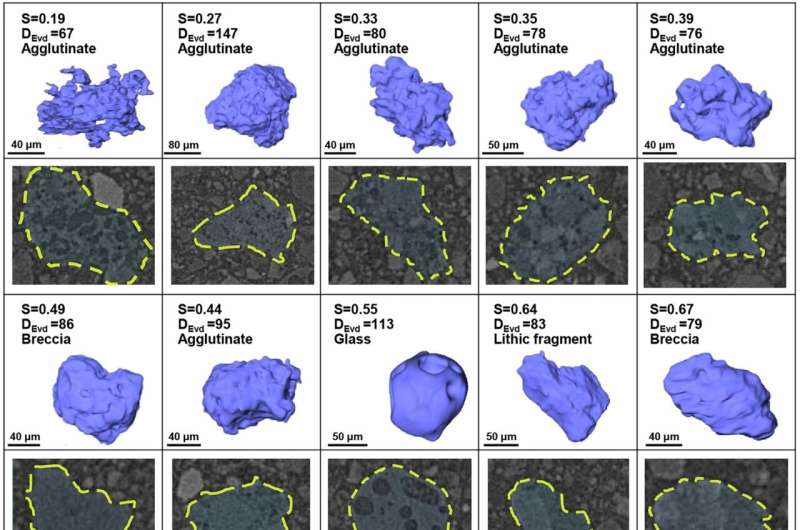
China’s Chang’e-6 mission has successfully returned lunar samples from the far side of the Moon, revealing unique characteristics that could reshape our understanding of lunar geology. On June 25, 2024, the mission retrieved approximately 1,935.3 grams of soil from the South Pole–Aitken Basin, the largest and oldest impact structure on the Moon. This marks a significant addition to the scientific community, as it provides the first samples from an area that has remained largely unexplored.
The analysis of these samples, conducted by a team led by Prof. Qi Shengwen from the Institute of Geology and Geophysics of the Chinese Academy of Sciences, indicates that the lunar soil exhibits notably cohesive behavior. According to Hu Hao, chief designer of the Chang’e-6 mission, the returned samples appear “slightly more viscous and somewhat clumpier” compared to the finer materials gathered during the Chang’e-5 mission.
Understanding Cohesion in Lunar Soil
To quantify the cohesiveness of the Chang’e-6 samples, researchers carried out fixed-funnel and rotating-drum experiments to assess the angle of repose, a critical parameter that reflects how easily granular materials can flow. The findings, published in Nature Astronomy, revealed that the angle of repose for Chang’e-6 soil is significantly higher than that of samples from the Moon’s near side. This suggests that the far-side soil behaves more like cohesive materials.
Further analysis determined that magnetic and cementation effects were not responsible for this elevated angle. The samples contained only trace amounts of magnetic minerals and no clay minerals. Instead, the high cohesion is attributed to three key interparticle forces: friction, van der Waals forces, and electrostatic forces. The friction force, which is influenced by the roughness of particle surfaces, plays a part, but the contributions of van der Waals and electrostatic forces become more pronounced as particle sizes decrease.
Using the D60 metric, which measures the particle diameter at which 60% of the sample is finer, researchers identified a critical size threshold of approximately 100 micrometers. Below this threshold, non-clay mineral particles in the lunar soil begin to demonstrate cohesive behavior. The Chang’e-6 samples had a D60 of just 48.4 micrometers, indicating they are significantly finer and more irregular in shape than near-side soils, with lower particle sphericity.
Implications for Lunar Geology
The unusual morphology of the Chang’e-6 samples has raised questions about the geological processes at work on the far side of the Moon. Prof. Qi noted that, “Finer particles are typically more spherical. Despite being fine-grained, Chang’e-6 soil displays more complex particle morphologies.” This complexity may be influenced by two factors: a higher content of feldspar, approximately 32.6%, which is prone to fragmentation, and more intense space weathering on the Moon’s far side.
The study provides a systematic explanation of the cohesive behavior of lunar soil from a granular mechanics perspective. As scientists continue to analyze the implications of these findings, they may uncover new insights into the physical properties of far-side regolith. This research not only enhances our understanding of the Moon’s history but also lays the groundwork for future lunar exploration and potential resource utilization.
This groundbreaking work exemplifies the importance of sample-return missions in bridging the gap between orbital remote sensing and ground-truth measurements. With the successful return of lunar samples, researchers are now better equipped to explore the Moon’s geological evolution and unique characteristics, paving the way for advancements in planetary science.

Bitcoin Plummets Below $88K Amid Tether Concerns and Warnings

Designers Unveil 5 Urgent Tricks to Transform Outdoor Eyesores

Shark Teeth Research Reveals Urgent Need to Protect Species

Church Members Unite in Resilience After Thanksgiving Fire

Community Unites to Attempt World Record for Largest Cookie Exchange

Mayor Lurie Appoints Alan Wong to District 4 Seat Amid Controversy

Mayor Appoints Alan Wong as New Supervisor for District 4

UK Report Reveals AI’s Role in Evaluating University Research Quality

Gabriela Jaquez Shines as No. 3 UCLA Dominates No. 14 Tennessee

University of Hawaiʻi Joins $25.6M AI Initiative to Monitor Disasters

Toledo City League Announces Hall of Fame Inductees for 2024

DOJ Seizes $15 Billion in Bitcoin from Major Crypto Fraud Network

Sharp Launches Five New Aquos QLED 4K Ultra HD Smart TVs

Celtics Coach Joe Mazzulla Dominates Local Media in Scrimmage

Mutual Advisors LLC Increases Stake in SPDR Portfolio ETF

Community Unites for 7th Annual Walk to Raise Mental Health Awareness

Western Executives Confront Harsh Realities of China’s Manufacturing Edge

INK Entertainment Launches Exclusive Sofia Pop-Up at Virgin Hotels
-
Science4 weeks ago
University of Hawaiʻi Joins $25.6M AI Initiative to Monitor Disasters
-
 Lifestyle2 months ago
Toledo City League Announces Hall of Fame Inductees for 2024
-
 Business2 months ago
DOJ Seizes $15 Billion in Bitcoin from Major Crypto Fraud Network
-
 Top Stories2 months ago
Sharp Launches Five New Aquos QLED 4K Ultra HD Smart TVs
-
 Sports2 months ago
Celtics Coach Joe Mazzulla Dominates Local Media in Scrimmage
-
 Politics2 months ago
Mutual Advisors LLC Increases Stake in SPDR Portfolio ETF
-
 Health2 months ago
Community Unites for 7th Annual Walk to Raise Mental Health Awareness
-
 Science2 months ago
Western Executives Confront Harsh Realities of China’s Manufacturing Edge
-
 World2 months ago
INK Entertainment Launches Exclusive Sofia Pop-Up at Virgin Hotels
-

 Politics2 months ago
Major Networks Reject Pentagon’s New Reporting Guidelines
-

 Science1 month ago
Astronomers Discover Twin Cosmic Rings Dwarfing Galaxies
-

 Top Stories1 month ago
Randi Mahomes Launches Game Day Clothing Line with Chiefs