
Business
Commemorating Rosa Parks: 70 Years of Courage and Protest

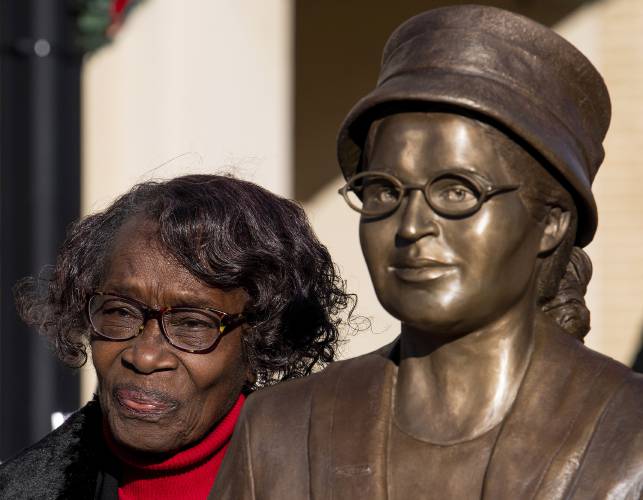
This week marks the 70th anniversary of Rosa Parks‘ arrest on December 1, 1955, for refusing to surrender her bus seat to a white passenger in Montgomery, Alabama. Her act of defiance sparked the Montgomery bus boycott, a pivotal moment in the civil rights movement, leading to significant changes in segregation laws in the United States. During a ceremony honoring Parks, Mary Louise Smith, a plaintiff in the landmark case Browder v. Gayle, stood beside the newly unveiled statue of Parks, emphasizing the collective struggle for justice.
Parks’ courageous choice to remain seated not only made her a global symbol of resistance but also ignited a powerful movement. She herself noted, “Many people don’t know the whole truth … I was just one of many who fought for freedom.” Despite her iconic status, many still struggle to name others who joined her in this fight for equality. Parks’ refusal to yield led to a 381-day boycott of the city’s buses, culminating in a U.S. District Court ruling that declared segregation on public transportation unconstitutional.
Legacy of Nonviolent Protest
The images from the 1956 Montgomery bus boycott became ingrained in the national consciousness, largely through media coverage that highlighted the struggle against segregation. Although this movement achieved a legal victory, it did not instantly transform societal attitudes or governmental actions. Subsequent protests, including boycotts in Tallahassee, Florida, and Jackson, Tennessee, as well as the 1960 student sit-in movement and the 1961 Freedom Rides, kept the momentum alive. These collective actions laid the groundwork for monumental events like the 1963 March on Washington and the Selma to Montgomery March in 1965.
The power of nonviolent protest continued to resonate through history, influencing opposition to the Vietnam War starting in 1965 and manifesting in significant public demonstrations, such as the 2017 Women’s March on Washington and the protests following the murder of George Floyd in 2020. These events underscore the enduring impact of organized, peaceful dissent in advocating for social change.
The Broader Historical Context
The narrative of resistance extends well before Parks’ arrest. In 1834, Black abolitionist David Ruggles faced violent discrimination while traveling and famously declared that he was being robbed of his rights. For the next 130 years, countless individuals, inspired by Ruggles’ example, refused to relinquish their right to equal treatment across various forms of transportation. Figures such as Frederick Douglass, Sojourner Truth, and Ida B. Wells-Barnett became renowned for their leadership, while others like Mary Ellen Pleasant and Bayard Rustin played vital roles that remain less recognized.
The struggle for rights has often come at a high cost, with many activists facing violence or even death for their convictions. This history serves as a reminder that public protest is a necessary tool for change, compelling those in power to recognize and rectify injustices. The right to protest is intrinsically linked to the right to vote, forming the backbone of democratic participation.
As we reflect on the legacy of Rosa Parks, it is essential to recognize that each individual’s participation in protests—regardless of scale—represents a vital expression of the rights to “life, liberty, and the pursuit of happiness.” The collective actions taken over decades demonstrate the enduring power of protest in the quest for justice.
John K. Bollard, a resident of Florence, is the author of “Protesting with Rosa Parks: From Stagecoaches to Driving While Black,” published by University of Georgia Press in 2025. His work explores the historical trajectory of civil rights activism, emphasizing the importance of remembering those who paved the way for today’s movements.

Giants Sign Top Prospect Luis Hernandez to $5M Deal Today

Three Robbers Steal $100,000 in Merchandise from NYC Pokémon Store

Boys Swimming Regular Season Heats Up: Champions Crowned Now

Nancy Cartwright Celebrates Special Bond With Niece Sabrina Carpenter

Insights from J.P. Morgan Healthcare Conference 2026

Save 50% on Ninja Foodi NeverStick Cookware: A Kitchen Revolution

Congress Approves Initial Funding Bills Following Shutdown

Researchers Unveil Breakthrough in Perovskite Display Technology

Pierce Johnson Joins Reds Bullpen, Teams Up with Emilio Pagan

University of Hawaiʻi Joins $25.6M AI Initiative to Monitor Disasters

Interstellar Object 3I/ATLAS Emits Unprecedented Metal Alloy

Toledo City League Announces Hall of Fame Inductees for 2024

DOJ Seizes $15 Billion in Bitcoin from Major Crypto Fraud Network

Western Executives Confront Harsh Realities of China’s Manufacturing Edge

Sharp Launches Five New Aquos QLED 4K Ultra HD Smart TVs

Mutual Advisors LLC Increases Stake in SPDR Portfolio ETF

Community Unites for 7th Annual Walk to Raise Mental Health Awareness

Celtics Coach Joe Mazzulla Dominates Local Media in Scrimmage
-
Science2 months ago
University of Hawaiʻi Joins $25.6M AI Initiative to Monitor Disasters
-
 Science3 months ago
Interstellar Object 3I/ATLAS Emits Unprecedented Metal Alloy
-
 Lifestyle3 months ago
Toledo City League Announces Hall of Fame Inductees for 2024
-
 Business3 months ago
DOJ Seizes $15 Billion in Bitcoin from Major Crypto Fraud Network
-
 Science3 months ago
Western Executives Confront Harsh Realities of China’s Manufacturing Edge
-
 Top Stories3 months ago
Sharp Launches Five New Aquos QLED 4K Ultra HD Smart TVs
-
 Politics3 months ago
Mutual Advisors LLC Increases Stake in SPDR Portfolio ETF
-
 Health3 months ago
Community Unites for 7th Annual Walk to Raise Mental Health Awareness
-
 Sports3 months ago
Celtics Coach Joe Mazzulla Dominates Local Media in Scrimmage
-

 Politics3 months ago
Major Networks Reject Pentagon’s New Reporting Guidelines
-

 World3 months ago
INK Entertainment Launches Exclusive Sofia Pop-Up at Virgin Hotels
-

 Top Stories3 months ago
Microsoft Releases Urgent Windows 11 25H2 Update for All Users