
Science
Boston University Hosts Tenth Annual Materials Day on Automation

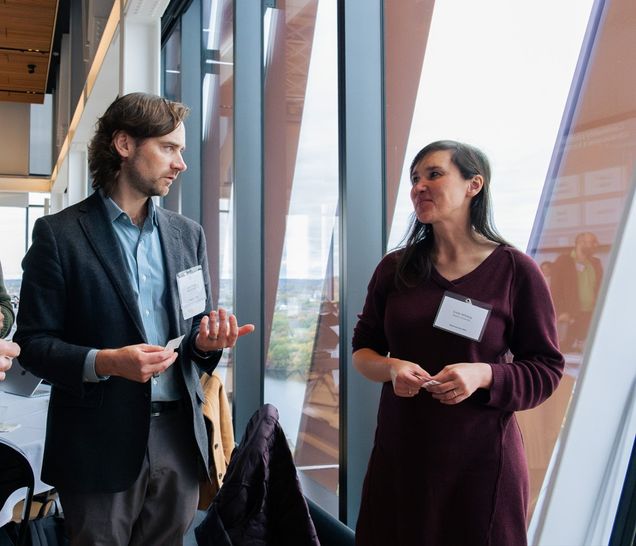
Researchers gathered on the 17th floor of Boston University’s Duan Family Center for Computing & Data Sciences for the tenth annual Materials Day, held on March 7, 2025. This year’s theme, “From Automation to Collaboration: The Future of Self-Driving Labs,” attracted nearly 130 attendees who explored the benefits and challenges of using automation in materials discovery. The event was organized by the Materials Science & Engineering (MSE) division of Boston University’s College of Engineering in collaboration with the Rafik B. Hariri Institute for Computing and Computational Science & Engineering.
Elise Morgan, Dean of the College of Engineering, opened the workshop by emphasizing the importance of a convergent approach in materials research. “We think that convergent approach really helps address the complex challenges that aren’t solvable by single-discipline thinking alone,” she stated. Morgan highlighted the transformative potential of self-driving labs (SDLs) in democratizing materials research and increasing its impact on society. She underscored the necessity of collaboration amidst ongoing threats to research funding.
Innovations in Self-Driving Labs
A self-driving lab is characterized by the use of robotic devices that conduct numerous experiments autonomously, guided by human scientists’ goals. One prominent example is the KABLab, managed by Keith Brown, who served as the event’s organizer and emcee. His lab employs a system known as the Bayesian Experimental Autonomous Researcher (BEAR), which integrates additive manufacturing, robotics, and machine learning to conduct thousands of experiments. This innovative approach led to the discovery of an advanced material optimized for energy absorption, applicable in fields such as crash protection and packaging.
Brown drew a parallel to the historical figure Thomas Edison, noting that Edison’s team tested around 6,000 materials to develop the electric light bulb. “The term ‘Edisonian’ has come to mean a brute-force approach that doesn’t leave room for thought. We need to do a lot of experiments, and automation helps us in this process,” he explained. The advancements in machine learning allow software to select experiments, illustrating the potential for computers to resolve complex problems in research.
Another key speaker, Professor Douglas Densmore, emphasized the value of reproducibility in automated labs. “Higher throughput is great, lower cost is great, but it’s really reproducibility,” he stated. Densmore manages the Design, Automation, Manufacturing and Processes (DAMP) Lab, which processed up to 6,000 COVID-19 tests daily during the pandemic. His lab is now a pivotal resource for synthetic biology researchers aiming to develop genetic materials, utilizing standardized processes that ensure efficiency despite personnel changes.
Exploring Polymer Research and Community Engagement
Assistant Professor Joerg Werner discussed the suitability of SDLs for his research on polymers, materials used in various applications including packaging, coatings, and drug delivery. He noted that the properties of polymers are highly dependent on processing parameters, making them ideal candidates for automation. Werner’s team, alongside collaborators like doctoral student Zhaoyi Zheng, has employed the BEAR DEN to expedite the development of novel polymer thin films using a method known as Electrodeposition of Polymer Networks.
The event also featured speakers from institutions such as MIT, Cornell, and Carnegie Mellon, who discussed various aspects of SDLs, including Bayesian optimization and workforce development. Notably, Nadya Peek from the University of Washington highlighted how DIY and makerspace approaches can facilitate automation. In contrast, Malte Jung of Cornell raised concerns about how automation might impact collaboration among researchers.
Lightning talks by graduate students played a significant role in the day’s agenda. “It’s nice to have the opportunity to share our recent focus with the whole community,” remarked Jiashuo Wang, a doctoral student in the KABLab. These discussions fostered connections among researchers and encouraged future collaborations.
A new feature at this year’s Materials Day was a community ideation exercise. Participants engaged in discussions about open questions and grand challenges related to automation. They placed their thoughts on sticky notes, which were then organized on poster boards covering topics such as hardware, software, and human-machine collaboration. This interactive element sparked lively dialogues, reflecting the collaborative spirit of the event.
As Yannis Paschalidis, Director of the Hariri Institute, noted, gatherings like Materials Day provide invaluable opportunities for scientists to share knowledge and experiences. “Our oral history, this way of sharing is the best we’ve got right now,” he stated. The event underscored the ongoing commitment to advancing materials research through automation, collaboration, and community engagement.

Urgent: Vehicle Fire Closes Two Lanes on I-215 in Salt Lake City

Knicks Dominate Raptors 116-94 at Home, Extend Winning Streak

Hallmark’s ‘Christmas at the Catnip Café’ Premieres Tonight!

Millville Woman Arrested for Threatening U-Haul Worker with Baton

Japan’s PM Takaichi Confirms Continued Fiscal Management Strategy

Bitcoin Plummets Below $88K Amid Tether Concerns and Warnings

Designers Unveil 5 Urgent Tricks to Transform Outdoor Eyesores

Shark Teeth Research Reveals Urgent Need to Protect Species

Church Members Unite in Resilience After Thanksgiving Fire

University of Hawaiʻi Joins $25.6M AI Initiative to Monitor Disasters

Toledo City League Announces Hall of Fame Inductees for 2024

DOJ Seizes $15 Billion in Bitcoin from Major Crypto Fraud Network

Sharp Launches Five New Aquos QLED 4K Ultra HD Smart TVs

Celtics Coach Joe Mazzulla Dominates Local Media in Scrimmage

Mutual Advisors LLC Increases Stake in SPDR Portfolio ETF

Community Unites for 7th Annual Walk to Raise Mental Health Awareness

Western Executives Confront Harsh Realities of China’s Manufacturing Edge

INK Entertainment Launches Exclusive Sofia Pop-Up at Virgin Hotels
-
Science4 weeks ago
University of Hawaiʻi Joins $25.6M AI Initiative to Monitor Disasters
-
 Lifestyle2 months ago
Toledo City League Announces Hall of Fame Inductees for 2024
-
 Business2 months ago
DOJ Seizes $15 Billion in Bitcoin from Major Crypto Fraud Network
-
 Top Stories2 months ago
Sharp Launches Five New Aquos QLED 4K Ultra HD Smart TVs
-
 Sports2 months ago
Celtics Coach Joe Mazzulla Dominates Local Media in Scrimmage
-
 Politics2 months ago
Mutual Advisors LLC Increases Stake in SPDR Portfolio ETF
-
 Health2 months ago
Community Unites for 7th Annual Walk to Raise Mental Health Awareness
-
 Science2 months ago
Western Executives Confront Harsh Realities of China’s Manufacturing Edge
-
 World2 months ago
INK Entertainment Launches Exclusive Sofia Pop-Up at Virgin Hotels
-

 Politics2 months ago
Major Networks Reject Pentagon’s New Reporting Guidelines
-

 Science1 month ago
Astronomers Discover Twin Cosmic Rings Dwarfing Galaxies
-

 Top Stories1 month ago
Randi Mahomes Launches Game Day Clothing Line with Chiefs