
Science
Dark Matter Displays Familiar Behavior in Groundbreaking Study

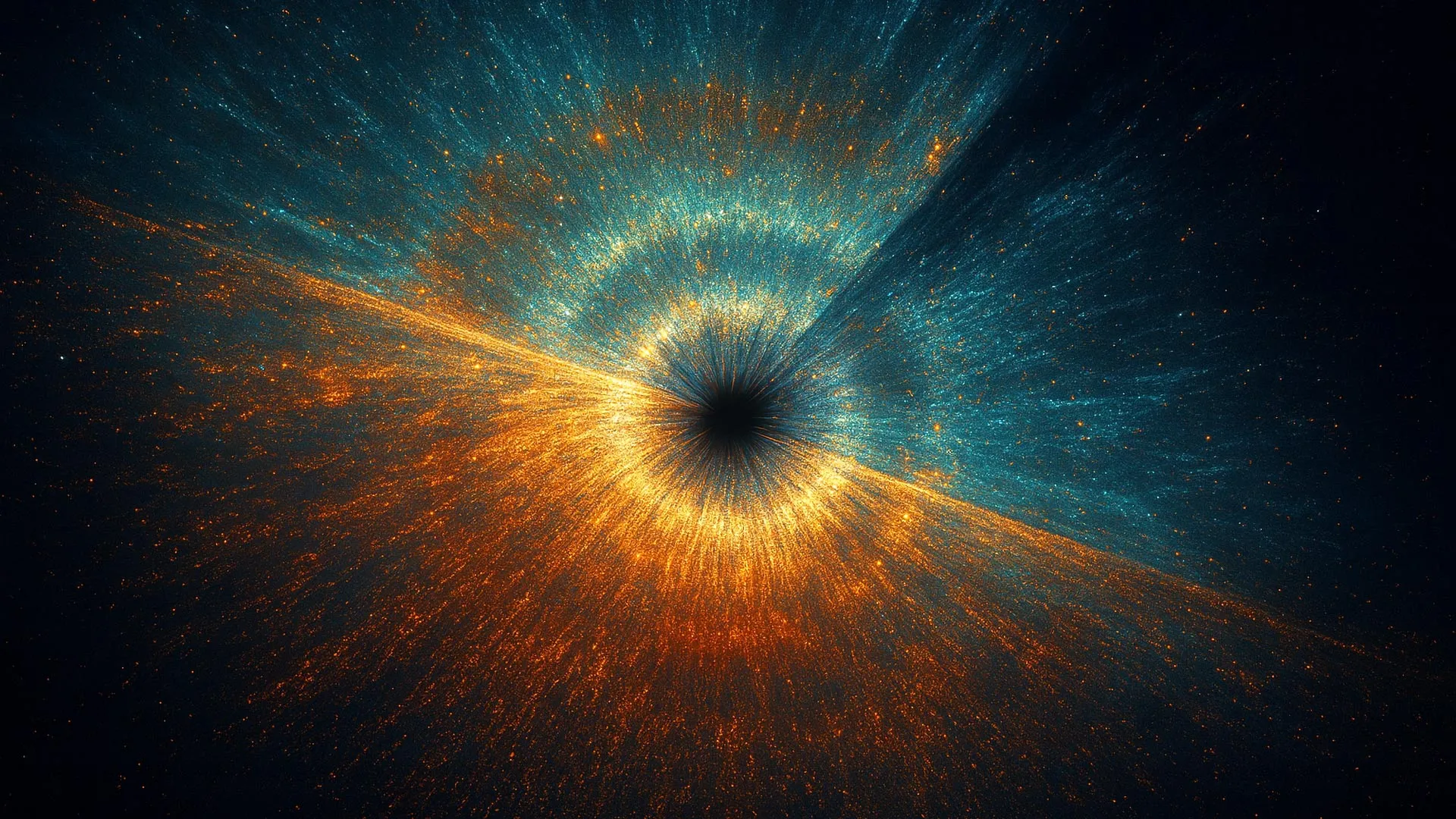
Recent research from the University of Geneva suggests that dark matter behaves in ways similar to ordinary matter, following established physical laws in cosmic settings. The study, published in Nature Communications on November 16, 2025, reveals that dark matter’s movement through gravitational wells aligns closely with how visible matter, like stars and galaxies, operates under known forces.
Dark matter, a form of matter that does not emit or reflect light and is believed to be five times more prevalent than ordinary matter, continues to puzzle scientists. The ongoing question is whether this elusive substance adheres to the same physical principles as its visible counterparts or if it is influenced by an undiscovered force.
Investigating Dark Matter’s Movement
To explore this, researchers led by Camille Bonvin, an associate professor at the Department of Theoretical Physics at the University of Geneva, examined how dark matter interacts with gravitational wells—regions in space where massive objects distort the fabric of space-time. By analyzing the velocities of galaxies relative to the depth of these wells, the team sought to determine if dark matter behaves according to the same rules established by Einstein’s general relativity and Euler’s equations.
Bonvin stated, “If dark matter is not subject to a fifth force, then galaxies—which are mostly made of dark matter—will fall into these wells like ordinary matter, governed solely by gravity.” This comparison allowed the researchers to test for potential hidden forces acting on dark matter.
Findings and Implications
The results indicate that dark matter sinks into gravitational wells similarly to ordinary matter, suggesting it is consistent with Euler’s equations. However, while these conclusions support existing theories, they do not entirely rule out the existence of an unknown force. According to Nastassia Grimm, the first author of the study, “If such a fifth force exists, it cannot exceed 7% of the strength of gravity; otherwise, it would have already been detected in our analyses.”
These findings mark a significant step towards enhancing our understanding of dark matter’s role in the universe. The next challenge for researchers is to ascertain whether a subtle fifth force truly affects dark matter’s behavior. Upcoming experiments, such as the Large Synoptic Survey Telescope (LSST) and the Dark Energy Spectroscopic Instrument (DESI), are expected to provide insights sensitive enough to detect forces as weak as 2% of gravity.
As the scientific community continues to unravel the mysteries of dark matter, this study lays the groundwork for future investigations into the fundamental nature of the universe. Isaac Tutusaus, a researcher at ICE-CSIC and IEEC, emphasized the importance of the upcoming data, stating that it should yield further understanding of dark matter’s behavior.
In summary, while dark matter remains an enigmatic component of the cosmos, its apparent adherence to familiar physical laws opens new avenues for exploration in modern cosmology.

Millville Woman Arrested for Threatening U-Haul Worker with Baton

Japan’s PM Takaichi Confirms Continued Fiscal Management Strategy

Bitcoin Plummets Below $88K Amid Tether Concerns and Warnings

Designers Unveil 5 Urgent Tricks to Transform Outdoor Eyesores

Shark Teeth Research Reveals Urgent Need to Protect Species

Church Members Unite in Resilience After Thanksgiving Fire

Community Unites to Attempt World Record for Largest Cookie Exchange

Mayor Lurie Appoints Alan Wong to District 4 Seat Amid Controversy

Mayor Appoints Alan Wong as New Supervisor for District 4

University of Hawaiʻi Joins $25.6M AI Initiative to Monitor Disasters

Toledo City League Announces Hall of Fame Inductees for 2024

DOJ Seizes $15 Billion in Bitcoin from Major Crypto Fraud Network

Sharp Launches Five New Aquos QLED 4K Ultra HD Smart TVs

Celtics Coach Joe Mazzulla Dominates Local Media in Scrimmage

Mutual Advisors LLC Increases Stake in SPDR Portfolio ETF

Community Unites for 7th Annual Walk to Raise Mental Health Awareness

Western Executives Confront Harsh Realities of China’s Manufacturing Edge

Major Networks Reject Pentagon’s New Reporting Guidelines
-
Science4 weeks ago
University of Hawaiʻi Joins $25.6M AI Initiative to Monitor Disasters
-
 Lifestyle2 months ago
Toledo City League Announces Hall of Fame Inductees for 2024
-
 Business2 months ago
DOJ Seizes $15 Billion in Bitcoin from Major Crypto Fraud Network
-
 Top Stories2 months ago
Sharp Launches Five New Aquos QLED 4K Ultra HD Smart TVs
-
 Sports2 months ago
Celtics Coach Joe Mazzulla Dominates Local Media in Scrimmage
-
 Politics2 months ago
Mutual Advisors LLC Increases Stake in SPDR Portfolio ETF
-
 Health2 months ago
Community Unites for 7th Annual Walk to Raise Mental Health Awareness
-
 Science2 months ago
Western Executives Confront Harsh Realities of China’s Manufacturing Edge
-
 Politics2 months ago
Major Networks Reject Pentagon’s New Reporting Guidelines
-

 World2 months ago
INK Entertainment Launches Exclusive Sofia Pop-Up at Virgin Hotels
-
 Science1 month ago
Astronomers Discover Twin Cosmic Rings Dwarfing Galaxies
-

 Top Stories1 month ago
Randi Mahomes Launches Game Day Clothing Line with Chiefs