
Science
DESI Unveils Surprising Evidence of Evolving Dark Energy

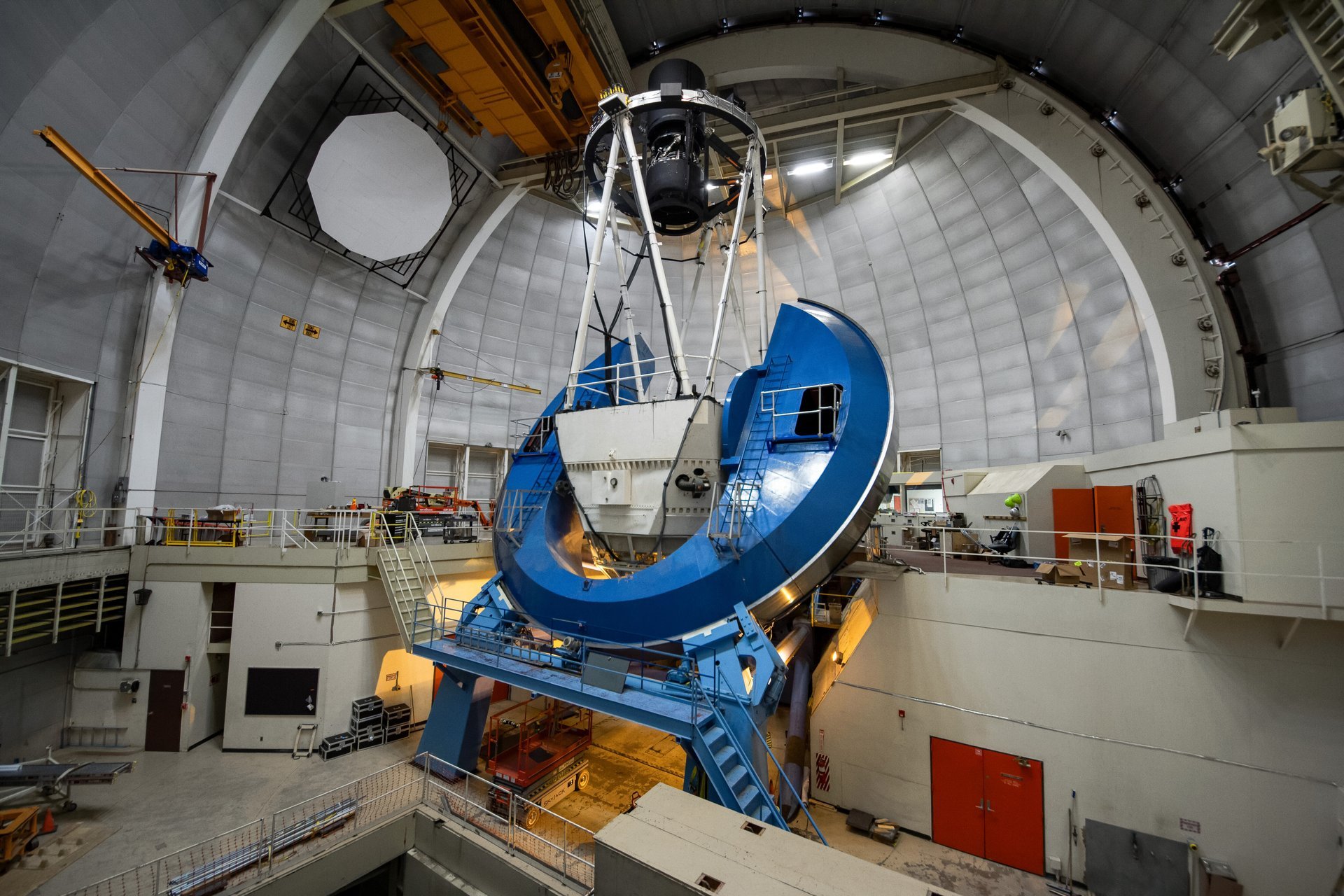
In March 2024, the Dark Energy Spectroscopic Instrument (DESI) revealed intriguing findings that suggest dark energy might be weakening over time. This discovery has sparked considerable interest within the cosmological community, as it challenges established theories regarding the nature of our universe. While the evidence is not definitive, it opens new avenues for exploration and discussion among researchers.
DESI, a sophisticated telescope located on Kitt Peak in southeastern Arizona, is at the forefront of this groundbreaking research. Designed for a comprehensive galaxy survey, the instrument employs 5,000 robotically controlled fiber optic cables to gather data on galaxies throughout the night sky. Over its operational period, DESI has cataloged more than 13 million galaxies, making it the largest and most detailed survey of galaxy positions in history. The ambitious goal is to ultimately observe 50 million galaxies.
By mapping these galaxies, scientists can glean significant insights about the universe’s structure and composition. A key focus of the recent analysis is a phenomenon known as baryon acoustic oscillations (BAO), which provides a framework for understanding the universe’s expansion. BAO refers to the fluctuations in density that occurred in the early universe, resulting in pressure waves that left an imprint on the distribution of galaxies.
To comprehend the significance of BAO, it is essential to consider the conditions of the early universe. Following the Big Bang, the universe was considerably smaller, hotter, and denser. In this primordial state, matter existed as an energized plasma, creating a landscape where sound waves traversed the cosmos. These waves resulted from the interplay between gravitational forces and radiation pressure, leading to regions of varying density.
As the universe expanded and cooled, these sound waves became “frozen” in place, leading to the formation of shells of matter. Today, those shells span approximately 800 million light-years in diameter and serve as a cosmic “standard ruler.” By comparing the expected size of these BAO features with their observed dimensions, researchers can infer details about cosmic evolution and the properties of dark energy.
The latest findings from DESI indicate that the BAO shells do not align perfectly with existing cosmological models. Instead, they suggest a scenario in which dark energy is evolving over time, challenging the long-standing assumption that dark energy remains constant. This revelation raises pivotal questions about the nature of dark energy—an elusive force that is believed to drive the accelerated expansion of the universe.
Understanding dark energy is crucial as it constitutes approximately 68% of the universe’s total energy density. The implications of an evolving dark energy model could reshape our comprehension of cosmic history and the ultimate fate of the universe. As scientists continue to analyze the data gathered by DESI, they remain optimistic about uncovering further insights that could illuminate the mysteries of dark energy.
In conclusion, the revelations from DESI are not merely an academic exercise; they represent a significant shift in our understanding of the universe. As researchers delve deeper into the implications of these findings, the cosmological community is poised for exciting developments that could alter our fundamental perceptions of reality. The journey has only just begun, and the universe still has many secrets to share.

Millville Woman Arrested for Threatening U-Haul Worker with Baton

Japan’s PM Takaichi Confirms Continued Fiscal Management Strategy

Bitcoin Plummets Below $88K Amid Tether Concerns and Warnings

Designers Unveil 5 Urgent Tricks to Transform Outdoor Eyesores

Shark Teeth Research Reveals Urgent Need to Protect Species

Church Members Unite in Resilience After Thanksgiving Fire

Community Unites to Attempt World Record for Largest Cookie Exchange

Mayor Lurie Appoints Alan Wong to District 4 Seat Amid Controversy

Mayor Appoints Alan Wong as New Supervisor for District 4

University of Hawaiʻi Joins $25.6M AI Initiative to Monitor Disasters

Toledo City League Announces Hall of Fame Inductees for 2024

DOJ Seizes $15 Billion in Bitcoin from Major Crypto Fraud Network

Sharp Launches Five New Aquos QLED 4K Ultra HD Smart TVs

Celtics Coach Joe Mazzulla Dominates Local Media in Scrimmage

Community Unites for 7th Annual Walk to Raise Mental Health Awareness

Mutual Advisors LLC Increases Stake in SPDR Portfolio ETF

Western Executives Confront Harsh Realities of China’s Manufacturing Edge

INK Entertainment Launches Exclusive Sofia Pop-Up at Virgin Hotels
-
Science4 weeks ago
University of Hawaiʻi Joins $25.6M AI Initiative to Monitor Disasters
-
 Lifestyle2 months ago
Toledo City League Announces Hall of Fame Inductees for 2024
-
 Business2 months ago
DOJ Seizes $15 Billion in Bitcoin from Major Crypto Fraud Network
-
 Top Stories2 months ago
Sharp Launches Five New Aquos QLED 4K Ultra HD Smart TVs
-
 Sports2 months ago
Celtics Coach Joe Mazzulla Dominates Local Media in Scrimmage
-
 Health2 months ago
Community Unites for 7th Annual Walk to Raise Mental Health Awareness
-
 Politics2 months ago
Mutual Advisors LLC Increases Stake in SPDR Portfolio ETF
-
 Science2 months ago
Western Executives Confront Harsh Realities of China’s Manufacturing Edge
-
 World2 months ago
INK Entertainment Launches Exclusive Sofia Pop-Up at Virgin Hotels
-

 Politics2 months ago
Major Networks Reject Pentagon’s New Reporting Guidelines
-
 Science1 month ago
Astronomers Discover Twin Cosmic Rings Dwarfing Galaxies
-

 Top Stories1 month ago
Randi Mahomes Launches Game Day Clothing Line with Chiefs