
Science
International Collaboration Concludes Record-Breaking Gravitational Wave Run

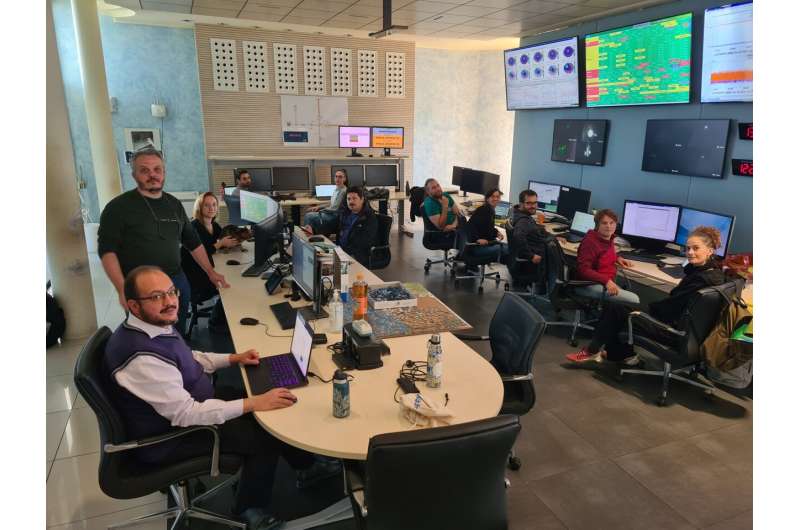
The international gravitational wave detection network, known as the LIGO-Virgo-KAGRA Collaboration, has successfully concluded its fourth observation campaign, referred to as O4. This extensive campaign, which commenced in May 2023, marks a significant milestone in the field of astrophysics, having lasted over two years and yielding approximately 250 new gravitational signals. These signals represent more than two-thirds of the total 350 gravitational signals detected by the collaboration to date.
The increase in detected events is attributed to advancements in detector technologies, which have enhanced the sensitivity of these instruments. As a result, scientists have made numerous groundbreaking discoveries during this observation run, furthering our understanding of compact binary systems and fundamental processes in the universe.
Milestones in Gravitational Wave Research
Gianluca Gemme, spokesperson for the Virgo Collaboration and a researcher at the Italian National Institute for Nuclear Physics, highlighted the significance of this achievement: “The completion of O4 marks a historic milestone: the longest observing run ever conducted by the global gravitational-wave network.” He emphasized the vital role played by Virgo in detecting and analyzing numerous signals, showcasing the strength of international collaboration in scientific research.
Among the notable findings from this observation cycle is the analysis of the event designated GW250114. For the first time, scientists were able to observe the merger of two black holes with unprecedented accuracy, providing empirical support for a theorem proposed by Stephen Hawking in 1971. According to this theorem, the total surface areas of black holes cannot decrease. In this specific merger, the initial black holes had a combined surface area of 240,000 square kilometers, which increased to approximately 400,000 square kilometers after the merger.
Another significant finding was the detection of “second generation” black holes, identified as GW241011 and GW241110. These events exhibited unusual characteristics related to the size and rotational orientation of the black holes, suggesting they are likely the result of earlier mergers. This indicates their formation occurred in extremely dense cosmic environments, such as star clusters, where repeated collisions and mergers of black holes are more common.
Additionally, the event GW231123 marked the observation of the most massive black hole merger recorded to date, resulting in a final black hole exceeding 225 times the mass of our sun. This discovery presents challenges to existing models of stellar evolution and black hole formation, prompting further investigation into the processes that govern these cosmic phenomena.
Looking Ahead: Future Upgrades and Observations
As the collaborative team continues to analyze hundreds of additional events collected during O4, a comprehensive gravitational signal catalog is expected to be published in the coming months. This catalog will include more detailed findings from the various events observed throughout the campaign.
The LIGO, Virgo, and KAGRA interferometers are now preparing for a new phase of technological upgrades and testing, which will likely unfold over the next few years. These enhancements are anticipated to significantly boost the sensitivity of the detectors. A new observation campaign is projected to commence in late summer or early fall of 2026, running for approximately six months.
The successful completion of O4 not only highlights the advancements in gravitational wave detection but also underscores the collaborative efforts of scientists worldwide. As the field progresses, researchers remain optimistic about the potential for further groundbreaking discoveries that could reshape our understanding of the universe.

Bitcoin Plummets Below $88K Amid Tether Concerns and Warnings

Designers Unveil 5 Urgent Tricks to Transform Outdoor Eyesores

Shark Teeth Research Reveals Urgent Need to Protect Species

Church Members Unite in Resilience After Thanksgiving Fire

Community Unites to Attempt World Record for Largest Cookie Exchange

Mayor Lurie Appoints Alan Wong to District 4 Seat Amid Controversy

Mayor Appoints Alan Wong as New Supervisor for District 4

UK Report Reveals AI’s Role in Evaluating University Research Quality

Gabriela Jaquez Shines as No. 3 UCLA Dominates No. 14 Tennessee

University of Hawaiʻi Joins $25.6M AI Initiative to Monitor Disasters

Toledo City League Announces Hall of Fame Inductees for 2024

DOJ Seizes $15 Billion in Bitcoin from Major Crypto Fraud Network

Sharp Launches Five New Aquos QLED 4K Ultra HD Smart TVs

Celtics Coach Joe Mazzulla Dominates Local Media in Scrimmage

Mutual Advisors LLC Increases Stake in SPDR Portfolio ETF

Community Unites for 7th Annual Walk to Raise Mental Health Awareness

Western Executives Confront Harsh Realities of China’s Manufacturing Edge

INK Entertainment Launches Exclusive Sofia Pop-Up at Virgin Hotels
-
Science4 weeks ago
University of Hawaiʻi Joins $25.6M AI Initiative to Monitor Disasters
-
 Lifestyle2 months ago
Toledo City League Announces Hall of Fame Inductees for 2024
-
 Business2 months ago
DOJ Seizes $15 Billion in Bitcoin from Major Crypto Fraud Network
-
 Top Stories2 months ago
Sharp Launches Five New Aquos QLED 4K Ultra HD Smart TVs
-
 Sports2 months ago
Celtics Coach Joe Mazzulla Dominates Local Media in Scrimmage
-
 Politics2 months ago
Mutual Advisors LLC Increases Stake in SPDR Portfolio ETF
-
 Health2 months ago
Community Unites for 7th Annual Walk to Raise Mental Health Awareness
-
 Science2 months ago
Western Executives Confront Harsh Realities of China’s Manufacturing Edge
-
 World2 months ago
INK Entertainment Launches Exclusive Sofia Pop-Up at Virgin Hotels
-

 Politics2 months ago
Major Networks Reject Pentagon’s New Reporting Guidelines
-
 Science1 month ago
Astronomers Discover Twin Cosmic Rings Dwarfing Galaxies
-

 Top Stories1 month ago
Randi Mahomes Launches Game Day Clothing Line with Chiefs