
Science
New Algorithm Transforms Soil Freeze-Thaw Monitoring from Space

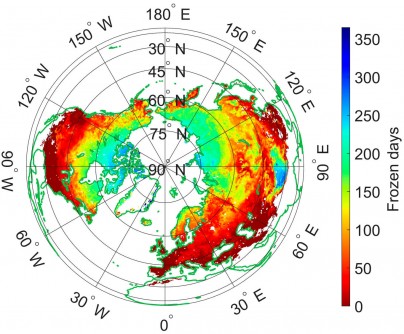
Research conducted by a team from Fudan University, the University of Twente, and Chengdu University of Information Technology has developed a new algorithm that significantly enhances the monitoring of soil freeze-thaw transitions from space. Published on September 10, 2025, in the Journal of Remote Sensing, the study introduces a dynamic parameter optimization framework that improves the accuracy of soil freeze-thaw (FT) detection using data from the Soil Moisture Active Passive (SMAP) satellite.
Soil freeze-thaw transitions influence a range of environmental factors, including surface albedo, moisture levels, and heat fluxes, all of which can impact weather patterns and hydrological cycles. Traditional large-scale models often overlook the daily variations in soil temperature and surface heterogeneity, making accurate monitoring challenging. The new algorithm addresses these shortcomings by utilizing L-band microwave remote sensing, which is sensitive to soil dielectric properties and can penetrate snow and vegetation.
Dynamic Parameters Enhance Accuracy
The existing algorithms based on SMAP data relied on fixed parameters, limiting their effectiveness across diverse land cover and climate conditions. The research team improved the previously established Diurnal Amplitude Variation-based Freeze-Thaw (DAV-FT) algorithm by introducing three dynamically optimized parameters—α, β, and γ—representing detection period, variance window, and threshold sensitivity, respectively. This innovative approach optimizes the parameters to maximize overall classification accuracy across various regions.
The enhanced algorithm effectively distinguishes between freezing and thawing states by analyzing annual variations in L-band brightness temperature observed by SMAP. Results indicate that areas achieving an overall accuracy (OA) greater than 0.7 expanded from 54.43% to 89.36%. Notably, the strongest performance was recorded in regions such as the Qinghai–Tibet Plateau, southwestern Eurasia, and southern North America.
Validation efforts showed the new model’s results align closely with existing datasets, achieving 81.28% consistency with ERA5-Land and 79.54% with SMAP-FT datasets. A validation using 828 in situ soil temperature stations further confirmed the algorithm’s superior accuracy and stability, with a median accuracy of 0.92, surpassing both fixed-parameter models and existing SMAP products.
Implications for Climate Monitoring
Dr. Shaoning Lv, the study’s corresponding author, emphasized the importance of this advancement. “The dynamic parameter optimization significantly enhances our ability to capture subtle soil freeze-thaw transitions that vary across regions and seasons,” he stated. “By reflecting diurnal surface changes in real time, our method not only refines the retrieval accuracy of L-band data but also provides a more physically consistent understanding of land-atmosphere interactions.”
The improved DAV-FT algorithm presents a robust framework for continuous soil freeze-thaw monitoring across diverse terrains. Its adaptability makes it particularly useful in high-latitude and mountainous regions where existing algorithms have struggled. The ability to account for daily temperature cycles and regional variability is crucial for advancing climate modeling, agricultural management, and hydrological forecasting.
By refining the detection of soil states from space, this new methodology strengthens the foundation for assessing permafrost dynamics, water availability, and land-atmosphere energy fluxes—factors that are essential for predicting climate change impacts and enhancing global land-surface models.
This research was funded by several grants, including the National Key R&D Program of China, the Key Research and Development and Achievement Transformation Program of Inner Mongolia Autonomous Region, and the National Natural Science Foundation of China, among others.
The findings not only contribute to the scientific community’s understanding of soil dynamics but also provide practical tools for environmental monitoring and climate action. As climate change continues to evolve, the ability to monitor these critical parameters from space will play an increasingly vital role in global climate assessments.

Japan’s PM Takaichi Confirms Continued Fiscal Management Strategy

Bitcoin Plummets Below $88K Amid Tether Concerns and Warnings

Designers Unveil 5 Urgent Tricks to Transform Outdoor Eyesores

Shark Teeth Research Reveals Urgent Need to Protect Species

Church Members Unite in Resilience After Thanksgiving Fire

Community Unites to Attempt World Record for Largest Cookie Exchange

Mayor Lurie Appoints Alan Wong to District 4 Seat Amid Controversy

Mayor Appoints Alan Wong as New Supervisor for District 4

UK Report Reveals AI’s Role in Evaluating University Research Quality

University of Hawaiʻi Joins $25.6M AI Initiative to Monitor Disasters

Toledo City League Announces Hall of Fame Inductees for 2024

DOJ Seizes $15 Billion in Bitcoin from Major Crypto Fraud Network

Sharp Launches Five New Aquos QLED 4K Ultra HD Smart TVs

Celtics Coach Joe Mazzulla Dominates Local Media in Scrimmage

Mutual Advisors LLC Increases Stake in SPDR Portfolio ETF

Community Unites for 7th Annual Walk to Raise Mental Health Awareness

Western Executives Confront Harsh Realities of China’s Manufacturing Edge

INK Entertainment Launches Exclusive Sofia Pop-Up at Virgin Hotels
-
Science4 weeks ago
University of Hawaiʻi Joins $25.6M AI Initiative to Monitor Disasters
-
 Lifestyle2 months ago
Toledo City League Announces Hall of Fame Inductees for 2024
-
 Business2 months ago
DOJ Seizes $15 Billion in Bitcoin from Major Crypto Fraud Network
-
 Top Stories2 months ago
Sharp Launches Five New Aquos QLED 4K Ultra HD Smart TVs
-
 Sports2 months ago
Celtics Coach Joe Mazzulla Dominates Local Media in Scrimmage
-
 Politics2 months ago
Mutual Advisors LLC Increases Stake in SPDR Portfolio ETF
-
 Health2 months ago
Community Unites for 7th Annual Walk to Raise Mental Health Awareness
-
 Science2 months ago
Western Executives Confront Harsh Realities of China’s Manufacturing Edge
-
 World2 months ago
INK Entertainment Launches Exclusive Sofia Pop-Up at Virgin Hotels
-

 Politics2 months ago
Major Networks Reject Pentagon’s New Reporting Guidelines
-

 Science1 month ago
Astronomers Discover Twin Cosmic Rings Dwarfing Galaxies
-

 Top Stories1 month ago
Randi Mahomes Launches Game Day Clothing Line with Chiefs