
Science
New Research Reveals Risks of Interstellar Objects to Earth

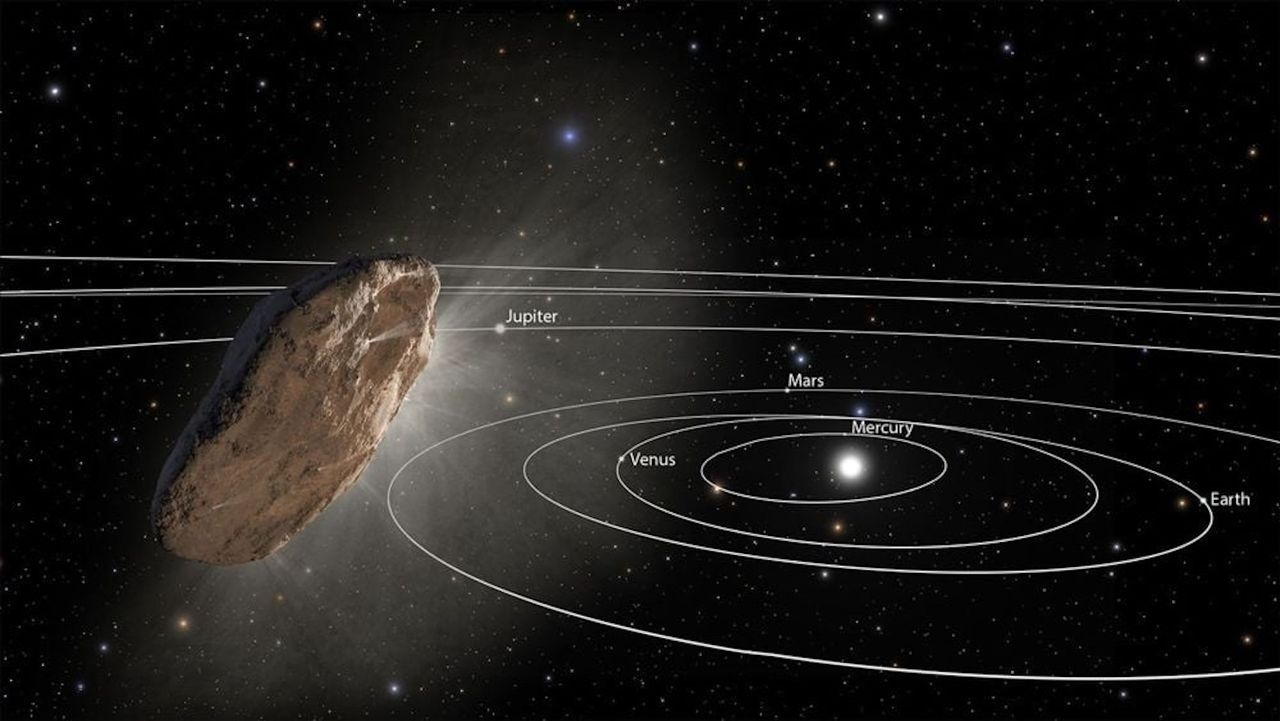
Three known interstellar objects (ISOs) have traversed our inner solar system, with the latest, 3I/ATLAS, currently making its approach. The first, Oumuamua, appeared in 2017, followed by the interstellar comet 2I/Borisov in 2019. As scientists study these cosmic visitors, new research sheds light on the potential impact risks they pose to Earth.
The study, titled “The Distribution of Earth-Impacting Interstellar Objects,” aims to quantify the risk associated with ISOs. It is led by Darryl Seligman, an assistant professor in the Physics and Astronomy Department at Michigan State University. The paper is accessible online at arxiv.org.
Historically, our solar system has experienced numerous chaotic collisions, with many objects potentially impacting Earth, including ancient craters like the Vredefort impact structure. While the solar system has stabilized over its 4.6 billion-year history, the influx of ISOs remains constant, raising concerns about their potential to collide with our planet.
The researchers focused on the orbital elements, radiants, and velocities of ISOs impacting Earth, albeit without concrete numbers due to a lack of constraints on their overall population. Instead, their work delves into the expected distribution of these objects.
A significant focus of the study is on M-star kinematics. M-stars, or red dwarfs, are the most common type of stars in the Milky Way. The researchers suggest that a majority of ISOs likely originate from these star systems. While this assumption is somewhat arbitrary due to the unconstrained nature of ISO kinematics, it provides a foundation for their analysis.
Through simulations, the researchers generated a synthetic population of approximately 10 billion ISOs, aiming to identify around 10,000 Earth-impacting objects. The results indicate that ISOs are more likely to approach Earth from two specific directions: the solar apex and the galactic plane.
The solar apex refers to the direction the Sun moves through its neighborhood in the Milky Way. This increased likelihood is akin to driving in the rain, where one encounters more raindrops when moving in their direction. The galactic plane, being the region with the highest concentration of stars, also presents a higher probability for ISOs, particularly because those approaching from this plane have a greater collisional cross-section.
The findings also reveal that while ISOs from the solar apex and galactic plane typically have higher velocities, the specific subset that could impact Earth tends to travel at lower speeds. This is attributed to the gravitational influence of the Sun, which can capture slower-moving objects and direct them toward Earth-crossing trajectories.
Seasonal variations further influence impact probabilities. The study indicates that ISOs are more likely to arrive in spring when Earth is moving towards the solar apex, while winter presents a higher frequency of potential impactors as Earth faces away from this direction.
Geographically, the research identifies low latitudes near the equator as the zones with the highest risk of ISO impacts. Additionally, there is a slightly elevated risk in the northern hemisphere, which is home to nearly 90% of the global population.
The authors clarify that their findings are specifically applicable to ISOs ejected from M-dwarf systems, and different kinematic assumptions could yield varying distributions. Nonetheless, they assert that the primary insights from their work likely extend to other kinematic scenarios.
It is crucial to note that the research does not predict the actual number of ISOs, as such data remains elusive. The authors explicitly state, “In this paper, we intentionally do not make any definitive predictions about the rates of interstellar impactors.”
As astronomers prepare for upcoming observations with the Vera Rubin Observatory and its Legacy Survey of Space and Time, this research provides valuable insights into the expected distribution of ISOs. These findings will help guide future studies to either support or challenge the current understanding of the risks posed by interstellar objects.
The exploration of ISOs and their potential impact on Earth is an emerging field, and this study marks a significant step in understanding where these objects are likely to originate, when they might strike, and where they could land. As observational capabilities expand, scientists will have the tools to better assess the reality of this cosmic threat.

Shark Teeth Research Reveals Urgent Need to Protect Species

Church Members Unite in Resilience After Thanksgiving Fire

Community Unites to Attempt World Record for Largest Cookie Exchange

Mayor Lurie Appoints Alan Wong to District 4 Seat Amid Controversy

Mayor Appoints Alan Wong as New Supervisor for District 4

UK Report Reveals AI’s Role in Evaluating University Research Quality

Gabriela Jaquez Shines as No. 3 UCLA Dominates No. 14 Tennessee

Trump Promises to Release MRI Results Despite Uncertainty on Scan

Japan’s Q3 Capital Expenditure Slows Despite Surge in Profits

University of Hawaiʻi Joins $25.6M AI Initiative to Monitor Disasters

Toledo City League Announces Hall of Fame Inductees for 2024

DOJ Seizes $15 Billion in Bitcoin from Major Crypto Fraud Network

Sharp Launches Five New Aquos QLED 4K Ultra HD Smart TVs

Celtics Coach Joe Mazzulla Dominates Local Media in Scrimmage

Mutual Advisors LLC Increases Stake in SPDR Portfolio ETF

Community Unites for 7th Annual Walk to Raise Mental Health Awareness

Western Executives Confront Harsh Realities of China’s Manufacturing Edge

INK Entertainment Launches Exclusive Sofia Pop-Up at Virgin Hotels
-
Science4 weeks ago
University of Hawaiʻi Joins $25.6M AI Initiative to Monitor Disasters
-
 Lifestyle2 months ago
Toledo City League Announces Hall of Fame Inductees for 2024
-
 Business2 months ago
DOJ Seizes $15 Billion in Bitcoin from Major Crypto Fraud Network
-
 Top Stories2 months ago
Sharp Launches Five New Aquos QLED 4K Ultra HD Smart TVs
-
 Sports2 months ago
Celtics Coach Joe Mazzulla Dominates Local Media in Scrimmage
-
 Politics2 months ago
Mutual Advisors LLC Increases Stake in SPDR Portfolio ETF
-
 Health2 months ago
Community Unites for 7th Annual Walk to Raise Mental Health Awareness
-
 Science2 months ago
Western Executives Confront Harsh Realities of China’s Manufacturing Edge
-
 World2 months ago
INK Entertainment Launches Exclusive Sofia Pop-Up at Virgin Hotels
-

 Politics2 months ago
Major Networks Reject Pentagon’s New Reporting Guidelines
-

 Science1 month ago
Astronomers Discover Twin Cosmic Rings Dwarfing Galaxies
-

 Top Stories1 month ago
Randi Mahomes Launches Game Day Clothing Line with Chiefs