
Science
Researchers Assess Vulnerability of Shield Tunnels Under Surcharge

Accidental surcharge poses a significant threat to the safety and structural integrity of shield tunnels, crucial components of urban metro systems. Researchers from Tongji University have conducted an in-depth analysis of the vulnerability of these tunnels under extreme surcharge loading. Their study, titled “Vulnerability Analysis of Shield Tunnels Under Surcharge Loading,” introduces a comprehensive framework to assess potential damage, addressing gaps in previous research that primarily focused on seismic hazards.
The study highlights the need for a more nuanced understanding of tunnel vulnerability. Existing literature often overlooks the effects of surcharge—an unpredictable man-made hazard—leading to issues such as horizontal convergence, structural deformations, joint dislocations, and leakage. Many previous analyses rely on singular damage indicators, which can result in misleading assessments, especially when they fail to account for uncertainties in soil parameters and burial depths.
To tackle this issue, the research team, including authors Zhongkai Huang, Hongwei Huang, Nianchen Zeng, and Xianda Shen, developed a two-dimensional numerical model of shield tunnels situated in soft soil. This model was created using ABAQUS software and validated against field monitoring data. The researchers defined specific damage indices, focusing on joint openings at various tunnel locations and horizontal convergence. They categorized damage states into five classifications: none, minor, moderate, extensive damage, and collapse.
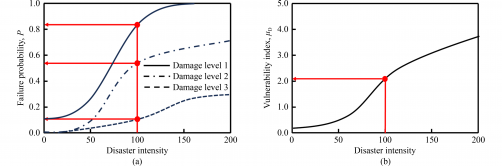
Using Monte Carlo simulations, the team generated fragility curves, which illustrate the probability of reaching a certain damage state, and vulnerability curves, indicating expected damage levels. They employed logistic functions for fragility curves and hyperbolic tangent functions for vulnerability curves, achieving a high fitting accuracy with R² values approaching 1.
The analysis encompassed shield tunnels at varying depths: 8 meters (shallow), 16 meters (moderately deep), and 30 meters (deep). Several key findings emerged from the research. Notably, Joint 2 exhibited the highest failure probability across different surcharge levels. For moderately deep tunnels, vulnerability increased significantly when surcharge levels exceeded 50 kPa. Although deep tunnels initially showed greater vulnerability due to higher soil and water pressure, their response to increased surcharge was less pronounced than that of moderately deep tunnels. Additionally, the vulnerability index based on horizontal convergence was found to exceed that of Joint 1 as surcharge levels rose.
The applied framework has practical implications. In a case study involving the Shanghai Metro Line 2, researchers effectively identified high-risk sections, specifically ring numbers 350–390 and 550–590. This rapid assessment allowed for targeted mitigation measures, such as grouting and the installation of bonded AFRP or steel plates, based on determined vulnerability levels.
The findings of this study contribute to the ongoing discourse on urban underground engineering by providing a structured approach to evaluating tunnel vulnerability under surcharge loading. The full text of the research can be accessed through the link: https://doi.org/10.1007/s11709-025-1193-4.

Hallmark’s ‘Christmas at the Catnip Café’ Premieres Tonight!

Millville Woman Arrested for Threatening U-Haul Worker with Baton

Japan’s PM Takaichi Confirms Continued Fiscal Management Strategy

Bitcoin Plummets Below $88K Amid Tether Concerns and Warnings

Designers Unveil 5 Urgent Tricks to Transform Outdoor Eyesores

Shark Teeth Research Reveals Urgent Need to Protect Species

Church Members Unite in Resilience After Thanksgiving Fire

Community Unites to Attempt World Record for Largest Cookie Exchange

Mayor Lurie Appoints Alan Wong to District 4 Seat Amid Controversy

University of Hawaiʻi Joins $25.6M AI Initiative to Monitor Disasters

Toledo City League Announces Hall of Fame Inductees for 2024

DOJ Seizes $15 Billion in Bitcoin from Major Crypto Fraud Network

Sharp Launches Five New Aquos QLED 4K Ultra HD Smart TVs

Celtics Coach Joe Mazzulla Dominates Local Media in Scrimmage

Mutual Advisors LLC Increases Stake in SPDR Portfolio ETF

Community Unites for 7th Annual Walk to Raise Mental Health Awareness

Western Executives Confront Harsh Realities of China’s Manufacturing Edge

INK Entertainment Launches Exclusive Sofia Pop-Up at Virgin Hotels
-
Science4 weeks ago
University of Hawaiʻi Joins $25.6M AI Initiative to Monitor Disasters
-
 Lifestyle2 months ago
Toledo City League Announces Hall of Fame Inductees for 2024
-
 Business2 months ago
DOJ Seizes $15 Billion in Bitcoin from Major Crypto Fraud Network
-
 Top Stories2 months ago
Sharp Launches Five New Aquos QLED 4K Ultra HD Smart TVs
-
 Sports2 months ago
Celtics Coach Joe Mazzulla Dominates Local Media in Scrimmage
-
 Politics2 months ago
Mutual Advisors LLC Increases Stake in SPDR Portfolio ETF
-
 Health2 months ago
Community Unites for 7th Annual Walk to Raise Mental Health Awareness
-
 Science2 months ago
Western Executives Confront Harsh Realities of China’s Manufacturing Edge
-
 World2 months ago
INK Entertainment Launches Exclusive Sofia Pop-Up at Virgin Hotels
-

 Politics2 months ago
Major Networks Reject Pentagon’s New Reporting Guidelines
-

 Science1 month ago
Astronomers Discover Twin Cosmic Rings Dwarfing Galaxies
-

 Top Stories1 month ago
Randi Mahomes Launches Game Day Clothing Line with Chiefs