
Science
Researchers Capture Atomic Twists of Light in Groundbreaking Study

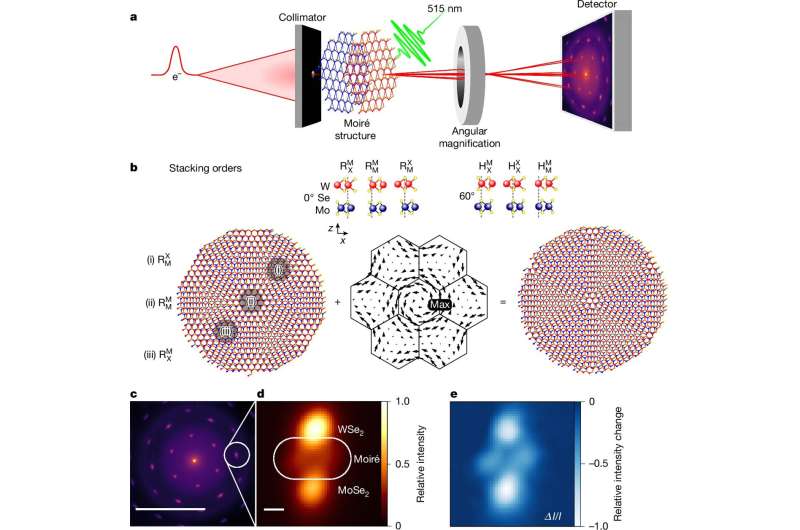
A collaboration between researchers at Cornell University and Stanford University has achieved a significant breakthrough in observing atomic movements triggered by light. Using ultrafast electron diffraction, the team captured the twisting motion of atomically thin materials in a process that occurs in just a trillionth of a second. This pioneering work, published on November 12, 2025 in the journal Nature, reveals new insights into how light can be used to manipulate materials, potentially leading to advancements in superconductivity, magnetism, and quantum electronics.
At the heart of this study is the ability to observe atomic layers in a crystalline structure responding in real time to precisely timed bursts of energy. The researchers found that these layers do not merely remain static once stacked at a fixed angle. Instead, they twist and untwist dynamically, akin to dancers synchronizing their movements to a rhythm. The findings challenge previous assumptions about the rigidity of moiré materials and highlight the fluidity of atomic arrangements under light exposure.
Jared Maxson, a professor of physics at Cornell and co-corresponding author of the paper, explained the significance of the research. “By stacking and twisting these atomically thin layers, you can significantly alter how a material behaves. We’ve shown that we can enhance that twist dynamically with light, and we can actually see it happening,” he stated.
The experimental setup relied on a specialized ultrafast electron diffraction instrument developed in Maxson’s lab. This sophisticated equipment fires intense bursts of electrons at a sample immediately after it has been struck by a laser pulse. This pump-and-probe technique allows researchers to track atomic shifts over time, revealing intricate details of the material’s response.
A crucial component of the experiment was the Electron Microscope Pixel Array Detector (EMPAD), also developed at Cornell. Originally intended for capturing still images, the EMPAD was adapted to function as a sensitive movie camera, enabling the team to capture subtle atomic movements that could have otherwise been obscured. “Most detectors would have blurred out the signal,” Maxson remarked. “The EMPAD let us capture incredibly subtle features.”
The materials used in this groundbreaking research were engineered by Fang Liu, project lead at Stanford, who noted the collaborative effort was essential for success. “There’s no way we could have witnessed this phenomenon without combining materials understanding with electron-beam expertise,” Liu said. “This was a true collaboration.”
The analysis of the data was significantly enhanced by contributions from Cameron Duncan, a doctoral student in Maxson’s group, who played a pivotal role in reconstructing atomic motion from complex diffraction patterns. “We were the first to succeed in finding the ultrafast moiré signal because we customized our home-built hardware specifically to enhance its diffraction-resolving power,” Duncan explained.
Looking ahead, Liu’s lab has already created new moiré samples designed to extend the capabilities of Cornell’s ultrafast instrument. The teams plan to conduct further experiments to explore how different materials and twist angles respond to light, which could deepen their understanding of real-time control over quantum behavior.
This research marks a significant advancement in the field of atomic physics and materials science, paving the way for innovative technologies that leverage light to manipulate material properties at the atomic level. The collaboration between Cornell and Stanford exemplifies the power of interdisciplinary teamwork in addressing complex scientific questions.

Millville Woman Arrested for Threatening U-Haul Worker with Baton

Japan’s PM Takaichi Confirms Continued Fiscal Management Strategy

Bitcoin Plummets Below $88K Amid Tether Concerns and Warnings

Designers Unveil 5 Urgent Tricks to Transform Outdoor Eyesores

Shark Teeth Research Reveals Urgent Need to Protect Species

Church Members Unite in Resilience After Thanksgiving Fire

Community Unites to Attempt World Record for Largest Cookie Exchange

Mayor Lurie Appoints Alan Wong to District 4 Seat Amid Controversy

Mayor Appoints Alan Wong as New Supervisor for District 4

University of Hawaiʻi Joins $25.6M AI Initiative to Monitor Disasters

Toledo City League Announces Hall of Fame Inductees for 2024

DOJ Seizes $15 Billion in Bitcoin from Major Crypto Fraud Network

Sharp Launches Five New Aquos QLED 4K Ultra HD Smart TVs

Celtics Coach Joe Mazzulla Dominates Local Media in Scrimmage

Mutual Advisors LLC Increases Stake in SPDR Portfolio ETF

Community Unites for 7th Annual Walk to Raise Mental Health Awareness

Western Executives Confront Harsh Realities of China’s Manufacturing Edge

INK Entertainment Launches Exclusive Sofia Pop-Up at Virgin Hotels
-
Science4 weeks ago
University of Hawaiʻi Joins $25.6M AI Initiative to Monitor Disasters
-
 Lifestyle2 months ago
Toledo City League Announces Hall of Fame Inductees for 2024
-
 Business2 months ago
DOJ Seizes $15 Billion in Bitcoin from Major Crypto Fraud Network
-
 Top Stories2 months ago
Sharp Launches Five New Aquos QLED 4K Ultra HD Smart TVs
-
 Sports2 months ago
Celtics Coach Joe Mazzulla Dominates Local Media in Scrimmage
-
 Politics2 months ago
Mutual Advisors LLC Increases Stake in SPDR Portfolio ETF
-
 Health2 months ago
Community Unites for 7th Annual Walk to Raise Mental Health Awareness
-
 Science2 months ago
Western Executives Confront Harsh Realities of China’s Manufacturing Edge
-
 World2 months ago
INK Entertainment Launches Exclusive Sofia Pop-Up at Virgin Hotels
-

 Politics2 months ago
Major Networks Reject Pentagon’s New Reporting Guidelines
-

 Science1 month ago
Astronomers Discover Twin Cosmic Rings Dwarfing Galaxies
-

 Top Stories1 month ago
Randi Mahomes Launches Game Day Clothing Line with Chiefs