
Science
Researchers Connect Time Crystals to Boost Quantum Computing Power

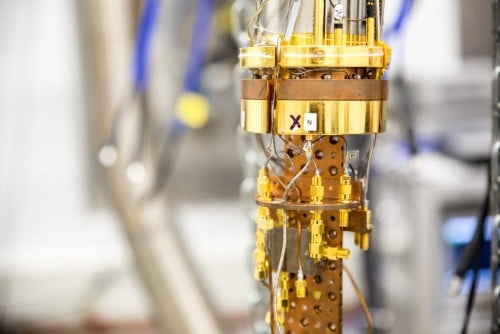
A groundbreaking advancement in quantum technology has emerged from researchers at Aalto University in Finland. They have successfully connected a time crystal to an external system for the first time, potentially revolutionizing quantum computing and sensing capabilities. This innovative approach could significantly enhance the efficiency of quantum memory systems and high-precision measurement devices.
Frank Wilczek, the 2012 Nobel Laureate in Physics, initially proposed the concept of time crystals, which are defined by their ability to maintain a perpetual motion state without external energy input. Experimental verification of time crystals occurred in 2016, but the recent study, led by Academy Research Fellow Jere Mäkinen, marks a pivotal development in their application.
The research team detailed their findings in a study published in Nature Communications on October 16, 2023. They transformed a time crystal into an optomechanical system, creating new possibilities for technologies such as ultra-accurate sensors and advanced memory systems for quantum computers.
Connecting Time Crystals to External Systems
Mäkinen explained the significance of the achievement: “Perpetual motion is possible in the quantum realm as long as it is not disturbed by external energy input, such as by observing it. We connected a time crystal to an external system and demonstrated, for the first time, that we could adjust the crystal’s properties using this method.”
To achieve this connection, the researchers utilized radio waves to introduce magnons—quasiparticles that behave like individual particles—into a superfluid of Helium-3 cooled to near absolute zero. When the radio waves were turned off, the magnons coalesced into a time crystal that sustained motion for an unprecedented duration, lasting up to 10^8 cycles or several minutes before its energy diminished.
During this fading process, the time crystal interacted with a nearby mechanical oscillator. The nature of this interaction was influenced by the oscillator’s frequency and amplitude, showcasing a novel link between the time crystal and classical mechanics.
Implications for Quantum Computing and Sensing
The implications of this research for quantum computing are profound. Mäkinen noted, “Time crystals last for orders of magnitude longer than the quantum systems currently used in quantum computing. In the best-case scenario, they could power the memory systems of quantum computers, significantly improving their performance.”
Time crystals may also function as frequency combs, which are critical in high-sensitivity measurement devices. By enhancing frequency stability and reducing energy loss in mechanical oscillators, this research could pave the way for more advanced quantum technologies.
The facilities utilized for this research included the Low Temperature Laboratory, part of OtaNano, Finland’s national research infrastructure dedicated to nano-, micro-, and quantum technologies. The computational resources were provided by the Aalto Science-IT project, further emphasizing the collaborative nature of this advancement.
As the field of quantum computing continues to evolve, the connection of time crystals to external systems represents a significant step forward, unlocking new pathways for innovation in technology and science.

Shark Teeth Research Reveals Urgent Need to Protect Species

Church Members Unite in Resilience After Thanksgiving Fire

Community Unites to Attempt World Record for Largest Cookie Exchange

Mayor Lurie Appoints Alan Wong to District 4 Seat Amid Controversy

Mayor Appoints Alan Wong as New Supervisor for District 4

UK Report Reveals AI’s Role in Evaluating University Research Quality

Gabriela Jaquez Shines as No. 3 UCLA Dominates No. 14 Tennessee

Trump Promises to Release MRI Results Despite Uncertainty on Scan

Japan’s Q3 Capital Expenditure Slows Despite Surge in Profits

University of Hawaiʻi Joins $25.6M AI Initiative to Monitor Disasters

Toledo City League Announces Hall of Fame Inductees for 2024

DOJ Seizes $15 Billion in Bitcoin from Major Crypto Fraud Network

Sharp Launches Five New Aquos QLED 4K Ultra HD Smart TVs

Celtics Coach Joe Mazzulla Dominates Local Media in Scrimmage

Mutual Advisors LLC Increases Stake in SPDR Portfolio ETF

Community Unites for 7th Annual Walk to Raise Mental Health Awareness

Western Executives Confront Harsh Realities of China’s Manufacturing Edge

INK Entertainment Launches Exclusive Sofia Pop-Up at Virgin Hotels
-
Science4 weeks ago
University of Hawaiʻi Joins $25.6M AI Initiative to Monitor Disasters
-
 Lifestyle2 months ago
Toledo City League Announces Hall of Fame Inductees for 2024
-
 Business2 months ago
DOJ Seizes $15 Billion in Bitcoin from Major Crypto Fraud Network
-
 Top Stories2 months ago
Sharp Launches Five New Aquos QLED 4K Ultra HD Smart TVs
-
 Sports2 months ago
Celtics Coach Joe Mazzulla Dominates Local Media in Scrimmage
-
 Politics2 months ago
Mutual Advisors LLC Increases Stake in SPDR Portfolio ETF
-
 Health2 months ago
Community Unites for 7th Annual Walk to Raise Mental Health Awareness
-
 Science2 months ago
Western Executives Confront Harsh Realities of China’s Manufacturing Edge
-
 World2 months ago
INK Entertainment Launches Exclusive Sofia Pop-Up at Virgin Hotels
-

 Politics2 months ago
Major Networks Reject Pentagon’s New Reporting Guidelines
-

 Science1 month ago
Astronomers Discover Twin Cosmic Rings Dwarfing Galaxies
-

 Top Stories1 month ago
Randi Mahomes Launches Game Day Clothing Line with Chiefs