
Science
Researchers Uncover Key Enzyme in Hops That Shapes Beer’s Flavor

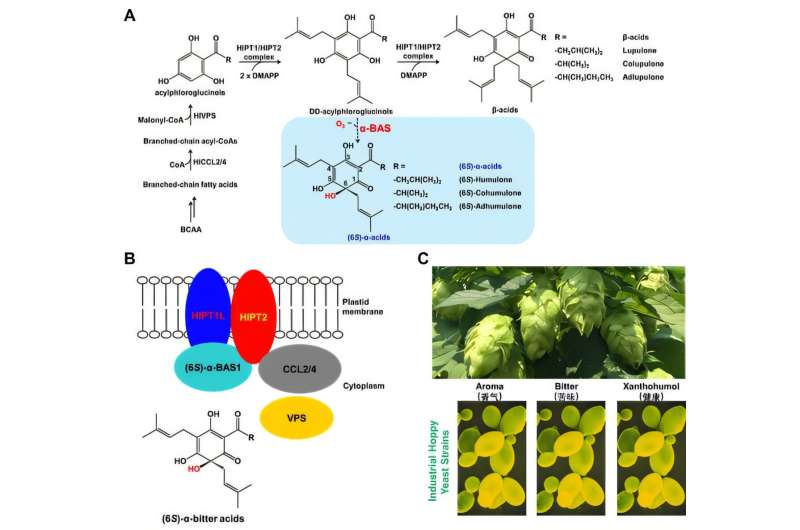
Hops, a fundamental ingredient in beer brewing, have just taken center stage in a significant scientific breakthrough. A research team from the Chinese Academy of Sciences, led by Prof. Wang Guodong, has confirmed the enzyme responsible for producing the key flavor compounds that give beer its characteristic bitterness. This discovery addresses a long-standing question in the field of brewing science.
The female flowers of hops contain specialized metabolites that define beer’s flavor and quality. Among these, α-bitter acids contribute crucial bitterness, while terpenes provide aroma and xanthohumol offers potential health benefits due to its antioxidant properties. Historically, these compounds acted as natural preservatives, enhancing shelf life long before modern brewing technologies were available.
Despite the established biosynthetic pathway for α-bitter acids, the enzyme known as α-bitter acid synthase (α-BAS) had remained functionally unverified for over a decade. Researchers had identified several candidate genes but lacked definitive proof of α-BAS’s role. To tackle this challenge, the team developed a highly sensitive liquid chromatography-mass spectrometry (LC-MS) method. This technique allowed them to distinguish between the two chiral forms of α-bitter acids, specifically the 6S and 6R types.
Their findings, published in the journal Plant Communications, indicated that hop glandular trichomes primarily accumulate the 6S-type α-bitter acid. The team also discovered that the precursor, deoxy-α-bitter acid, undergoes spontaneous oxidation when exposed to air, leading to a racemic mixture of both chiral forms. This spontaneous reaction had previously complicated efforts to confirm α-BAS’s function.
By overcoming this technical barrier, the researchers established a yeast heterologous expression system to systematically analyze more than ten candidate genes. Their efforts led to the identification of HlMO18 as the enzyme that catalyzes the oxidation of deoxy-α-bitter acid to predominantly produce the 6S form.
Further analysis revealed critical amino acid residues essential for the enzyme’s activity. The study also demonstrated that 6S-type α-bitter acid synthase forms a metabolic complex with upstream enzymes, explaining why only the 6S form accumulates in hop glandular trichomes. This research completes the biosynthetic map of α-bitter acids in hops and offers valuable insights for the brewing industry.
Looking ahead, the research team plans to harness synthetic biology to engineer industrial yeast strains capable of producing “hoppy beer.” This innovative approach aims to replicate authentic hop flavors without using hop plants, potentially reducing production costs and allowing for the creation of more customized and flavor-rich beers.
This breakthrough not only enhances our understanding of hops but also suggests new avenues for innovation in the brewing industry. The implications of this research could alter traditional brewing methods, paving the way for a new era of beer production.
For further details, refer to the study by Chengyong Feng et al., titled “A flavin-dependent monooxygenase favors the formation of (6S)-α-bitter acids in hop glandular trichomes,” published on November 5, 2025.

Knicks Dominate Raptors 116-94 at Home, Extend Winning Streak

Hallmark’s ‘Christmas at the Catnip Café’ Premieres Tonight!

Millville Woman Arrested for Threatening U-Haul Worker with Baton

Japan’s PM Takaichi Confirms Continued Fiscal Management Strategy

Bitcoin Plummets Below $88K Amid Tether Concerns and Warnings

Designers Unveil 5 Urgent Tricks to Transform Outdoor Eyesores

Shark Teeth Research Reveals Urgent Need to Protect Species

Church Members Unite in Resilience After Thanksgiving Fire

Community Unites to Attempt World Record for Largest Cookie Exchange

University of Hawaiʻi Joins $25.6M AI Initiative to Monitor Disasters

Toledo City League Announces Hall of Fame Inductees for 2024

DOJ Seizes $15 Billion in Bitcoin from Major Crypto Fraud Network

Sharp Launches Five New Aquos QLED 4K Ultra HD Smart TVs

Celtics Coach Joe Mazzulla Dominates Local Media in Scrimmage

Mutual Advisors LLC Increases Stake in SPDR Portfolio ETF

Community Unites for 7th Annual Walk to Raise Mental Health Awareness

Western Executives Confront Harsh Realities of China’s Manufacturing Edge

Major Networks Reject Pentagon’s New Reporting Guidelines
-
Science4 weeks ago
University of Hawaiʻi Joins $25.6M AI Initiative to Monitor Disasters
-
 Lifestyle2 months ago
Toledo City League Announces Hall of Fame Inductees for 2024
-
 Business2 months ago
DOJ Seizes $15 Billion in Bitcoin from Major Crypto Fraud Network
-
 Top Stories2 months ago
Sharp Launches Five New Aquos QLED 4K Ultra HD Smart TVs
-
 Sports2 months ago
Celtics Coach Joe Mazzulla Dominates Local Media in Scrimmage
-
 Politics2 months ago
Mutual Advisors LLC Increases Stake in SPDR Portfolio ETF
-
 Health2 months ago
Community Unites for 7th Annual Walk to Raise Mental Health Awareness
-
 Science2 months ago
Western Executives Confront Harsh Realities of China’s Manufacturing Edge
-
 Politics2 months ago
Major Networks Reject Pentagon’s New Reporting Guidelines
-

 World2 months ago
INK Entertainment Launches Exclusive Sofia Pop-Up at Virgin Hotels
-

 Science1 month ago
Astronomers Discover Twin Cosmic Rings Dwarfing Galaxies
-

 Top Stories1 month ago
Randi Mahomes Launches Game Day Clothing Line with Chiefs