
Science
Researchers Unveil Polaron Discovery, Transforming Quantum Physics

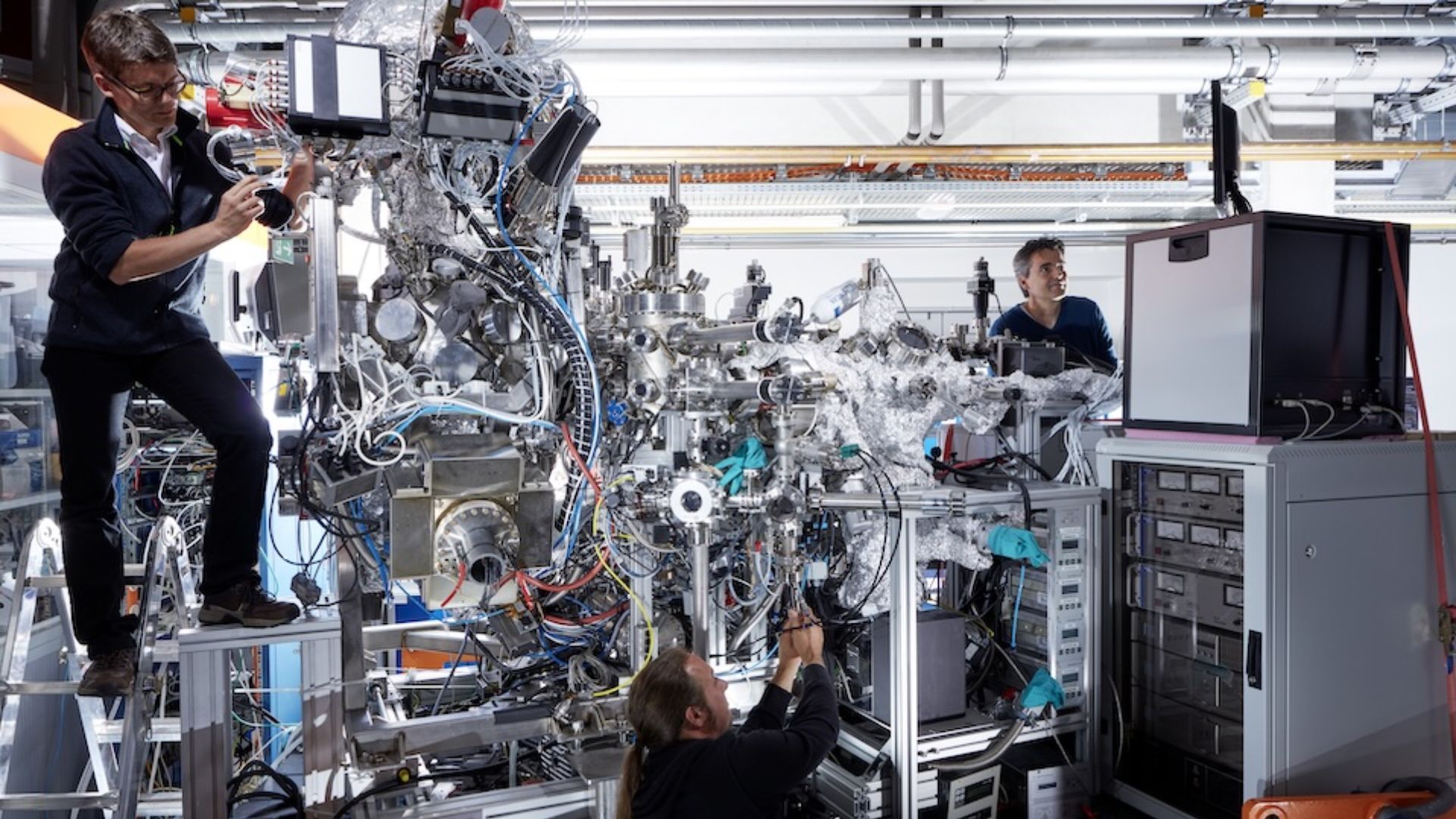
An international team of researchers has made a significant breakthrough in quantum physics by identifying a quasiparticle known as a polaron within a rare-earth material. This discovery, led by scientists from Kiel University and the DESY Research Centre, elucidates the mechanism behind how the compound thulium selenium tellurium (TmSe1−xTex) transitions from a conducting metal to a perfect insulator when the tellurium content reaches about 30 percent.
The research focused on a perplexing behavior of TmSe1−xTex, which puzzled physicists for years. They could not explain why the material abruptly ceased to conduct electricity at a specific threshold of tellurium. The answer lies not in a simple particle, but rather in a more complex interaction involving the atomic structure of the material.
Understanding Polarons and Their Role
The polaron phenomenon occurs when an electron interacts strongly with the vibrations of surrounding atoms, forming a composite entity that exhibits particle-like properties. “A polaron can be described as a kind of ‘dance’ between an electron and the atoms,” stated the research team in a press release. In this specific material, the electron travels alongside a slight distortion in the crystal lattice, akin to a dent moving through the structure. This interaction slows the electron’s movement, ultimately causing the material to lose its conductive properties.
The research team utilized high-resolution photoemission spectroscopy, deploying intense X-rays at various synchrotron facilities worldwide. Their investigation revealed a persistent “small additional signal” in their measurements, which they initially dismissed as a technical anomaly. As reported by Dr. Chul-Hee Min, who has been studying this material since 2015, the signal’s reappearance warranted a deeper examination.
The breakthrough was achieved when the researchers collaborated with theoretical physicists to adapt the periodic Anderson model, incorporating electron-atom coupling into their calculations. “That was the decisive step,” Dr. Min explained. “As soon as we included this interaction in the calculations, the simulation and measurements matched perfectly.”
Broader Implications for Quantum Research
While the concept of polarons has been theoretically established for some time, this study marks the first experimental confirmation of their existence in this class of quantum materials. The findings could have far-reaching implications, as similar coupling effects are believed to occur in other advanced materials, such as high-temperature superconductors and two-dimensional materials.
Professor Kai Rossnagel emphasized the importance of persistent research in achieving such discoveries, stating, “Such discoveries often arise from persistent basic research. But they are exactly what can lead to new technologies in the long term.”
The identification of the polaron not only clarifies the unusual transition from metal to insulator in TmSe1−xTex but also validates a crucial theoretical concept within a new category of materials. This work paves the way for future research, allowing scientists to investigate how the electron-atom interactions might be harnessed in other quantum systems.
The research was published in the journal Physical Review Letters, marking a pivotal moment in the understanding of quantum materials and their potential applications in technology.

Shark Teeth Research Reveals Urgent Need to Protect Species

Church Members Unite in Resilience After Thanksgiving Fire

Community Unites to Attempt World Record for Largest Cookie Exchange

Mayor Lurie Appoints Alan Wong to District 4 Seat Amid Controversy

Mayor Appoints Alan Wong as New Supervisor for District 4

UK Report Reveals AI’s Role in Evaluating University Research Quality

Gabriela Jaquez Shines as No. 3 UCLA Dominates No. 14 Tennessee

Trump Promises to Release MRI Results Despite Uncertainty on Scan

Japan’s Q3 Capital Expenditure Slows Despite Surge in Profits

University of Hawaiʻi Joins $25.6M AI Initiative to Monitor Disasters

Toledo City League Announces Hall of Fame Inductees for 2024

DOJ Seizes $15 Billion in Bitcoin from Major Crypto Fraud Network

Sharp Launches Five New Aquos QLED 4K Ultra HD Smart TVs

Celtics Coach Joe Mazzulla Dominates Local Media in Scrimmage

Community Unites for 7th Annual Walk to Raise Mental Health Awareness

Mutual Advisors LLC Increases Stake in SPDR Portfolio ETF

Western Executives Confront Harsh Realities of China’s Manufacturing Edge

INK Entertainment Launches Exclusive Sofia Pop-Up at Virgin Hotels
-
Science4 weeks ago
University of Hawaiʻi Joins $25.6M AI Initiative to Monitor Disasters
-
 Lifestyle2 months ago
Toledo City League Announces Hall of Fame Inductees for 2024
-
 Business2 months ago
DOJ Seizes $15 Billion in Bitcoin from Major Crypto Fraud Network
-
 Top Stories2 months ago
Sharp Launches Five New Aquos QLED 4K Ultra HD Smart TVs
-
 Sports2 months ago
Celtics Coach Joe Mazzulla Dominates Local Media in Scrimmage
-
 Health2 months ago
Community Unites for 7th Annual Walk to Raise Mental Health Awareness
-
 Politics2 months ago
Mutual Advisors LLC Increases Stake in SPDR Portfolio ETF
-
 Science2 months ago
Western Executives Confront Harsh Realities of China’s Manufacturing Edge
-
 World2 months ago
INK Entertainment Launches Exclusive Sofia Pop-Up at Virgin Hotels
-

 Politics2 months ago
Major Networks Reject Pentagon’s New Reporting Guidelines
-

 Science1 month ago
Astronomers Discover Twin Cosmic Rings Dwarfing Galaxies
-

 Top Stories1 month ago
Randi Mahomes Launches Game Day Clothing Line with Chiefs