
Science
Scientists Explore How Variable Stars Affect Exoplanet Habitability

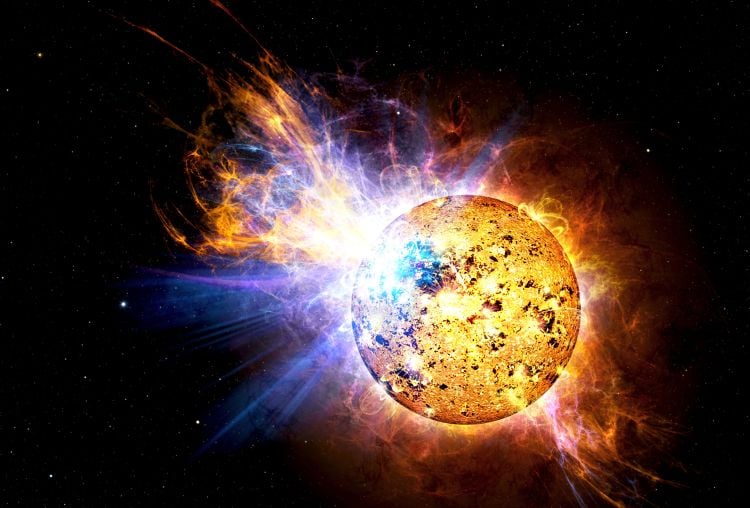
Astronomers are gaining new insights into how the variability of stars influences the habitability of exoplanets. A recent study accepted into The Astronomical Journal investigates the relationship between stellar activity—changes in a star’s brightness—and exoplanetary atmospheres. This research aims to enhance our understanding of how such variability affects the search for habitable exoplanets, particularly those orbiting stars distinctly different from our Sun.
The research team examined data related to nine exoplanets, each orbiting a separate star located within the habitable zone. These stars exhibit varying levels of stellar variability, which is crucial in determining the potential for life-supporting conditions. The exoplanets analyzed include TOI-1227 b (328 light-years), HD 142415 b (116 light-years), HD 147513 b (42 light-years), HD 221287 b (182 light-years), BD-08 2823 c (135 light-years), KELT-6 c (785 light-years), HD 238914 b (1,694 light-years), HD 147379 b (35 light-years), and HD 63765 b (106 light-years).
The primary aim of the study was to determine how the variability of these stars impacts the equilibrium temperature of their orbiting exoplanets and whether planets situated on the inner edge of their stars’ habitable zones could retain water. Equilibrium temperature refers to the ideal temperature of a planetary body without any heat exchange.
Findings indicated that the nine stars analyzed displayed minimal influence on the equilibrium temperature of their respective exoplanets. Moreover, the research confirmed that exoplanets within the inner edge of their stars’ habitable zones have the potential to retain water, irrespective of the stars’ variability.
The study encompassed stars with mass ranging from 0.17 to 1.25 solar masses, including M-, K-, G-, and F-type stars. M-type stars, which are the smallest, contrast with our Sun, categorized as a G-type star. Understanding this diversity is essential for identifying stars that might host habitable exoplanets. Notably, M-type stars are of particular interest due to their abundance and extended lifetimes, estimated to last up to trillions of years. In comparison, the Sun’s lifetime is projected to be between 10 and 12 billion years.
M-type stars are also characterized by significant variability, including sunspots, flares, and fluctuations in magnetic fields. This extreme activity raises questions about the habitability of their exoplanets, as stellar flares can strip atmospheres and ozone layers, potentially jeopardizing conditions suitable for life.
Two prominent examples of M-type stars are Proxima Centauri and TRAPPIST-1. Proxima Centauri, located approximately 4.24 light-years from Earth, is known for its intense activity, which has raised concerns about the habitability of its single rocky exoplanet. Similarly, TRAPPIST-1, about 39.5 light-years away, hosts seven rocky exoplanets, one of which may be habitable, despite the star’s significant variability.
As researchers continue to explore the dynamics between star variability and exoplanet habitability, new insights are expected to emerge in the coming years. This ongoing investigation reflects the broader quest to better understand the cosmos and the conditions that foster life beyond our planet.

Shark Teeth Research Reveals Urgent Need to Protect Species

Church Members Unite in Resilience After Thanksgiving Fire

Community Unites to Attempt World Record for Largest Cookie Exchange

Mayor Lurie Appoints Alan Wong to District 4 Seat Amid Controversy

Mayor Appoints Alan Wong as New Supervisor for District 4

UK Report Reveals AI’s Role in Evaluating University Research Quality

Gabriela Jaquez Shines as No. 3 UCLA Dominates No. 14 Tennessee

Trump Promises to Release MRI Results Despite Uncertainty on Scan

Japan’s Q3 Capital Expenditure Slows Despite Surge in Profits

University of Hawaiʻi Joins $25.6M AI Initiative to Monitor Disasters

Toledo City League Announces Hall of Fame Inductees for 2024

DOJ Seizes $15 Billion in Bitcoin from Major Crypto Fraud Network

Sharp Launches Five New Aquos QLED 4K Ultra HD Smart TVs

Celtics Coach Joe Mazzulla Dominates Local Media in Scrimmage

Mutual Advisors LLC Increases Stake in SPDR Portfolio ETF

Community Unites for 7th Annual Walk to Raise Mental Health Awareness

Western Executives Confront Harsh Realities of China’s Manufacturing Edge

INK Entertainment Launches Exclusive Sofia Pop-Up at Virgin Hotels
-
Science4 weeks ago
University of Hawaiʻi Joins $25.6M AI Initiative to Monitor Disasters
-
 Lifestyle2 months ago
Toledo City League Announces Hall of Fame Inductees for 2024
-
 Business2 months ago
DOJ Seizes $15 Billion in Bitcoin from Major Crypto Fraud Network
-
 Top Stories2 months ago
Sharp Launches Five New Aquos QLED 4K Ultra HD Smart TVs
-
 Sports2 months ago
Celtics Coach Joe Mazzulla Dominates Local Media in Scrimmage
-
 Politics2 months ago
Mutual Advisors LLC Increases Stake in SPDR Portfolio ETF
-
 Health2 months ago
Community Unites for 7th Annual Walk to Raise Mental Health Awareness
-
 Science2 months ago
Western Executives Confront Harsh Realities of China’s Manufacturing Edge
-
 World2 months ago
INK Entertainment Launches Exclusive Sofia Pop-Up at Virgin Hotels
-

 Politics2 months ago
Major Networks Reject Pentagon’s New Reporting Guidelines
-

 Science1 month ago
Astronomers Discover Twin Cosmic Rings Dwarfing Galaxies
-

 Top Stories1 month ago
Randi Mahomes Launches Game Day Clothing Line with Chiefs