
Science
Scientists Explore Mysterious Gamma Rays in Milky Way’s Center

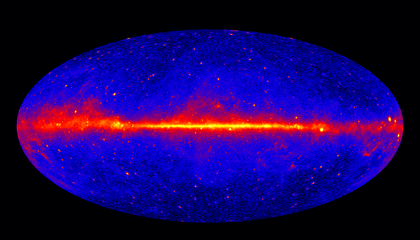
An intriguing discovery at the center of the Milky Way has captured the attention of scientists, as recent observations indicate an unusual excess of gamma rays. This phenomenon may suggest the potential detection of dark matter particles, a long-sought element in the field of astrophysics, though researchers caution against jumping to conclusions.
The findings, which emerged from data collected by the Fermi Gamma-ray Space Telescope, reveal a spike in gamma-ray emissions concentrated in the vicinity of the galactic core. According to scientists at the European Space Agency, this excess could signify interactions between dark matter particles or other astrophysical processes yet to be fully understood.
Understanding the Gamma-Ray Excess
The gamma rays in question are high-energy photons typically produced by significant cosmic events, such as supernova explosions or the annihilation of dark matter particles. The research team from the Institute of Cosmology and Gravitation has been analyzing this data for months, aiming to unravel the complex mechanisms driving these emissions.
Past observations have hinted at the possibility of dark matter’s presence in various forms, yet direct evidence has remained elusive. The current findings, however, mark a pivotal moment in the search for understanding the universe’s hidden components. Dr. Emily Chen, a leading astrophysicist involved in the study, stated, “This could be the first real indication of dark matter, but we need more data to confirm its nature.”
The research team noted that while the gamma-ray excess is compelling, it is essential to consider alternative explanations. Other astrophysical phenomena, such as pulsars or cosmic rays, could also account for the increased gamma-ray emissions. The team is currently conducting further studies to rule out these possibilities.
The Broader Implications for Dark Matter Research
Dark matter makes up approximately 27% of the universe’s total mass-energy content, yet its exact nature remains unknown. The search for dark matter has driven numerous studies and experiments in particle physics and astrophysics. If confirmed, the presence of dark matter particles would have profound implications for our understanding of the universe’s formation and evolution.
As researchers continue to analyze the gamma-ray data, they are hopeful that upcoming missions and advanced telescopes will shed more light on this mystery. The findings from the Fermi telescope, combined with future observational efforts, could significantly enhance our understanding of dark matter.
For now, scientists urge caution. While the gamma-ray excess is undoubtedly exciting, it is crucial to approach these findings with scientific rigor and an open mind. The quest to unlock the secrets of dark matter continues, with every new piece of data bringing us one step closer to understanding the cosmos.

Designers Unveil 5 Urgent Tricks to Transform Outdoor Eyesores

Shark Teeth Research Reveals Urgent Need to Protect Species

Church Members Unite in Resilience After Thanksgiving Fire

Community Unites to Attempt World Record for Largest Cookie Exchange

Mayor Lurie Appoints Alan Wong to District 4 Seat Amid Controversy

Mayor Appoints Alan Wong as New Supervisor for District 4

UK Report Reveals AI’s Role in Evaluating University Research Quality

Gabriela Jaquez Shines as No. 3 UCLA Dominates No. 14 Tennessee

Trump Promises to Release MRI Results Despite Uncertainty on Scan

University of Hawaiʻi Joins $25.6M AI Initiative to Monitor Disasters

Toledo City League Announces Hall of Fame Inductees for 2024

DOJ Seizes $15 Billion in Bitcoin from Major Crypto Fraud Network

Sharp Launches Five New Aquos QLED 4K Ultra HD Smart TVs

Celtics Coach Joe Mazzulla Dominates Local Media in Scrimmage

Mutual Advisors LLC Increases Stake in SPDR Portfolio ETF

Community Unites for 7th Annual Walk to Raise Mental Health Awareness

Western Executives Confront Harsh Realities of China’s Manufacturing Edge

INK Entertainment Launches Exclusive Sofia Pop-Up at Virgin Hotels
-
Science4 weeks ago
University of Hawaiʻi Joins $25.6M AI Initiative to Monitor Disasters
-
 Lifestyle2 months ago
Toledo City League Announces Hall of Fame Inductees for 2024
-
 Business2 months ago
DOJ Seizes $15 Billion in Bitcoin from Major Crypto Fraud Network
-
 Top Stories2 months ago
Sharp Launches Five New Aquos QLED 4K Ultra HD Smart TVs
-
 Sports2 months ago
Celtics Coach Joe Mazzulla Dominates Local Media in Scrimmage
-
 Politics2 months ago
Mutual Advisors LLC Increases Stake in SPDR Portfolio ETF
-
 Health2 months ago
Community Unites for 7th Annual Walk to Raise Mental Health Awareness
-
 Science2 months ago
Western Executives Confront Harsh Realities of China’s Manufacturing Edge
-
 World2 months ago
INK Entertainment Launches Exclusive Sofia Pop-Up at Virgin Hotels
-

 Politics2 months ago
Major Networks Reject Pentagon’s New Reporting Guidelines
-

 Science1 month ago
Astronomers Discover Twin Cosmic Rings Dwarfing Galaxies
-

 Top Stories1 month ago
Randi Mahomes Launches Game Day Clothing Line with Chiefs