
Science
Swansea Physicists Achieve Major Antihydrogen Breakthrough at CERN

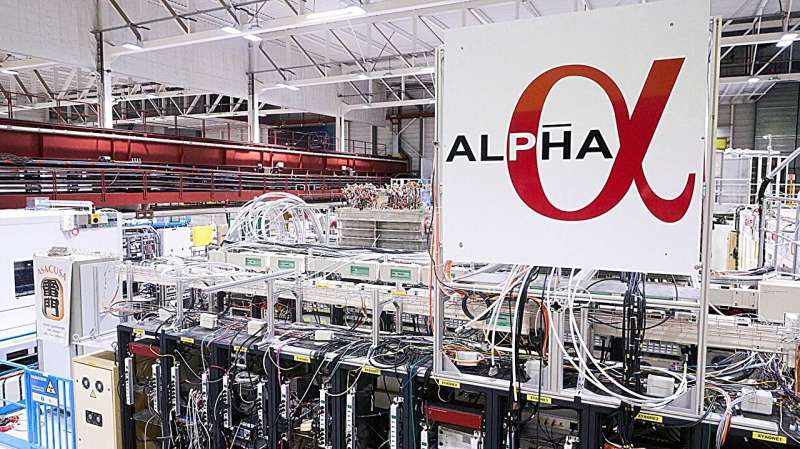
Physicists from Swansea University have made significant strides in the field of antimatter research by developing a groundbreaking technique at CERN that increases the trapping rate of antihydrogen by a factor of ten. This advancement, part of the international Antihydrogen Laser Physics Apparatus (ALPHA) collaboration, was published in the journal Nature Communications on November 18, 2025. The research aims to address one of the most profound questions in physics: why does the universe contain far more matter than antimatter?
Antihydrogen, composed of an antiproton and a positron, serves as a mirror counterpart to hydrogen and offers insights into the fundamental properties of antimatter. The conventional methods for producing and trapping antihydrogen were laborious, often taking up to 24 hours to capture just 2,000 atoms. This limitation hindered the scope of experiments at CERN’s ALPHA facility.
The innovative approach by the Swansea team employs laser-cooled beryllium ions, enabling the cooling of positrons to temperatures below 10 Kelvin (approximately –263°C). This new technique allows for the efficient production and trapping of antihydrogen, culminating in a record achievement of trapping over 15,000 atoms in less than seven hours.
Implications for Fundamental Physics
This breakthrough marks a transformative period for the ALPHA project, opening avenues for advanced experiments that could refine our understanding of fundamental physics. With this enhanced trapping capability, researchers can investigate critical questions regarding how antimatter interacts with gravity and whether it adheres to the same symmetries as matter.
Professor Niels Madsen, lead author of the study and Deputy Spokesperson for ALPHA, expressed his excitement, stating, “It’s more than a decade since I first realized that this was the way forward, so it’s incredibly gratifying to see the spectacular outcome that will lead to many new exciting measurements on antihydrogen.”
Ph.D. student Maria Gonçalves, who played a pivotal role in the project, shared her enthusiasm: “This result was the culmination of many years of hard work. The first successful attempt instantly improved the previous method by a factor of two, giving us 36 antihydrogen atoms—my new favorite number! It was a very exciting project to be a part of, and I’m looking forward to seeing what pioneering measurements this technique has made possible.”
A Collaborative Effort
Dr. Kurt Thompson, another key researcher on the project, highlighted the collaborative nature of the achievement. “This fantastic achievement was accomplished by the dedication and collaborative efforts of many Swansea graduate students, summer students, and researchers over the past decade. It represents a major paradigm shift in the capabilities of antihydrogen research. Experiments that used to take months can now be performed in a single day.”
As the ALPHA collaboration continues to explore the properties of antihydrogen, this milestone is poised to significantly enhance the understanding of the universe’s composition and the fundamental laws of physics. The research not only demonstrates the potential of modern techniques in experimental physics but also invites further inquiry into one of the most enigmatic aspects of our universe.
For more information, refer to the study published by R. Akbari et al in Nature Communications (2025). DOI: 10.1038/s41467-025-65085-4.

Bitcoin Plummets Below $88K Amid Tether Concerns and Warnings

Designers Unveil 5 Urgent Tricks to Transform Outdoor Eyesores

Shark Teeth Research Reveals Urgent Need to Protect Species

Church Members Unite in Resilience After Thanksgiving Fire

Community Unites to Attempt World Record for Largest Cookie Exchange

Mayor Lurie Appoints Alan Wong to District 4 Seat Amid Controversy

Mayor Appoints Alan Wong as New Supervisor for District 4

UK Report Reveals AI’s Role in Evaluating University Research Quality

Gabriela Jaquez Shines as No. 3 UCLA Dominates No. 14 Tennessee

University of Hawaiʻi Joins $25.6M AI Initiative to Monitor Disasters

Toledo City League Announces Hall of Fame Inductees for 2024

DOJ Seizes $15 Billion in Bitcoin from Major Crypto Fraud Network

Sharp Launches Five New Aquos QLED 4K Ultra HD Smart TVs

Celtics Coach Joe Mazzulla Dominates Local Media in Scrimmage

Mutual Advisors LLC Increases Stake in SPDR Portfolio ETF

Community Unites for 7th Annual Walk to Raise Mental Health Awareness

Western Executives Confront Harsh Realities of China’s Manufacturing Edge

INK Entertainment Launches Exclusive Sofia Pop-Up at Virgin Hotels
-
Science4 weeks ago
University of Hawaiʻi Joins $25.6M AI Initiative to Monitor Disasters
-
 Lifestyle2 months ago
Toledo City League Announces Hall of Fame Inductees for 2024
-
 Business2 months ago
DOJ Seizes $15 Billion in Bitcoin from Major Crypto Fraud Network
-
 Top Stories2 months ago
Sharp Launches Five New Aquos QLED 4K Ultra HD Smart TVs
-
 Sports2 months ago
Celtics Coach Joe Mazzulla Dominates Local Media in Scrimmage
-
 Politics2 months ago
Mutual Advisors LLC Increases Stake in SPDR Portfolio ETF
-
 Health2 months ago
Community Unites for 7th Annual Walk to Raise Mental Health Awareness
-
 Science2 months ago
Western Executives Confront Harsh Realities of China’s Manufacturing Edge
-
 World2 months ago
INK Entertainment Launches Exclusive Sofia Pop-Up at Virgin Hotels
-

 Politics2 months ago
Major Networks Reject Pentagon’s New Reporting Guidelines
-

 Science1 month ago
Astronomers Discover Twin Cosmic Rings Dwarfing Galaxies
-

 Top Stories1 month ago
Randi Mahomes Launches Game Day Clothing Line with Chiefs