
Science
Thelma Escobar Unveils Insights on Epigenetics and Blood Cancer

Thelma Escobar, an assistant professor of biochemistry at the University of Washington, presented significant findings on epigenetics and its implications for hematopoietic stem cells and cancer during a seminar at the Hopkins Department of Biology on September 25, 2025. Her presentation highlighted recent advancements in her lab’s research regarding chromatin modifications and their role in maintaining stem cell identity and function.
Hematopoietic stem cells (HSCs) play a crucial role in the body, residing in bone marrow and responsible for the production of blood and immune cells. Escobar explained that the regulation of HSCs involves a complex interplay of epigenetic factors, particularly histone modifications. These modifications influence how DNA is packaged within the cell nucleus, affecting gene expression. Looser associations in regions of euchromatin allow for greater gene activity, while tightly packed heterochromatin sequesters genes from transcription machinery.
Exploring the Role of NPM1 in Acute Myeloid Leukemia
During her talk, Escobar delved into her investigation of Nucleophosmin 1 (NPM1), a histone chaperone protein linked to acute myeloid leukemia (AML), a severe blood cancer originating in the bone marrow. She noted that mutations in the NPM1 gene are present in approximately 30% to 35% of all AML cases, yet targeted therapies for this mutation remain elusive. Escobar’s lab aims to uncover the gene’s potential role in the development of leukemia.
Current hypotheses suggest that mutations in NPM1 may lead to increased activity of HOX genes, which could drive the proliferation of HSCs at the expense of their differentiation into functional blood cells. To explore these dynamics, Escobar’s team has differentiated induced pluripotent stem cells (iPSCs) into HSCs, allowing them to produce sufficient quantities for analysis.
A key focus of their research involves comparing the interactions of normal NPM1 with its mutated counterpart. A noteworthy finding revealed that normal NPM1 interacts with a protein often mutated in AML precursors. Additionally, the lab discovered a fragment of the NPM1 protein within the nuclei of HSCs, a phenomenon not typically observed in other cell types. This led to investigations into the cleavage site of NPM1, with mutations in specific amino acids indicating the location of this cleavage.
Chromatin Changes and the Adaptive Immune Response
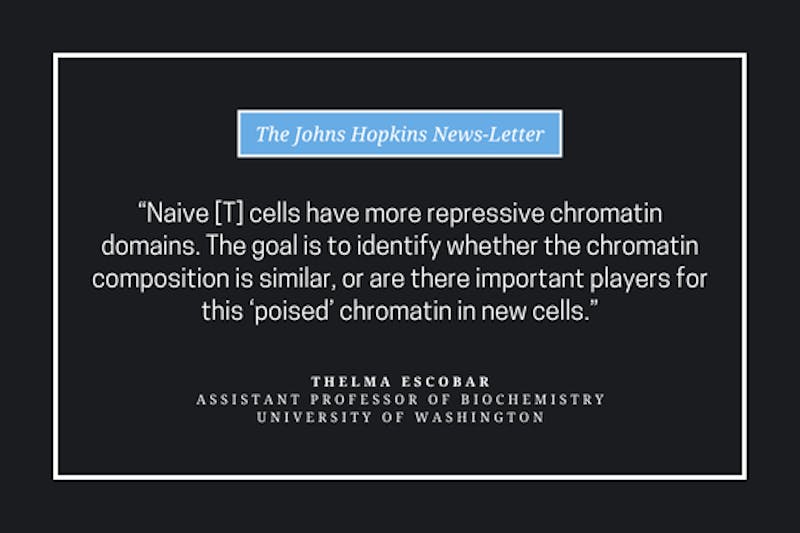
Escobar also addressed her lab’s work on chromatin dynamics in T cells, which are essential components of the adaptive immune system. While much previous research has highlighted the rapid proliferation of B and T cells upon pathogen re-exposure, Escobar emphasized the significance of chromatin states in these processes. She remarked, “Naive T cells have more repressive chromatin domains,” and the lab aims to discern whether the chromatin composition varies in newly activated cells.
The concept of “poised” chromatin emerged as a focal point, as it contains both activating and repressive histone modifications. Escobar posited that T cells with poised chromatin might respond more swiftly to infections due to the presence of modifications that enhance gene activation necessary for an effective immune response.
Throughout her presentation, Escobar expressed enthusiasm for her lab’s future projects, urging attendees to stay informed about their progress. “Stay tuned, because we’re mixing biochemistry and hematopoietic stem cell differentiation. Hopefully, we can have this story published in the near future,” she concluded.
By shedding light on the intricate mechanisms governing HSCs and their implications for blood cancers, Escobar’s research not only enhances our understanding of epigenetics but also paves the way for potential therapeutic advancements in AML treatment.

Shark Teeth Research Reveals Urgent Need to Protect Species

Church Members Unite in Resilience After Thanksgiving Fire

Community Unites to Attempt World Record for Largest Cookie Exchange

Mayor Lurie Appoints Alan Wong to District 4 Seat Amid Controversy

Mayor Appoints Alan Wong as New Supervisor for District 4

UK Report Reveals AI’s Role in Evaluating University Research Quality

Gabriela Jaquez Shines as No. 3 UCLA Dominates No. 14 Tennessee

Trump Promises to Release MRI Results Despite Uncertainty on Scan

Japan’s Q3 Capital Expenditure Slows Despite Surge in Profits

University of Hawaiʻi Joins $25.6M AI Initiative to Monitor Disasters

Toledo City League Announces Hall of Fame Inductees for 2024

DOJ Seizes $15 Billion in Bitcoin from Major Crypto Fraud Network

Sharp Launches Five New Aquos QLED 4K Ultra HD Smart TVs

Celtics Coach Joe Mazzulla Dominates Local Media in Scrimmage

Mutual Advisors LLC Increases Stake in SPDR Portfolio ETF

Community Unites for 7th Annual Walk to Raise Mental Health Awareness

Western Executives Confront Harsh Realities of China’s Manufacturing Edge

INK Entertainment Launches Exclusive Sofia Pop-Up at Virgin Hotels
-
Science4 weeks ago
University of Hawaiʻi Joins $25.6M AI Initiative to Monitor Disasters
-
 Lifestyle2 months ago
Toledo City League Announces Hall of Fame Inductees for 2024
-
 Business2 months ago
DOJ Seizes $15 Billion in Bitcoin from Major Crypto Fraud Network
-
 Top Stories2 months ago
Sharp Launches Five New Aquos QLED 4K Ultra HD Smart TVs
-
 Sports2 months ago
Celtics Coach Joe Mazzulla Dominates Local Media in Scrimmage
-
 Politics2 months ago
Mutual Advisors LLC Increases Stake in SPDR Portfolio ETF
-
 Health2 months ago
Community Unites for 7th Annual Walk to Raise Mental Health Awareness
-
 Science2 months ago
Western Executives Confront Harsh Realities of China’s Manufacturing Edge
-
 World2 months ago
INK Entertainment Launches Exclusive Sofia Pop-Up at Virgin Hotels
-

 Politics2 months ago
Major Networks Reject Pentagon’s New Reporting Guidelines
-

 Science1 month ago
Astronomers Discover Twin Cosmic Rings Dwarfing Galaxies
-

 Top Stories1 month ago
Randi Mahomes Launches Game Day Clothing Line with Chiefs