
Science
Trump Launches Ambitious AI-Driven ‘Genesis Mission’ for Science

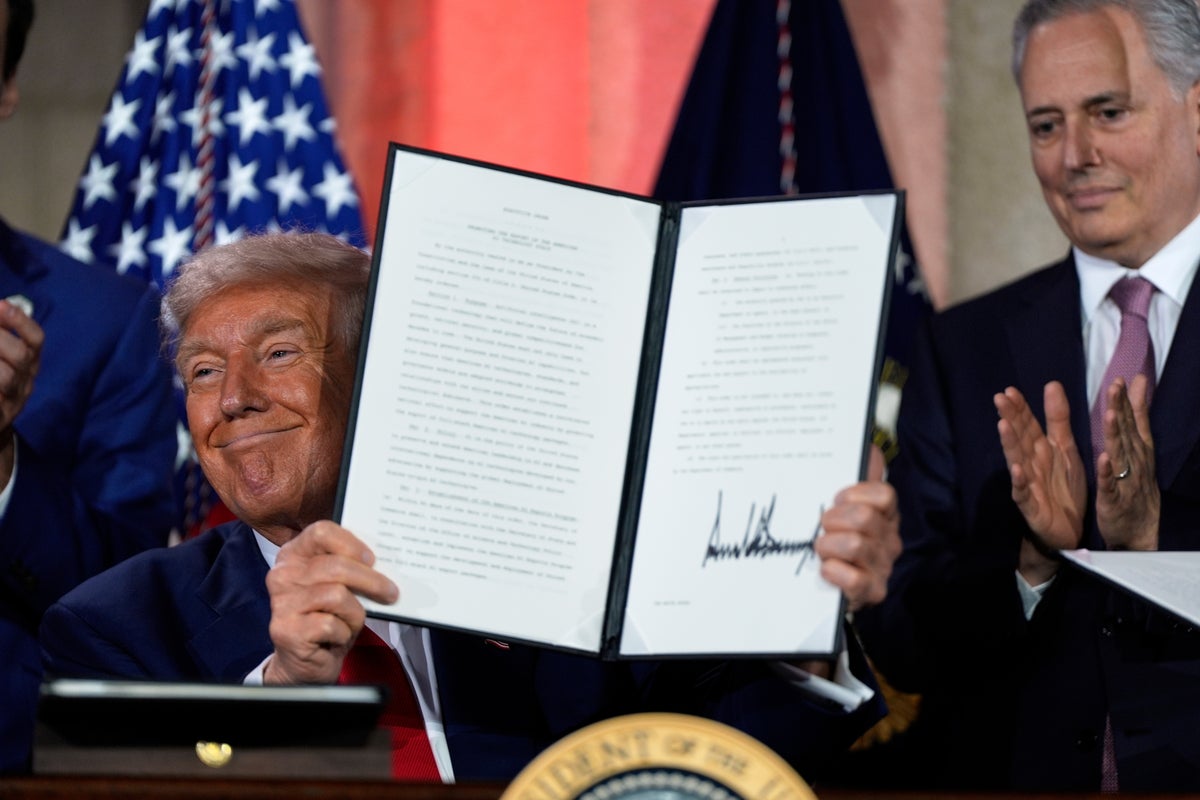
President Donald Trump signed an executive order on September 25, 2023, establishing the Genesis Mission, a groundbreaking initiative aimed at revolutionizing scientific research in the United States. This ambitious project seeks to leverage artificial intelligence (AI) to analyze vast amounts of federal data, enabling significant breakthroughs in areas such as drug development and other critical scientific advancements.
During a press call, Michael Kratsios, the director of the White House Office of Science and Technology, emphasized the mission’s importance, likening it to the historic Apollo program. He stated that the initiative represents the largest mobilization of federal scientific resources since the Moon landing. The Genesis Mission aims to integrate AI as a core scientific tool, unifying efforts across various government agencies and national laboratories.
The project intends to harness the advanced computing capabilities of the Department of Energy’s national laboratories to unlock federal data sets. Kratsios highlighted that this effort would enable “autonomous, closed-loop experimentation,” which could dramatically speed up the rate of scientific discoveries. He noted that the current rate of new drug approvals has stagnated, and the Genesis Mission aims to address this challenge by automating experiment design and generating predictive models.
According to Kratsios, the initiative could shorten discovery timelines from years to mere days or hours, empowering scientists to explore bolder hypotheses. He remarked, “With the power of AI, America is on the brink of a scientific revolution that will redefine American global scientific supremacy.”
Christopher Wright, the U.S. Secretary of Energy, added that the Genesis Mission would facilitate collaboration among top scientists across the nation’s 17 national laboratories and universities. He elaborated that the initiative would transition existing AI technologies, typically used in business and consumer services, toward scientific discovery and engineering advancement. Wright anticipates this shift will significantly enhance the pace of innovation in the country.
A senior administration official, speaking on condition of anonymity, assured that the use of data within the Genesis project would adhere to strict intellectual property guidelines. This official indicated that while certain national security concerns would limit access to specific data, a wealth of scientific and engineering information would still be available for AI-driven exploration.
The U.S. national laboratories are set to expand their supercomputing capacity, which already includes three of the world’s top supercomputers, by incorporating additional AI supercomputing resources in partnership with private sector entities. Another official stated, “We are going to leverage all the resources we have already, and then we expect that to our partners and in the future with Congress, that we will continue to invest increasing amounts for the success of the mission.”
This initiative is part of a broader trend within the Trump administration to embrace artificial intelligence and technological innovation. Following the 2022 presidential election, several technology leaders invested significantly in the administration’s initiatives.
Even First Lady Melania Trump has participated in this AI discourse, attending a White House meeting for an AI Task Force in September. During her remarks, she highlighted the transformative impact of AI, stating, “Cars now steer themselves through our cities, robots hold steady hands in the operating room, and drones are redefining the future of war.” She urged technology leaders to guide AI development responsibly, likening the technology to “our own children.”
The Genesis Mission represents a significant step toward harnessing the full potential of AI in scientific research, with the aim of propelling the United States to the forefront of global scientific leadership. The administration’s strategic focus on AI may redefine the future landscape of research and innovation, potentially yielding unprecedented advancements in various scientific fields.

Designers Unveil 5 Urgent Tricks to Transform Outdoor Eyesores

Shark Teeth Research Reveals Urgent Need to Protect Species

Church Members Unite in Resilience After Thanksgiving Fire

Community Unites to Attempt World Record for Largest Cookie Exchange

Mayor Lurie Appoints Alan Wong to District 4 Seat Amid Controversy

Mayor Appoints Alan Wong as New Supervisor for District 4

UK Report Reveals AI’s Role in Evaluating University Research Quality

Gabriela Jaquez Shines as No. 3 UCLA Dominates No. 14 Tennessee

Trump Promises to Release MRI Results Despite Uncertainty on Scan

University of Hawaiʻi Joins $25.6M AI Initiative to Monitor Disasters

Toledo City League Announces Hall of Fame Inductees for 2024

DOJ Seizes $15 Billion in Bitcoin from Major Crypto Fraud Network

Sharp Launches Five New Aquos QLED 4K Ultra HD Smart TVs

Celtics Coach Joe Mazzulla Dominates Local Media in Scrimmage

Mutual Advisors LLC Increases Stake in SPDR Portfolio ETF

Community Unites for 7th Annual Walk to Raise Mental Health Awareness

Western Executives Confront Harsh Realities of China’s Manufacturing Edge

INK Entertainment Launches Exclusive Sofia Pop-Up at Virgin Hotels
-
Science4 weeks ago
University of Hawaiʻi Joins $25.6M AI Initiative to Monitor Disasters
-
 Lifestyle2 months ago
Toledo City League Announces Hall of Fame Inductees for 2024
-
 Business2 months ago
DOJ Seizes $15 Billion in Bitcoin from Major Crypto Fraud Network
-
 Top Stories2 months ago
Sharp Launches Five New Aquos QLED 4K Ultra HD Smart TVs
-
 Sports2 months ago
Celtics Coach Joe Mazzulla Dominates Local Media in Scrimmage
-
 Politics2 months ago
Mutual Advisors LLC Increases Stake in SPDR Portfolio ETF
-
 Health2 months ago
Community Unites for 7th Annual Walk to Raise Mental Health Awareness
-
 Science2 months ago
Western Executives Confront Harsh Realities of China’s Manufacturing Edge
-
 World2 months ago
INK Entertainment Launches Exclusive Sofia Pop-Up at Virgin Hotels
-

 Politics2 months ago
Major Networks Reject Pentagon’s New Reporting Guidelines
-

 Science1 month ago
Astronomers Discover Twin Cosmic Rings Dwarfing Galaxies
-

 Top Stories1 month ago
Randi Mahomes Launches Game Day Clothing Line with Chiefs