
Science
University of Nebraska Secures $2.5 Million Grant for Quantum Research

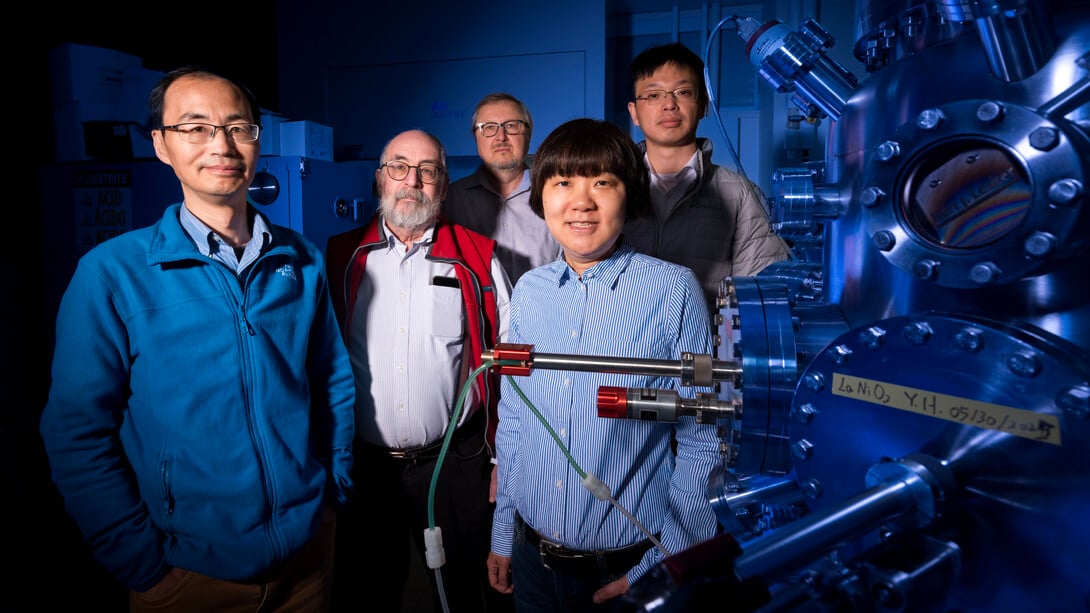
The University of Nebraska–Lincoln has received a substantial boost in its quantum research initiatives with a new grant of $2.5 million from the Department of Energy. This funding will support a project focused on utilizing ferroelectric oxides to investigate emergent quantum phases and to develop advanced electronic devices that are both more powerful and energy-efficient.
Led by Xia Hong, a professor of physics and astronomy, the seven-member research team aims to harness the unique properties of ferroelectric oxides. The goal is to manipulate materials in ways that were previously thought unattainable, such as transitioning between metallic and insulating states, or toggling between magnetic and non-magnetic conditions. “The overarching goal is to use nanoscale control of ferroelectricity to induce a new state of matter,” Hong stated, emphasizing the potential for creating smaller and more energy-efficient devices.
This two-year grant, awarded through the Established Program to Stimulate Competitive Research (EPSCoR), marks the third significant funding success for the university’s Emergent Quantum Materials and Technologies (EQUATE) Center in recent months. Previously, a team led by Christian Binek, EQUATE’s director, secured a $1.8 million grant from the National Science Foundation (NSF) for research into novel two-dimensional materials. Additionally, an international collaboration led by Evgeny Tsymbal received $2 million under the NSF’s Designing Materials to Revolutionize and Engineer Our Future program.
Enhancing Workforce Development and Research Capacity
The EPSCoR grant is not solely focused on research; it also emphasizes workforce development. The project, titled “Emergent Interface Phenomena Enabled by Ferroelectric Oxide Thin Films and Membranes,” will involve collaboration with the South Dakota School of Mines and Technology. The grant has provisions for renewal, potentially extending support for up to four more years. It is designed to enhance research infrastructure in both Nebraska and South Dakota, while also providing career opportunities for early-stage scientists.
Among those benefiting from this initiative are Zuocheng Zhang, assistant professor at the University of Nebraska–Lincoln, along with Tula Paudel and Alexey Lipatov, assistant professors at the South Dakota institution. Each of the seven team members will engage graduate students and postdoctoral researchers in their work, ensuring a comprehensive educational experience for undergraduate students as well.
“The idea with EPSCoR is you’re not just looking into the research, you’re looking into the infrastructure and human resource development,” Hong explained.
Innovative Research Directions
The research is structured around three main thrusts. The first focuses on examining the interface between ferroelectric oxides and strongly correlated oxides. The team aims to reversibly control quantum phase transitions, such as switching between metallic and insulating states. By leveraging ferroelectric polarization rather than traditional destructive methods, researchers hope to achieve a low-voltage control mechanism suitable for binary logic and memory devices.
Hong noted, “Basically, this is our competitive edge — we have a new technique that is very special and energy efficient.”
The second research thrust will explore multiferroic systems, which exhibit both ferroelectric and magnetic properties. The team plans to utilize various doping techniques to convert ferroelectric insulators into polar metals, potentially enabling low-energy data storage by manipulating magnetic states via electric fields.
The third thrust focuses on creating superlattices of ferroelectric domains, aimed at engineering new electronic and optical properties in two-dimensional van der Waals materials. By employing oxide membrane stacking techniques, researchers can adjust the rotation angle between oxide layers to create new Moiré patterns, which may induce innovative electronic and magnetic states.
If successful, this groundbreaking research could pave the way for the development of advanced platforms for smartphones and other electronic devices. The anticipated materials could lead to new operating systems that offer improved performance while reducing energy consumption.
Reflecting on her long-standing commitment to science, Hong remarked, “That’s the beauty of fundamental science — even sometimes you don’t see the impact right away, you are motivated by curiosity and the beauty of nature, and the fascination with how things behave.”
The University of Nebraska–Lincoln stands poised to make significant contributions to the field of quantum materials science, bolstered by its recent funding successes and the passion of its research community.

Church Members Unite in Resilience After Thanksgiving Fire

Community Unites to Attempt World Record for Largest Cookie Exchange

Mayor Lurie Appoints Alan Wong to District 4 Seat Amid Controversy

Mayor Appoints Alan Wong as New Supervisor for District 4

UK Report Reveals AI’s Role in Evaluating University Research Quality

Gabriela Jaquez Shines as No. 3 UCLA Dominates No. 14 Tennessee

Trump Promises to Release MRI Results Despite Uncertainty on Scan

Japan’s Q3 Capital Expenditure Slows Despite Surge in Profits

South Korea Announces Urgent FX Oversight Measures to Stabilize Won

University of Hawaiʻi Joins $25.6M AI Initiative to Monitor Disasters

Toledo City League Announces Hall of Fame Inductees for 2024

DOJ Seizes $15 Billion in Bitcoin from Major Crypto Fraud Network

Sharp Launches Five New Aquos QLED 4K Ultra HD Smart TVs

Celtics Coach Joe Mazzulla Dominates Local Media in Scrimmage

Mutual Advisors LLC Increases Stake in SPDR Portfolio ETF

Community Unites for 7th Annual Walk to Raise Mental Health Awareness

Western Executives Confront Harsh Realities of China’s Manufacturing Edge

INK Entertainment Launches Exclusive Sofia Pop-Up at Virgin Hotels
-
Science4 weeks ago
University of Hawaiʻi Joins $25.6M AI Initiative to Monitor Disasters
-
 Lifestyle2 months ago
Toledo City League Announces Hall of Fame Inductees for 2024
-
 Business2 months ago
DOJ Seizes $15 Billion in Bitcoin from Major Crypto Fraud Network
-
 Top Stories2 months ago
Sharp Launches Five New Aquos QLED 4K Ultra HD Smart TVs
-
 Sports2 months ago
Celtics Coach Joe Mazzulla Dominates Local Media in Scrimmage
-
 Politics2 months ago
Mutual Advisors LLC Increases Stake in SPDR Portfolio ETF
-
 Health2 months ago
Community Unites for 7th Annual Walk to Raise Mental Health Awareness
-
 Science2 months ago
Western Executives Confront Harsh Realities of China’s Manufacturing Edge
-
 World2 months ago
INK Entertainment Launches Exclusive Sofia Pop-Up at Virgin Hotels
-

 Politics2 months ago
Major Networks Reject Pentagon’s New Reporting Guidelines
-

 Science1 month ago
Astronomers Discover Twin Cosmic Rings Dwarfing Galaxies
-

 Top Stories1 month ago
Randi Mahomes Launches Game Day Clothing Line with Chiefs