
World
Troops Honor Reptiles: A Symbol of Resilience and Strength

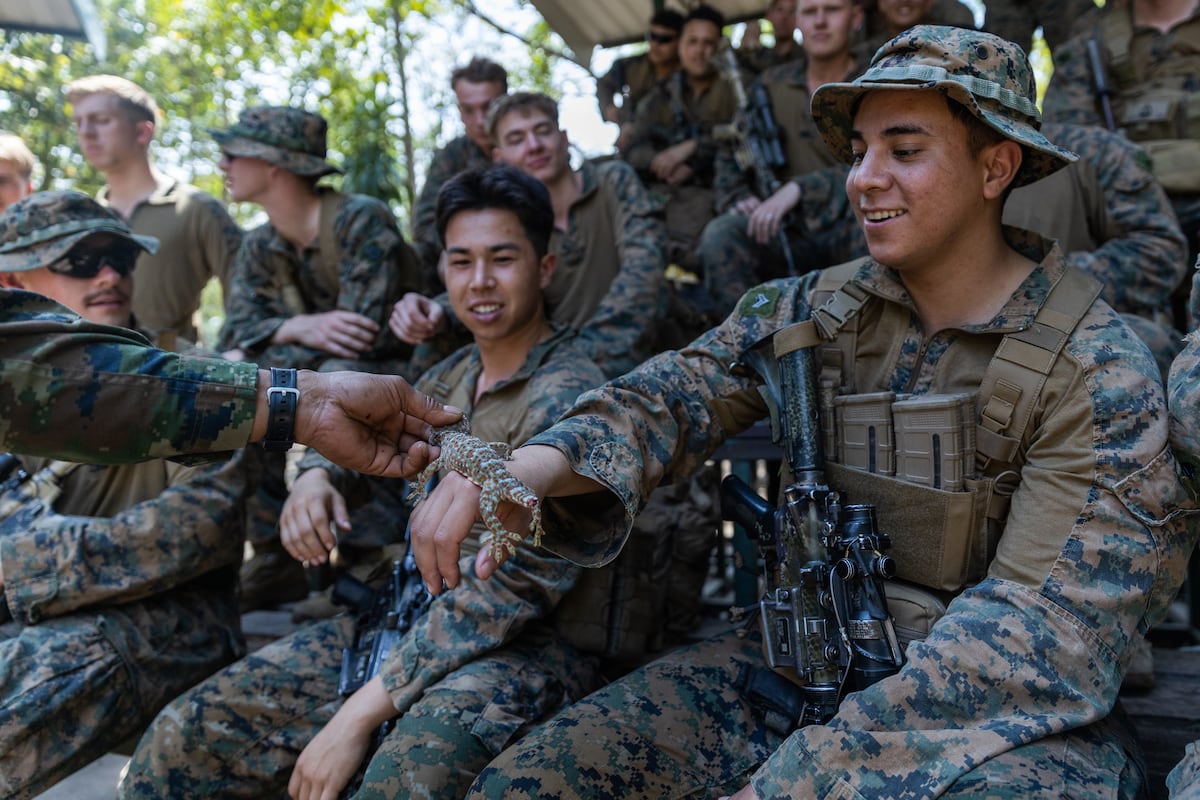
On National Reptile Awareness Day, observed on October 17, the U.S. military reflects on the significance of reptiles, which have become enduring symbols of resilience and strength across its branches. From cobras to alligators, these cold-blooded creatures appear on unit insignias, patches, and aircraft, embodying qualities that resonate deeply with service members: patience, precision, and power.
Reptiles exemplify a primal toughness that aligns with military values. A cobra strikes without warning, while an alligator remains motionless until the opportune moment. This instinct for timing mirrors the training of military personnel, where a sniper may hold his breath for hours, akin to a gator’s silent wait before an ambush. Both rely on control and discipline, not chaos.
Historical Significance of Reptilian Symbols
The symbolism of reptiles has been integral to military identity for generations. During World War II, the U.S. 158th Infantry Regiment earned the nickname “Bushmasters” after frequent encounters with the venomous snake in Panama and the Pacific. This name was not just a moniker; it reflected their daily survival challenges and became emblematic of their resilience. Today, the Bushmaster’s image remains coiled on the regiment’s insignia.
Reptiles thrive in environments where American forces have fought extensively—deserts, swamps, and jungles. This shared toughness has made them fitting emblems. For instance, Marines in amphibious assault units in Iraq and Afghanistan referred to themselves as “Gators,” highlighting their versatility and ability to navigate both land and water with ease. Adaptability became a core part of their identity.
The 75th Field Artillery Regiment has formalized this symbolism with its distinctive unit insignia, which features a gold lizard on a red shield. Approved in 1923, the design honors Alabama’s nickname, “Lizard State,” symbolizing quickness and survival—traits that define the artillerymen under its banner.
Practicality in Military Communication
Reptilian call signs and nicknames also serve a practical purpose. On radio channels, concise names like “Cobra One” or “Viper Six” cut through static, offering clarity and decisiveness. Their sharp consonants convey speed and aggression, reinforcing the identity of the unit. Over time, these names have become part of military folklore, cherished by generations of soldiers.
The connection between reptiles and aviation solidified during the Vietnam War with the introduction of the Bell AH-1 “Cobra” helicopter in 1967. Its sleek design and lethal precision matched the reptile’s attributes perfectly, helping to establish the cobra as a symbol of American air dominance. This legacy continues with the AH-1Z “Viper,” a modernized model that retains the same combat effectiveness.
Reptilian imagery also permeates the Army’s heraldic tradition. The 3rd Armored Cavalry Regiment once proudly bore the motto, “Brave Rifles, Scales of the Dragon,” merging reptilian symbolism with mythology to convey unity and strength. In California, the Marine Corps’ Amphibious Assault Schools informally refer to themselves as “the Gator School,” honoring their amphibious heritage linked to World War II operations.
Throughout history, reptiles have been woven into military symbolism across the globe. In ancient Egypt, crocodiles symbolized power and protection, and the crocodile god Sobek was called upon for military success. This instinct to channel the strength of reptiles is mirrored in modern American military patches, coins, and mottos. The message remains timeless: be patient, strike decisively, and survive.
Reptiles have even influenced the language of service members. The term “cold-blooded” now describes individuals who operate without emotional influence, executing missions despite fear or fatigue. This isn’t heartlessness; it reflects the focused discipline akin to a gator poised to strike.
When observing a call sign like “Cobra One” or spotting a gator emblem on a uniform, one witnesses a rich tapestry of military history and tradition. Reptiles, having survived longer than most species, exemplify adaptability, endurance, and dominance in silence. It is fitting that service members, trained to embody these traits, would identify with such symbols.
From the jungles of the Pacific to the deserts of Iraq, and from the cockpits of attack helicopters to the beaches of Camp Pendleton, reptiles remain among the military’s most significant symbols. They signify readiness, resilience, and survival. Thus, when a young soldier earns a patch adorned with a gator’s jaw or a coiled snake, they join a lineage steeped in decades of service and tradition.

Brooks Nader Stuns Fans with Eye-Catching Swimsuit Selfie

Beatles Autographs and Guitar String Expected to Fetch Thousands

Solana Approaches $150 as ETF Inflows Surge: Can It Reach $200?

Sean Mortimer’s ‘Misfit’ Inspires Acceptance of Individuality

Surge in ADHD Coaching: Study Reveals Growing Trend

Vintage Dealer Unearths Rare Gown by Forgotten Designer Zelda Wynn Valdes

J Street Emerges as Key Player in Shifting Democratic Dynamics

Taylor Swift & Travis Kelce Delay Wedding Plans, Focus on Love

Wyomissing Police Report Busy November with Hundreds of Calls

University of Hawaiʻi Joins $25.6M AI Initiative to Monitor Disasters

Interstellar Object 3I/ATLAS Emits Unprecedented Metal Alloy

Toledo City League Announces Hall of Fame Inductees for 2024

DOJ Seizes $15 Billion in Bitcoin from Major Crypto Fraud Network

Western Executives Confront Harsh Realities of China’s Manufacturing Edge

Sharp Launches Five New Aquos QLED 4K Ultra HD Smart TVs

Mutual Advisors LLC Increases Stake in SPDR Portfolio ETF

Celtics Coach Joe Mazzulla Dominates Local Media in Scrimmage

Community Unites for 7th Annual Walk to Raise Mental Health Awareness
-
Science2 months ago
University of Hawaiʻi Joins $25.6M AI Initiative to Monitor Disasters
-
 Science3 months ago
Interstellar Object 3I/ATLAS Emits Unprecedented Metal Alloy
-
 Lifestyle3 months ago
Toledo City League Announces Hall of Fame Inductees for 2024
-
 Business3 months ago
DOJ Seizes $15 Billion in Bitcoin from Major Crypto Fraud Network
-
 Science3 months ago
Western Executives Confront Harsh Realities of China’s Manufacturing Edge
-
 Top Stories3 months ago
Sharp Launches Five New Aquos QLED 4K Ultra HD Smart TVs
-
 Politics3 months ago
Mutual Advisors LLC Increases Stake in SPDR Portfolio ETF
-
 Sports3 months ago
Celtics Coach Joe Mazzulla Dominates Local Media in Scrimmage
-
 Health3 months ago
Community Unites for 7th Annual Walk to Raise Mental Health Awareness
-

 Politics3 months ago
Major Networks Reject Pentagon’s New Reporting Guidelines
-

 World3 months ago
INK Entertainment Launches Exclusive Sofia Pop-Up at Virgin Hotels
-

 Top Stories3 months ago
Microsoft Releases Urgent Windows 11 25H2 Update for All Users