
World
Trump Signals Limited Support for Argentina if Milei Fails

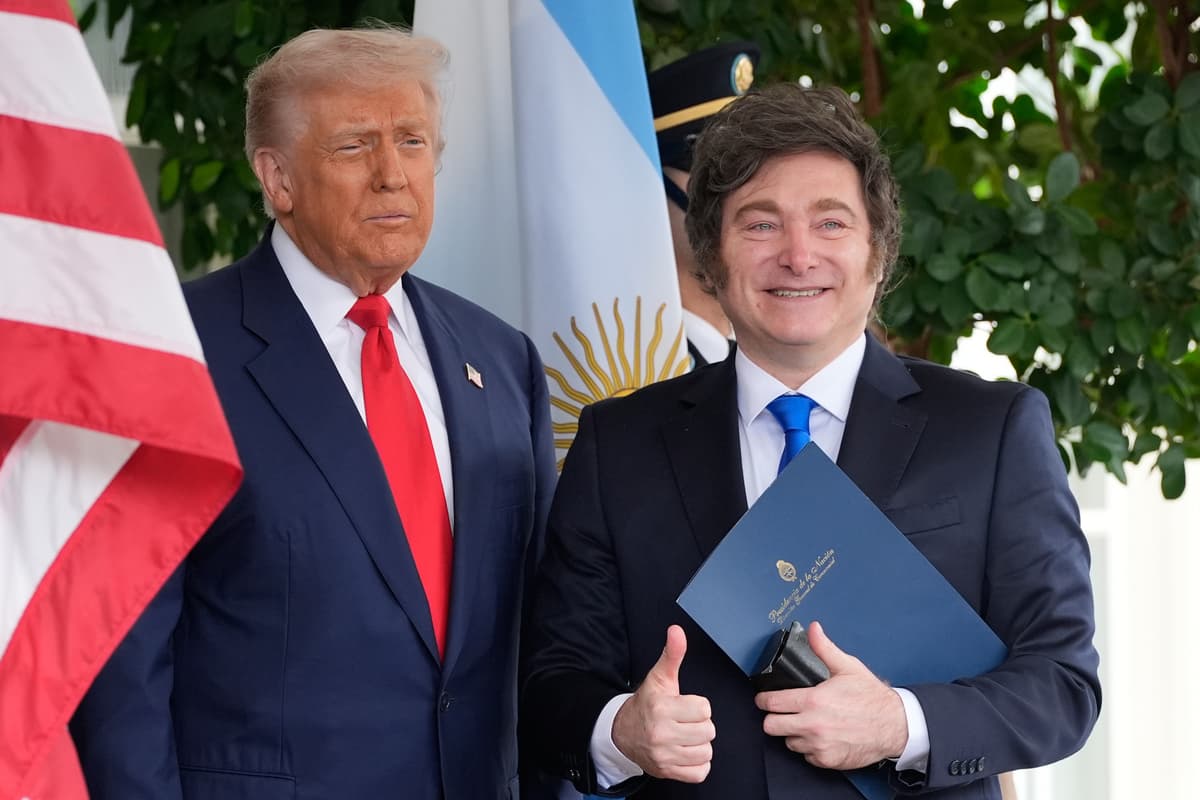
Former President Donald Trump indicated that the United States would not offer substantial support to Argentina if current President Javier Milei loses the upcoming election. Trump made these remarks during a meeting at the White House, where he welcomed Milei, who recently secured a $20 billion currency swap to address the nation’s financial challenges.
The discussion took place as Argentina prepares for midterm elections for its legislative body later this month. Trump expressed confidence in Milei’s electoral prospects, stating, “I think they’ll be better after this,” referring to the newly established currency swap. He noted that the U.S. approval of further assistance hinges on the election’s outcome, emphasizing that if Milei does not win, the U.S. would be less inclined to support Argentina.
Trump’s comments suggested that his administration views the potential election of Milei’s opponent—whom he characterized as “extremely far left”—as detrimental to Argentina’s economic recovery. “If the president doesn’t win, we are not going to be generous with Argentina,” Trump stated, highlighting a transactional approach to international relations.
The $20 billion deal has been perceived as a bailout for Argentina, which is grappling with significant financial issues. However, it has drawn criticism from some U.S. lawmakers. Senator Elizabeth Warren, a Democrat from Massachusetts, criticized Trump’s support for Argentina while domestic issues persist. “It is inexplicable that President Trump is propping up a foreign government, while he shuts down our own,” she remarked. Warren recently introduced legislation aimed at halting the bailout.
Senator Jeanne Shaheen echoed similar concerns, arguing that focusing on Argentina detracts from addressing pressing issues at home. “President Trump seems to think it’s more important to offer $20 billion to bail out Argentina than it is to make a bipartisan deal to prevent health insurance premiums from spiking for over 20 million Americans,” she said. Shaheen underscored the need for prioritizing domestic welfare over foreign aid.
Critics from the economic sphere also weighed in on the deal. Monica de Bolle, a senior fellow at the Peterson Institute for International Economics, described the assistance as a bailout, stating, “It’s a country in crisis, it’s running out of dollars, and the U.S. is giving the country dollars. That’s a bailout by definition.” Her remarks reflect broader concerns regarding the implications of U.S. financial aid on domestic priorities.
As Argentina approaches a critical moment in its political landscape, the outcome of the elections may significantly influence its relationship with the United States. Trump’s statements reveal a focus on electoral outcomes that could reshape international support and cooperation, particularly concerning economic assistance.

Community Unites to Attempt World Record for Largest Cookie Exchange

Mayor Lurie Appoints Alan Wong to District 4 Seat Amid Controversy

Mayor Appoints Alan Wong as New Supervisor for District 4

UK Report Reveals AI’s Role in Evaluating University Research Quality

Gabriela Jaquez Shines as No. 3 UCLA Dominates No. 14 Tennessee

Trump Promises to Release MRI Results Despite Uncertainty on Scan

Japan’s Q3 Capital Expenditure Slows Despite Surge in Profits

South Korea Announces Urgent FX Oversight Measures to Stabilize Won

Tampa’s Annual Tree Lighting Ignites Holiday Spirit Tonight

University of Hawaiʻi Joins $25.6M AI Initiative to Monitor Disasters

Toledo City League Announces Hall of Fame Inductees for 2024

DOJ Seizes $15 Billion in Bitcoin from Major Crypto Fraud Network

Sharp Launches Five New Aquos QLED 4K Ultra HD Smart TVs

Celtics Coach Joe Mazzulla Dominates Local Media in Scrimmage

Mutual Advisors LLC Increases Stake in SPDR Portfolio ETF

Community Unites for 7th Annual Walk to Raise Mental Health Awareness

Western Executives Confront Harsh Realities of China’s Manufacturing Edge

INK Entertainment Launches Exclusive Sofia Pop-Up at Virgin Hotels
-
Science4 weeks ago
University of Hawaiʻi Joins $25.6M AI Initiative to Monitor Disasters
-
 Lifestyle2 months ago
Toledo City League Announces Hall of Fame Inductees for 2024
-
 Business2 months ago
DOJ Seizes $15 Billion in Bitcoin from Major Crypto Fraud Network
-
 Top Stories2 months ago
Sharp Launches Five New Aquos QLED 4K Ultra HD Smart TVs
-
 Sports2 months ago
Celtics Coach Joe Mazzulla Dominates Local Media in Scrimmage
-
 Politics2 months ago
Mutual Advisors LLC Increases Stake in SPDR Portfolio ETF
-
 Health2 months ago
Community Unites for 7th Annual Walk to Raise Mental Health Awareness
-
 Science2 months ago
Western Executives Confront Harsh Realities of China’s Manufacturing Edge
-
 World2 months ago
INK Entertainment Launches Exclusive Sofia Pop-Up at Virgin Hotels
-

 Politics2 months ago
Major Networks Reject Pentagon’s New Reporting Guidelines
-

 Science1 month ago
Astronomers Discover Twin Cosmic Rings Dwarfing Galaxies
-

 Top Stories1 month ago
Randi Mahomes Launches Game Day Clothing Line with Chiefs